A machined steel bracket with a customs value of $40 pays nothing at the US border if it was made in Ohio. From Monterrey it pays $20.00, from Stuttgart $21.16 and from Dongguan $31.16. In 2026 a sourcing decision has to start from numbers like these, not from the factory price, and they change again for a plastic part.
So where should you make a machined or fabricated part this year: in the US, in Mexico, in China or in Europe?
This guide puts the four side by side as of November 12, 2026: the US duty on the same part from each, lead time and freight, time zones and language, labour costs, and what the 8,718 job shops in our index say they do in each region. Tariff rules changed many times in 2025 and 2026; check the rate for your exact tariff (HTS) code with a customs broker before you decide.
The short answer
| US | Mexico | China | Europe | |
|---|---|---|---|---|
| Duty on a $40 steel bracket (our example below) | $0 | $20.00 with a USMCA claim | $31.16 | $21.16 (EU) |
| Duty on a $40 plastic part | $0 | $0 with a USMCA claim | $17.12 | $4.00 (EU) |
| How parts arrive | Truck, days | Truck across the border, days | Ocean, weeks | Ocean, a shorter crossing than from Asia |
| Time difference with Chicago | 0 to 2 hours (lower 48) | 0 or 1 hour | 13 or 14 hours | 7 hours (Germany) |
| Company websites in English (our index) | English-speaking market | 10% | 65% | 28% |
| What our list there is strongest in | Machining, welding, AS9100 | CNC machining, welding, fixtures | Molds, injection molding, die casting | Machining, turning, welding, assembly |
| Shops in our index | 3,783 | 110 | 1,817 | 3,008 |
The rest of the guide explains each row, with the sources.
What the shops in each region do
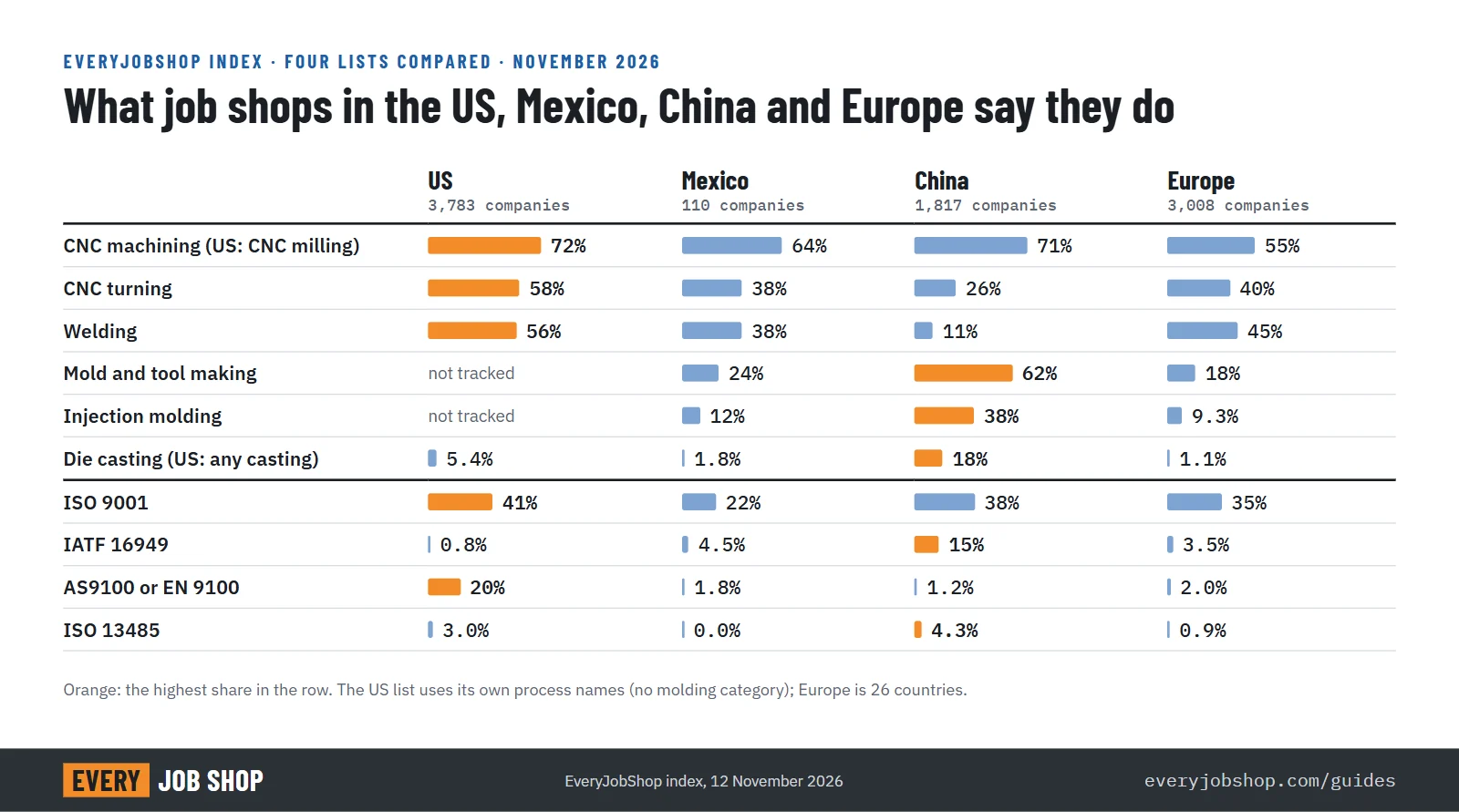
Our index read each company's own website: 3,783 in the US, 110 in Mexico, 1,817 in China and 3,008 in 26 European countries. The lists were built in different ways (the US list from a trade show list and the SBA small business search, the lists outside the US by a separate search of business directories and company websites), so the shares describe what we found, not each country's industry. Still, the profiles differ clearly:
- China is the mold and molding list. 62% of the Chinese companies state mold or tool making, 37% injection molding and 18% die casting, against 18%, 9% and 1% in Europe. 635 Chinese companies state both mold making and injection molding. See mold makers in China, injection molding in China and die casting in China, and our guide to mold making and injection molding in China.
- China also states automotive quality most often. 15% of the Chinese companies state IATF 16949 (or its older name TS 16949), against 4.5% in Mexico (5 of 110), 3.5% in Europe and 0.8% in the US list.
- The US list is the aerospace list. 20% of US companies state AS9100, against 1% to 2% of the companies elsewhere (EN 9100 counted with AS9100 in Europe). Defense work under ITAR has to stay with registered US shops anyway; see our AS9100 and ITAR guide.
- Europe and the US weld more. 45% of European and 56% of US companies state welding, against 11% of the Chinese list. Europe's list is led by Germany (1,549 companies), where 43% state CNC turning and 47% assembly.
- Mexico's list is small and machining-led. 64% of the 110 companies state CNC machining, 38% CNC turning and 38% welding, and 24 state fixtures and gauges, which fits the automotive plants around Monterrey and Querétaro. Browse CNC machining in Mexico.
- ISO 9001 is common everywhere we looked: 41% of the US list, 38% of the Chinese, 35% of the European and 22% of the Mexican.
The companies also differ in age. The median founding year stated on the websites is 1986 in our European list, 1992 in the US list, 1993 in the Mexican and 2005 in the Chinese.
The US duty on the same part, November 2026
For metal parts, one tariff decides more than any other: Section 232. Since April 6, 2026, steel, aluminum and copper articles in the covered chapters pay 50% on their full customs value from almost every country (UK steel pays less), and a list of derivative products pays 25%. Goods that pay Section 232 do not also pay the 2026 Section 301 duties described below.
For everything else, the rules depend on the origin:
- Mexico. A part that qualifies under USMCA and is entered with a USMCA claim pays no normal duty, and is exempt from the 10% Section 301 duty on Mexican goods that started on July 24, 2026. A part that does not qualify pays the normal duty plus 10%. On July 1, 2026 the United States did not agree to extend USMCA; it stays in force and is now reviewed every year.
- China. The normal duty, plus the older Section 301 duties of 25% (Lists 1 to 3) or 7.5% (List 4A) when the code is on a list, plus 12.5% under the Section 301 forced-labor action since July 24, 2026, which does not apply to goods that pay Section 232.
- The EU. A Section 301 duty that brings the normal duty up to 10% in total (USTR notice). Switzerland nets to 12.5% and the UK pays a flat 10% on top of the normal duty; our Europe guide has the details.
The IEEPA tariffs of 2025 are gone: the Supreme Court held on February 20, 2026 that IEEPA does not authorize tariffs. And since August 29, 2025 there is no duty-free de minimis entry for small shipments from any country, so samples by courier pay duty too.
A worked example
Two parts, each with a customs value of $40.00. Our assumptions: the tariff codes are right, the Mexican parts qualify under USMCA and are entered with a claim, the Chinese codes are on Section 301 List 3 (25%), and we leave out the small merchandise processing fee and freight.
| Part and HTS code | US | Mexico (USMCA) | China | EU |
|---|---|---|---|---|
| Machined steel bracket, 7326.90.86, normal duty 2.9% | $0 | 50%: $20.00 | 50% + 25% + 2.9%: $31.16 | 50% + 2.9%: $21.16 |
| Molded plastic part, 3926.90.99, normal duty 5.3% | $0 | $0 | 5.3% + 25% + 12.5%: $17.12 | 10% in total: $4.00 |
Two conclusions. For steel and aluminum parts, Section 232 makes every foreign source pay about half the part's value again, so the comparison is mostly the US shop's price against the foreign price plus 50% plus freight; our reshoring guide works one through to a landed cost. For other parts, USMCA status is worth more than any price difference: a Mexican part that qualifies pays nothing, the same part without the paperwork pays 15.3% here.
Lead time and freight
China and Europe ship by sea. Flexport, a freight forwarder, publishes an Ocean Timeliness Indicator measured from the day the cargo is ready at the factory to the day the container leaves the US destination port. In the week to August 10, 2026 it stood at 37.6 days from China to the US West Coast and 66.1 days to the East Coast (vendor figures). That comes after the shop's own lead time, and before trucking to your door. Rates were high this autumn: Drewry assessed Shanghai to Los Angeles at $8,007 and Shanghai to New York at $10,166 per 40-foot container on October 22, 2026. A small batch shares a container (less than container load) and pays more per kilogram.
Plan around the holidays too. Chinese New Year falls on February 6, 2027; output slows weeks before and staff return slowly after, so anything needed in February should ship in early January. Many German shops close for a company holiday (Betriebsurlaub); our Germany guide suggests asking for the dates with the quote.
Mexico ships by truck. In August 2026 trucks carried $73.9 billion of US-Mexico freight, and Laredo alone handled $37.7 billion (Bureau of Transportation Statistics figures). A truck from Monterrey can deliver to Texas in days, though border waits vary, and a second shipment can follow next week instead of next month, which keeps your safety stock small.
US shops deliver in releases. A domestic shop can deliver against a blanket order, a part of the quantity every month, so you hold weeks of stock instead of months.
Time zones and language
A quote that needs three rounds of questions takes three days with a shop in your time zone and can take a week across twelve hours. Against Chicago (Central time):
- Mexico: central Mexico, including Monterrey, Querétaro and Guadalajara, stays on UTC-6 all year since the 2022 time zone law ended daylight saving time outside the northern border strip. It is on Chicago time in winter and one hour behind in US summer. The whole working day overlaps.
- Germany and most of Europe: Central European Time, 7 hours ahead of Chicago for most of the year. A morning in Chicago is the afternoon in Germany: one reply a day, early.
- China: UTC+8 with no daylight saving time, 14 hours ahead of Chicago in winter and 13 in summer. Your afternoon is their next morning, so questions sent before you leave are answered overnight, and a phone call means an early or late hour for someone.
Language shows on the websites. Of the companies in our index, 65% of the Chinese sites we read were in English (export sites), against 28% of the European ones (mostly German, then Italian and Polish) and 10% of the Mexican ones (the rest in Spanish). An English website is a good sign the shop has answered foreign RFQs before. Our country guides list the words shops use: Mexico, Germany, Italy, Poland and China.
Labour costs
Labour is one input of a shop's hourly rate, next to machines, energy, tooling and margin, so a country with half the wages does not quote half the price. The official figures we use:
- US: manufacturing employers paid $48.62 per hour worked in June 2026 in wages and benefits (BLS).
- Europe: labour cost per hour worked in manufacturing in 2025 was €35.00 on average in the EU, €49.50 in Germany, €32.80 in Italy and €17.10 in Poland (Eurostat).
- Mexico: the 2026 minimum wage is 315.04 pesos a day in most of the country (CONASAMI), and the average daily wage registered with IMSS was 666 pesos at the end of September 2026.
- China: we have no comparable official figure for machine shop labour, so we do not quote one.
The surveys measure different things, so compare them as orders of magnitude. Our guide on how shops set their hourly rate shows how labour turns into a quote.
Which region for which part
| The part | Usually best made in | Why |
|---|---|---|
| Defense part with ITAR technical data | US | Registered US shops only; exports to China fall under a policy of denial |
| Prototype, or a design that still changes | US, or Mexico for Texas and the Midwest | Same time zone, visits by car, no ocean between revisions |
| Steel or aluminum part, low to medium volume | US | Section 232 adds 50% to any foreign source; freight and stock add more |
| Machined or welded part for a plant in Texas or the Midwest, steady volume | Mexico, if it qualifies under USMCA | No duty with a claim, trucks in days, overlapping hours |
| Injection mold and molded parts in volume | China, or Mexico for the molding near the plant | The deepest mold making base in our index; plastic parts pay no Section 232 |
| Die castings and investment castings in volume | China | 322 die casting and 229 investment casting companies in our list |
| Precision turned parts, small batches, European customers too | Europe, especially Germany, Italy and Switzerland | Deep lists of turning shops (673 in Germany, 107 in Italy); 10% Section 301 netting on non-metal parts from the EU |
| Welded frames and sheet metal for the EU market | Europe, for example Poland | 103 European companies in our list state EN 1090, the basis of CE marking for welded structures; lower labour cost in Central Europe |
| Labour-heavy assembly in high volume | Mexico or China | Labour is the largest cost; check the Section 301 stack for China |
One way to split the work: prototypes and the first batches in the US, then the stable high-volume parts abroad, and keep a second source in another region for any part a tariff change could reprice.
How to run one RFQ across regions
- Send the same package everywhere: drawing, 3D model, material, finish, quantity per release and per year, and the certificate you need. Our RFQ guide has the checklist.
- Ask for the tariff code and the country of origin the foreign shop will declare, and for a Mexican shop whether it can certify USMCA origin.
- Ask for the Incoterms rule (Incoterms 2020) and compare landed cost: price, duty, freight, brokerage, stock and the deposit.
- Ask for a ship date, not a number of weeks, and the holiday calendar.
- Pay for a first article before you release production, whichever region wins.
Find shops in each region
- US: search 3,783 shops by process, state and certification, or start from a state such as Ohio, Texas or California; our state by state guide shows where each process is.
- Mexico: 110 companies, most in Nuevo León and Querétaro.
- China: 1,817 companies, most in Guangdong and Zhejiang.
- Europe: 3,008 companies in 26 countries, with hubs for Germany, Italy and Poland.
With a drawing ready, send one RFQ to up to 30 US shops and set their quotes against your landed cost from abroad.
Questions people ask
- Is it cheaper to make parts in Mexico or China in 2026?
- For steel and aluminum parts the factory price matters less than it did: both pay the 50% Section 232 tariff on full value. For other parts, a part that qualifies under USMCA enters from Mexico free of the normal duty and of the 10% Section 301 duty, while a Chinese part pays the normal duty, the older Section 301 duty of 7.5% or 25% if its code is on a list, and the 12.5% Section 301 forced-labor duty since July 24, 2026. Mexico also delivers by truck in days rather than weeks at sea. China still leads where tooling and volume dominate, such as molds and injection molded parts.
- What US duty applies to a machined steel part from Europe?
- Steel articles pay the Section 232 tariff of 50% on their full value from the EU and Switzerland, plus the normal duty, and do not also pay the Section 301 duty. From the UK the rate is 25% when the steel was melted and poured in the UK. For a $40 steel part with a 2.9% normal duty that is $21.16 from the EU.
- How long does shipping take from China to the US?
- Port to port is only part of it. Flexport's Ocean Timeliness Indicator, which measures from the day the cargo is ready at the factory to the day it leaves the US destination port, stood at 37.6 days to the West Coast and 66.1 days to the East Coast in the week to August 10, 2026. Add the shop's own lead time before that and inland trucking after.
- What are the time differences with suppliers in Mexico, China and Germany?
- Against Chicago: central Mexico (Monterrey, Querétaro, Guadalajara) keeps UTC-6 all year since Mexico dropped daylight saving time in 2022, so it is on Chicago time in winter and one hour behind in summer. Germany is 7 hours ahead most of the year. China is UTC+8 with no daylight saving time, 14 hours ahead of Chicago in winter and 13 in summer.
- How many job shops are there in Mexico, China and Europe on EveryJobShop?
- As of November 12, 2026 the index lists 110 companies in Mexico, 1,817 in China and 3,008 in 26 European countries, next to 3,783 in the US. Each was read from the company's own website.