Search "machine shop Mexico" or "mexico contract manufacturing" and you get consultancies, industrial parks and shelter companies. The shops themselves write in Spanish, about maquinado and pailería, and many have a website and a phone number and little else. They are there: Mexico's export program alone counted 6,516 registered establishments employing 3.18 million people in July 2026 (INEGI).
So how do you find a Mexican shop that can make your part, and what does it cost at your dock?
This guide covers where the shops cluster, what they are good at, the US tariff rules for Mexican parts as of November 9, 2026, wages, certifications, freight, and how to write an RFQ a Mexican shop will answer. Tariff rules have changed many times since 2025; confirm the rate for your tariff code with a customs broker.
Where Mexican shops cluster
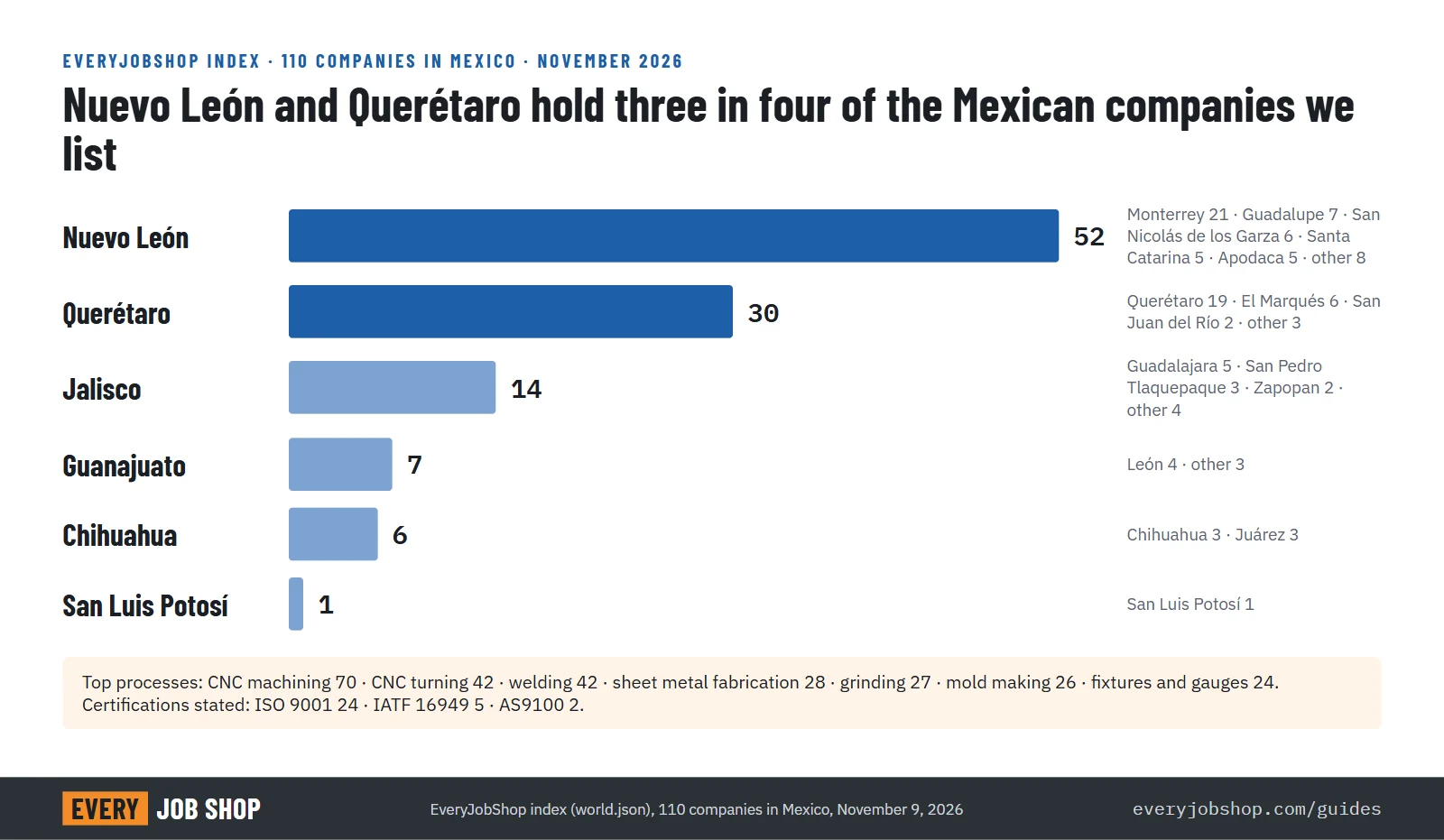
EveryJobShop lists 110 Mexican machine shops, fabricators, molders and foundries as of November 2026, read from each company's website and INEGI's business directory DENUE. It is a starting index, not a census, but it shows the pattern:
| Area | Companies in our index | Known for |
|---|---|---|
| Monterrey metro, Nuevo León (Monterrey 21, Guadalupe 7, San Nicolás de los Garza 6, Santa Catarina 5, Apodaca 5) | 52 in the state | Heavy machining, fabrication and pailería, stamping, forging, foundries |
| Querétaro and El Marqués | 30 in the state | Automotive supply, fixtures and gauges, injection molding, machining |
| Bajío: León, Irapuato, Celaya area, San Luis Potosí | 8 | Automotive tier 2 and 3, molds, machining |
| Guadalajara metro, Jalisco | 14 | Machining, molds, electrical hardware, iron castings |
| Chihuahua: Juárez and Chihuahua city | 6 | Maquiladoras, stamping, machining for US plants |
Tijuana and the rest of Baja California hold the most export program plants, 17.3% of all IMMEX establishments, ahead of Nuevo León with 13.8% and Chihuahua with 9.3%, but our index has no Tijuana shop yet. If you know one, it can add itself.
What Mexican shops are good at
Automotive plants, and more recently aerospace plants, have shaped the supply base. In our index the most common processes are CNC machining (70 companies), CNC turning (42), welding (42), sheet metal fabrication (28), grinding (27), mold making (26) and fixtures and gauges (24).
- Fixtures and gauges. Checking fixtures, welding fixtures, go/no-go gauges and Poka-Yoke devices for assembly lines are a Querétaro and Monterrey specialty, for example Grupo Arger in Querétaro.
- Automotive metal parts. Laser cutting, bending, welding and machining under IATF 16949, as at MIMSA in Apodaca.
- Injection molds and molding. Mold shops and injection molders (13 in our index), such as Providence Plastics in Guadalupe.
- Forging and aerospace. A few large groups hold AS9100 and NADCAP, for example FRISA in Santa Catarina.
Expect strength in production runs with PPAP paperwork, tooling and steel weldments. One-off prototypes in exotic alloys are often easier to source at home.
Maquiladora (IMMEX) or an independent shop
IMMEX lets a company import materials temporarily with the general import tax and VAT deferred, as long as it transforms, makes or repairs goods for export (index, the national council of the maquiladora and export manufacturing industry). Most maquiladoras are plants of foreign groups making their own products, or shelter operations that run a plant for a foreign company under their program.
An independent taller de maquinado is different: a Mexican company that makes parts to your drawing, invoices you, and ships. Some hold IMMEX so they can import your material duty deferred; many do not. Ask which one you are talking to, because it changes who imports the material, who files the customs paperwork and how you pay. Our general vetting guide applies to both.
US tariffs on Mexican parts, November 2026
| Measure | Applies to Mexican parts? |
|---|---|
| Normal (MFN) duty | No, if the part qualifies under USMCA and you claim it; yes otherwise |
| IEEPA "fentanyl" tariff of 25% | Ended. USMCA goods were exempt from March 7, 2025; the Supreme Court ended IEEPA tariffs on February 20, 2026 |
| Section 301 forced-labor duty, 10% for Mexico, since July 24, 2026 | Not on goods entered duty free under USMCA, and not on goods that pay Section 232; yes on non-qualifying goods |
| Section 232 steel and aluminum | Yes. 50% of full customs value for the base list since April 6, 2026; for listed derivatives at 25%, USMCA-qualifying goods from Mexico pay only on non-US content, with a 15% minimum, since June 8, 2026 |
Three practical points:
- USMCA status is the whole game. A part qualifies when it meets the product rule of origin, and the import needs a certification of origin with the nine data elements of Annex 5-A (CBP). Ask the shop whether it can certify origin and with what supplier records.
- Steel and aluminum do not get a free pass. A Mexican steel weldment in chapter 73 can pay the same Section 232 rate as one from China. Our reshoring guide shows how that rate builds a landed cost.
- The agreement is under annual review. On July 1, 2026 the United States did not agree to extend USMCA; it stays in force and is now reviewed every year. Keep a second source in mind for parts you cannot afford to have repriced.
Labor cost and wages, 2026
CONASAMI set the 2026 minimum wage at 315.04 pesos a day in most of the country and 440.87 pesos in the northern border free zone (Juárez, Tijuana, Reynosa, Nuevo Laredo and other border municipalities; Monterrey is not in it), from January 1, 2026. The professional minimum for a welder (soldador con soplete o con arco eléctrico) is 359.63 pesos a day outside the border zone. At about 18.7 pesos per dollar (Banxico, early November 2026), that is roughly $17, $24 and $19 a day.
These are floors. The average daily wage registered with IMSS was 666 pesos at the end of September 2026 (IMSS data reported by Diario de México), and CNC programmers and setters in Monterrey and Querétaro earn more. Shop rates also carry machines, energy and tooling priced in dollars, so a Mexican hourly rate is lower than a US one but not in proportion to wages. Our guide on how shops set hourly rates shows what goes into the number.
Certifications
Of the 110 Mexican companies in our index, 24 state ISO 9001 on their website, 5 IATF 16949 and 2 AS9100, as of November 2026. These are what the companies say, not checked with the registrars. Ask for the certificate, check the site address and scope, and see our guide to what each certification proves. IATF 16949 matters for automotive production parts; AS9100 and NADCAP for aerospace.
Logistics and lead times
Most Mexican parts cross by truck. In August 2026 trucks carried $73.9 billion of US-Mexico freight, and Laredo, El Paso and Otay Mesa were the top truck ports with Mexico (BTS figures). Laredo alone handled $37.7 billion that month, more than any other US port.
For Monterrey, Laredo is the natural crossing; for Juárez, El Paso; for Tijuana, Otay Mesa. Shipments from the Bajío and Guadalajara often cross at Laredo too. A truck from Monterrey can deliver to Texas in days rather than the weeks of an ocean shipment, but border waits vary. Ask the shop who books the freight, which customs broker it uses on the Mexican side, and whether it has shipped to the US before.
How to write an RFQ a Mexican shop answers
Use the same package as for any shop (checklist and template), plus:
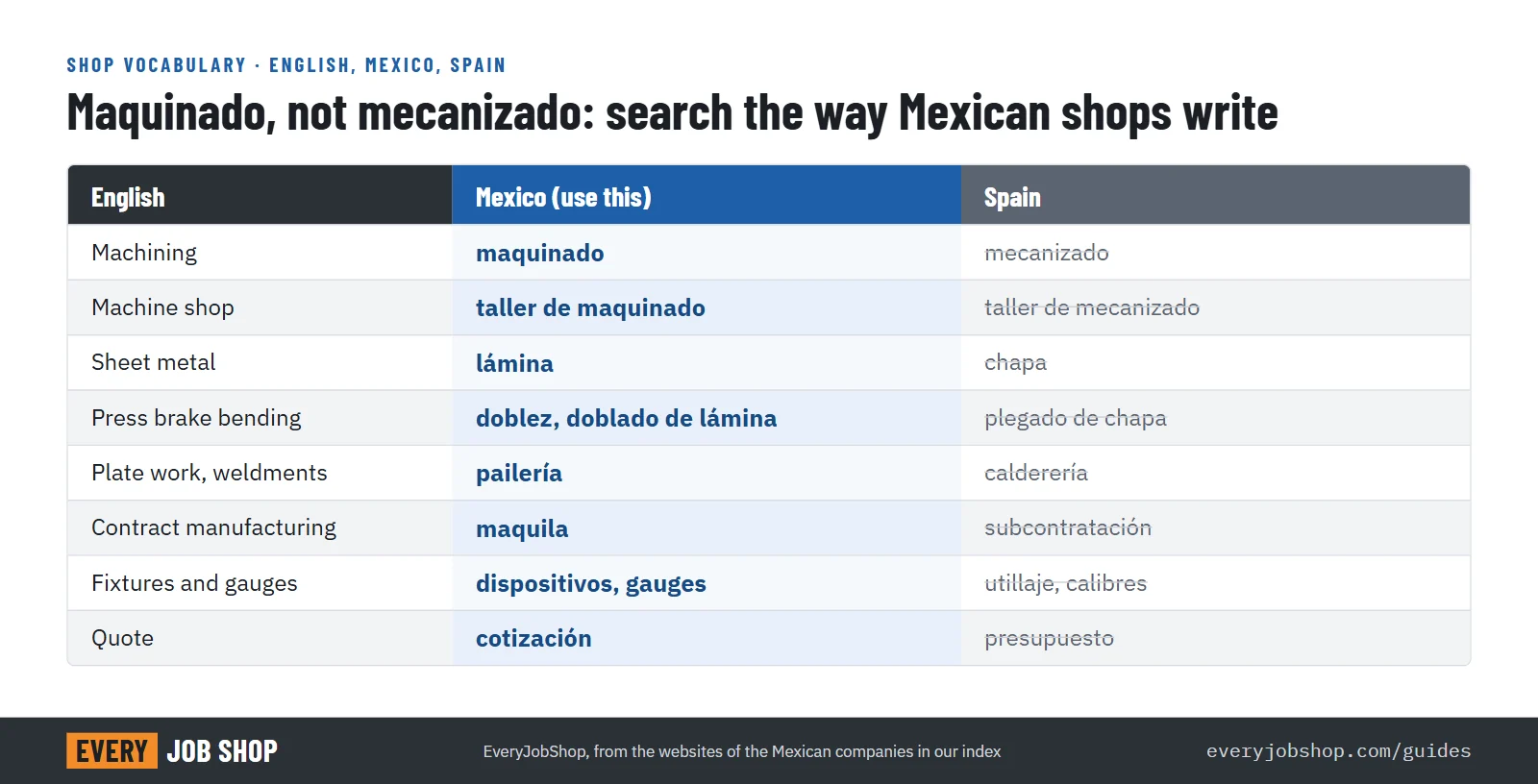
- Language. A short cover e-mail in English and Spanish. Use Mexican terms: cotización for quote, maquinado for machining, lámina for sheet metal (see the table below).
- Units. Say whether the drawing is in inches or millimetres. Most Mexican machines and measuring tools are metric; shops serving US customers handle inch drawings every day, but a stated unit avoids a scaled part.
- Incoterm and currency. Ask for prices in US dollars, and say where you take the goods: ex works at the shop, delivered to Laredo, or delivered to your dock.
- Paperwork. A Mexican supplier invoices with an electronic CFDI from the tax authority SAT. For an export sale, SAT requires the CFDI with the foreign trade complement and the pedimento, the Mexican customs declaration filed by a licensed customs broker. Ask who files it.
- USMCA. Ask whether the shop will certify origin, and with what supplier records.
- Payment. Established shops often take 30 days after a first order; a deposit on the first order or on tooling is common.
Red flags
- A "manufacturer" with no shop floor photos, machine list or address, quoting every process. It may be a broker; know that before you order.
- No answer on origin or USMCA paperwork for a part you will import under it.
- A quote in pesos with no incoterm, or no mention of who exports and files the pedimento.
- Certificates that cannot be found with the registrar, or that cover another plant of the group.
- A request to pay a personal account or a company name that differs from the one on the CFDI.
Start your shortlist
Browse all Mexican companies in our index or go straight to CNC machining, welding, fixtures and gauges or mold making. Comparing with US suppliers? Our vetting guide and the US list work the same way.
Questions people ask
- Do parts made in Mexico pay US tariffs in 2026?
- Parts that qualify under the USMCA rules of origin and are entered with a USMCA claim enter free of the normal duty and are exempt from the 10% Section 301 duty on Mexican goods that started on July 24, 2026. Parts that do not qualify pay the normal duty plus that 10%. Steel and aluminum articles pay Section 232 whatever their origin: 50% of full value for the base list since April 6, 2026, and 25% for listed derivatives, which for USMCA-qualifying goods applies only to non-US content with a 15% minimum since June 8, 2026. The IEEPA tariffs ended with the Supreme Court ruling of February 20, 2026. Check your tariff code with a customs broker.
- Where are most machine shops in Mexico?
- In the industrial metros of the north and centre: Monterrey and its neighbours Guadalupe, San Nicolás de los Garza, Apodaca and Santa Catarina in Nuevo León; Querétaro and El Marqués; León and the rest of the Bajío; Guadalajara; and the border cities such as Juárez and Tijuana. Of the 110 Mexican companies in the EveryJobShop index in November 2026, 52 are in Nuevo León and 30 in Querétaro.
- What is the difference between a maquiladora and a Mexican machine shop?
- A maquiladora usually runs under IMMEX, a Mexican program that lets a company import materials temporarily with import tax and VAT deferred, as long as it transforms or repairs them for export. Many are plants of foreign groups making their own products. An independent machine shop (taller de maquinado) makes parts to your drawing, invoices you directly, and may or may not hold an IMMEX program.
- What is the minimum wage in Mexico in 2026?
- 315.04 pesos a day in most of the country and 440.87 pesos a day in the northern border free zone, from January 1, 2026, according to CONASAMI. At about 18.7 pesos per dollar that is roughly $17 and $24 a day. Skilled machinists earn well above the minimum.
- Should I send drawings to a Mexican shop in English or Spanish?
- English drawings are normal in shops that serve US automotive and aerospace customers, and most will quote from them. Write the cover e-mail in both languages if you can, state the units, give metric equivalents for key dimensions if the drawing is in inches, and say which incoterm and currency you want the quote in.