Poland is where a lot of Europe's welded and machined metal parts get made. Many Polish job shops in our index describe their customers as machine builders, vehicle makers and boat yards elsewhere in Europe, and built their machine parks and quality systems serving them.
So when is a Polish shop the right source?
For welded steel assemblies, sheet metal work, machined parts in steel and stainless, and anything where a lot of labour goes into each part, Poland is often the best value inside the EU. Labour costs less than half the EU average, and many shops already work to EN and ISO standards for customers across Europe. For parts that are mostly machine time on simple aluminum, the gap to a US shop is smaller, and the 50% US metal tariff can close it. This guide shows what Polish shops do, where they are, what they hold, what they cost, what the US charges at the border as of November 2026, and how to check a supplier before you send money.
What Polish job shops are strong at
Our index shows the profile clearly. Of the 169 Polish companies EveryJobShop lists as of November 2026, 101 name CNC machining, 99 welding, 76 CNC turning, 71 metal bending, 52 laser cutting, 48 grinding and 43 sheet metal fabrication. Welding sits almost level with machining, which is unusual: in Germany machining and assembly lead by far.
That points to what Polish shops do well:
- Welded steel and stainless assemblies, from machine frames to tanks, cabins and structures, often cut, bent, welded, machined and painted under one roof. 30 companies in our index offer powder coating and several run their own galvanizing line.
- Sheet metal work: laser cutting, punching, press brake bending and stamping (20 companies).
- Machined and turned parts in steel and stainless. Steel is the most named material (97 companies), then stainless steel (69) and aluminum (57).
- Tooling: 28 companies do mold and tool making, some together with injection molding.
Many of these businesses are older than the free market. Of the 100 companies that state a founding year, 35 started before 1990 and the median year is 1994. Examples from our index: Dynaxo near Poznań, a sheet metal shop with about 150 employees doing laser cutting, punching, bending, robotic welding and powder coating; GELG in Wronki, stamping on more than 50 presses up to 500 t with its own tool shop; and D&H Engineering in Gdańsk, which turns and mills over 7 million parts a year, about a third for automotive.
Where they cluster
Polish shops are spread more evenly than German ones. The six largest regions in our index:
| Region (voivodeship) | Companies in our index (Nov 2026) | Most named processes |
|---|---|---|
| Greater Poland (Wielkopolskie), around Poznań | 29 | CNC machining 21, welding 21, bending 17 |
| Silesia (Śląskie), around Katowice | 21 | Welding 12, CNC machining 11, bending 9 |
| Pomerania (Pomorskie), around Gdańsk | 18 | Welding 9, CNC machining 9, turning 8 |
| Kuyavia-Pomerania, around Bydgoszcz and Toruń | 17 | Welding 11, CNC machining 10, laser cutting 7 |
| West Pomerania, around Szczecin | 14 | Welding 9, CNC machining 8, bending 6 |
| Subcarpathia (Podkarpackie), around Rzeszów | 12 | CNC machining 8, welding 7, grinding 5 |
Subcarpathia is the home of Polish aerospace: the Aviation Valley association, founded in 2003 in Rzeszów, lists more than 200 member companies. Shops there, such as Esko Mielec (milling, turning, wire and sinker EDM, grinding, dies and molds) and B-Technology in Jasionka next to Rzeszów airport (Y-axis turning, 5-axis milling, laser cutting, prototypes), work to tight tolerances. None of the Polish companies in our index states AS9100 or EN 9100 yet, so ask for it if you need it.
Certifications you will see
| Certificate | What it covers | Where to check it |
|---|---|---|
| ISO 9001 | Quality management, any industry | IAF CertSearch |
| ISO 14001 | Environmental management | IAF CertSearch |
| IATF 16949 | Automotive production quality | IATF validity check |
| EN 1090 | Factory production control and CE marking of load-bearing steel and aluminum structures, required in the EU since July 2014; execution classes EXC1 to EXC4 | The certificate names the notified body; ask for it |
| ISO 3834 | Quality requirements for fusion welding; part 2 is the comprehensive level | Issued by a certification body, ask for the certificate and scope |
| EN 15085-2 | Welding of railway vehicles and their parts, in levels CL1 (highest safety relevance) to CL4 (TÜV Rheinland) | Certificate with scope and level |
In our index, 57 of the 169 Polish companies state ISO 9001, 19 ISO 14001 and 6 IATF 16949. The welding certificates are where Poland stands out: 4 state ISO 3834, 3 EN 1090 and 3 EN 15085. dBP Products in Rawicz holds EN 15085-2 CL1 and makes rail vehicle components, cabins and tanks; Lindem in Zawiercie builds steel structures up to EXC3 under EN 1090 and is qualified to the American AWS D1.1 welding code. Graform in Bydgoszcz, a toolmaker and molder with IATF 16949, builds injection and blow molds up to 10 t. Our certification guide explains what each one proves and what it does not, and the welding guide covers the US codes.
What a Polish shop hour costs
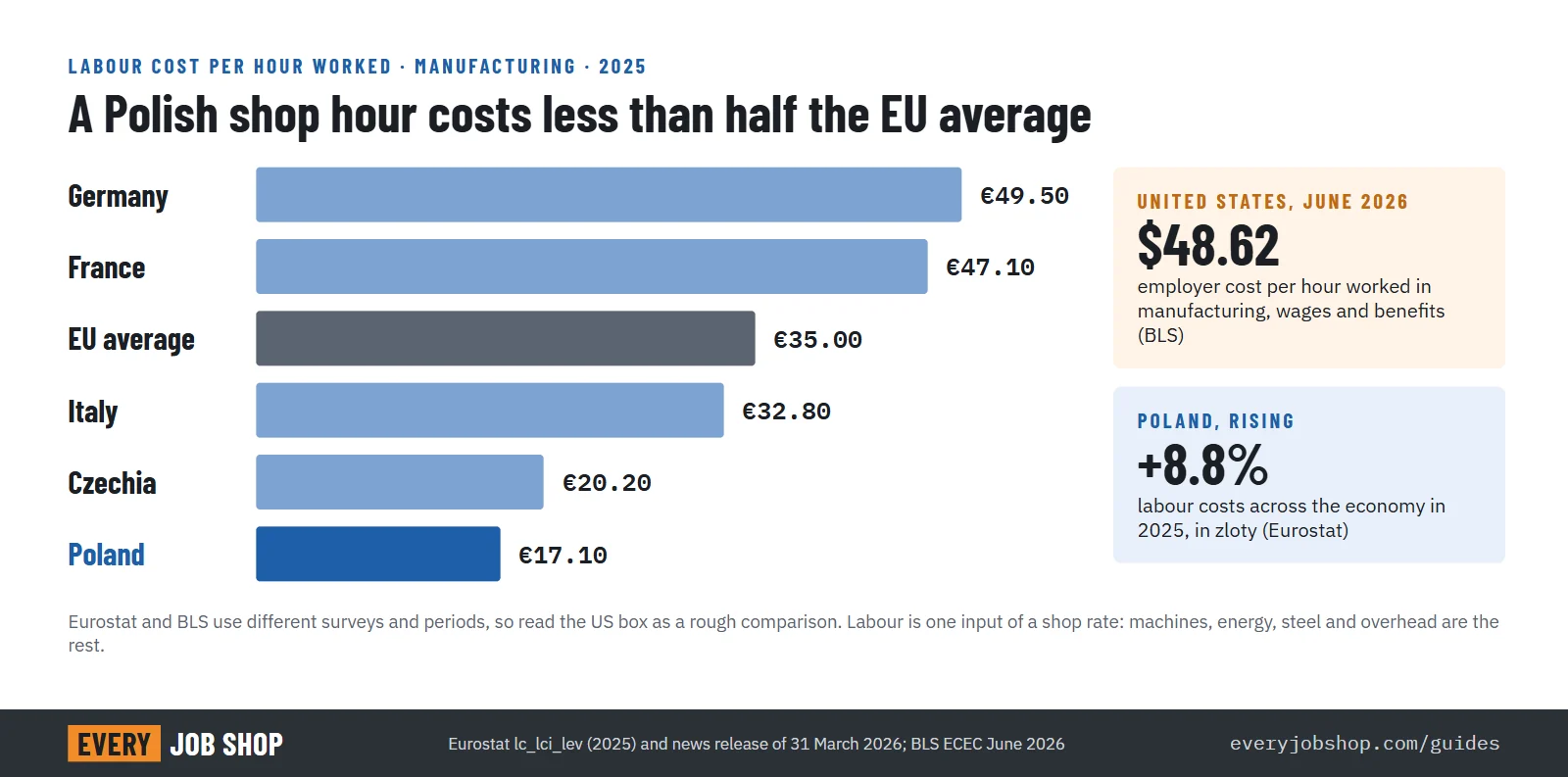
The Eurostat figures for manufacturing put Poland at €17.10 per hour in 2025, against an EU average of €35.00 and €49.50 in Germany:
| Country, manufacturing, 2025 | Labour cost per hour |
|---|---|
| Germany | €49.50 |
| France | €47.10 |
| EU average | €35.00 |
| Italy | €32.80 |
| Czechia | €20.20 |
| Poland | €17.10 |
The closest US figure is the BLS employer cost of $48.62 per hour worked in manufacturing in June 2026. The surveys differ, so treat it as a rough comparison: a Polish shop pays roughly a third of what a US one does per hour of labour. Machines, tooling, energy and steel cost about the same everywhere, so the saving is largest on welded and assembled work and smallest on parts that run unattended on a CNC machine.
The gap is narrowing. Eurostat reports that Polish labour costs across the economy rose 8.8% in 2025 in zloty, among the largest rises in the EU outside the euro area. Ask for prices valid for a stated period, and for long programs agree how labour and steel price changes are passed on.
US duty on Polish parts, November 2026
Poland is in the EU customs union, so Polish parts pay what German or Italian parts pay. Since July 24, 2026 EU goods pay a Section 301 duty that brings the normal duty up to 10% in total, with nothing extra where the normal duty is already 10% or more, and goods that pay Section 232 are exempt from it.
For metal parts, Section 232 is the one that matters. Since April 6, 2026 it applies to the full customs value: 50% for goods in chapter 72 and most of chapters 73, 74 and 76, 25% for listed derivative products, and a 15% cap including the normal duty for a short list of equipment until December 31, 2027.
What that means for one part with a customs value of $40.00 (our example; we assume each code below is the right one and leave out the small merchandise processing fee):
| Part and HTS code | Normal duty | Extra duty | Total duty |
|---|---|---|---|
| Welded steel frame, 7308.90.95 | 0%: $0.00 | Section 232, 50%: $20.00 | $20.00 (50%) |
| Machined steel bracket, 7326.90.86 | 2.9%: $1.16 | Section 232, 50%: $20.00 | $21.16 (52.9%) |
| Molded plastic part, 3926.90.99 | 5.3%: $2.12 | Section 301, 4.7%: $1.88 | $4.00 (10%) |
So a welded steel frame that costs $40.00 in Poland lands at about $60.00 before freight. With Polish labour at a third of the US rate, that can still win on labour-heavy work, but run the numbers per part. A part classified as a machine component in chapter 84 can fall under the 25% derivative list or outside Section 232 entirely, so classification is worth a broker's hour. Small shipments get no relief: duty-free de minimis entry ended for every country on August 29, 2025.
How to write an RFQ a Polish shop answers
The basics are the same as anywhere (our RFQ checklist lists twelve items). What changes for Poland:
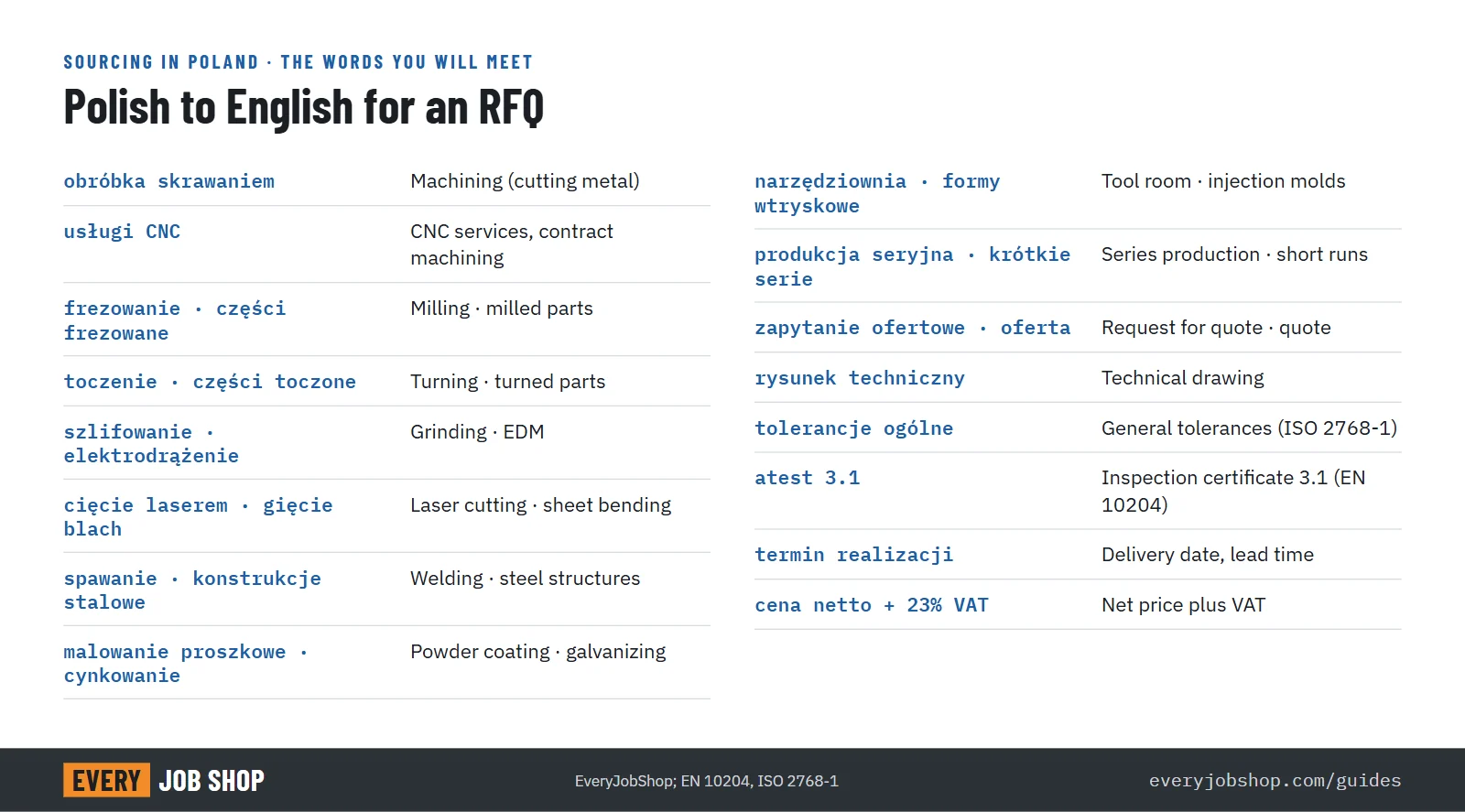
- Write in English, and add the Polish process name. Shops that export usually answer in English, often also in German. A subject line such as "Zapytanie ofertowe: obróbka CNC, 500 szt." tells a small shop at once what you want.
- Send metric drawings, or a dimensioned STEP model. Polish shops work in millimetres to EN and ISO standards. State the general tolerance (ISO 2768-1, see our tolerance guide) and the material by its EN designation as well as the US grade (for 304 stainless, 1.4301).
- Name the welding standard. For welded work say which code applies: ISO 5817 quality level, AWS D1.1, or EN 1090 with an execution class. Shops in our index that hold ISO 3834 or EN 1090 are used to welding procedure specifications (WPS) and welder qualifications.
- Agree the currency. Domestic prices are in złoty (PLN), but most shops that export quote in euros, some in dollars. The National Bank of Poland publishes the daily reference rates.
- Expect a net price. Polish quotes are net ("cena netto"), plus VAT. Poland's standard VAT rate is 23%, but an export of goods outside the EU is taxed at 0% once the shop holds the customs proof that the goods left, usually the IE-599 message. If the proof never arrives, the shop owes Polish VAT on the sale, so with EXW agree who files the export declaration and sends the shop the proof.
- Agree the Incoterms rule. The ICC's Incoterms 2020 define who carries which costs and risks. FCA at the shop or a forwarder's warehouse is common; with DDP the Polish seller would have to clear US customs and pay the 50% metal tariff, so check that the shop really means it.
- Ask for a delivery date and the documents together: the delivery date (termin realizacji), the material certificate 3.1 to EN 10204 ("atest 3.1"), the inspection report, and for welded parts the welding documents.
For a first price on simple laser-cut or bent parts, our sheet metal cost guide shows what drives it.
How to check a Polish company
Poland has free public registers that tell you in minutes whether a supplier exists and who runs it:
| Register | What it tells you |
|---|---|
| KRS, the National Court Register | Companies (sp. z o.o., S.A., partnerships): registered address, board members, share capital, financial statements filed |
| CEIDG | Sole traders and civil partnerships, which many small shops are |
| VAT white list (wykaz podatników VAT) | Whether the company is an active VAT payer, and its bank accounts reported to the tax office; search by NIP, REGON, name or account number |
| VIES | Whether its EU VAT number (PL plus the NIP) is valid |
Before the first payment, compare the bank account on the invoice with the accounts on the white list. An e-mail announcing a new account number is a classic payment fraud.
Red flags
- No NIP or KRS number on the website, the quote or the invoice. Polish companies normally print them.
- A bank account that is not on the white list, or a request to pay a private account.
- A certificate you cannot find, or one issued for another site of the group.
- A price with no questions, far below the others, on a welded part with no welding standard named.
- DDP offered casually, with no word on who pays the US metal tariff.
Where to start
Our list of Polish companies shows every shop we have checked, with processes, certifications and a link to its website; each company page lists the sources we read. To compare countries, see the European list, our guides to Germany and Italy, and the reshoring guide for how a Chinese part's landed cost adds up. Run a shop in Poland that should be listed? Add your company.
Questions people ask
- What US tariff applies to machined parts from Poland in November 2026?
- The same as for any EU country. Steel and aluminum articles in chapters 72 and most of 73 and 76 pay the Section 232 metal tariff, 50% on the full customs value, plus the normal duty. Listed derivative products pay 25%. Most other Polish goods pay a Section 301 duty that tops the normal duty up to 10% in total, in place since July 24, 2026; goods that pay Section 232 do not also pay it. Check the rate for your HTS code with a customs broker.
- How much does an hour of labour cost in Polish manufacturing?
- €17.10 per hour in 2025, according to Eurostat, less than half the EU average of €35.00 and about a third of Germany's €49.50. It is rising fast: Polish labour costs across the economy grew 8.8% in 2025, measured in zloty, among the largest rises in the EU outside the euro area.
- Where are the machine shops in Poland?
- The 169 Polish companies in our index as of November 2026 are spread over 16 regions. The largest groups are in Greater Poland around Poznań (29), Silesia (21), Pomerania around Gdańsk (18), Kuyavia-Pomerania around Bydgoszcz and Toruń (17), West Pomerania (14) and Subcarpathia around Rzeszów and Mielec (12).
- What does obróbka skrawaniem mean?
- Obróbka skrawaniem is machining, literally processing by cutting. Related words: frezowanie (milling), toczenie (turning), szlifowanie (grinding), gięcie blach (sheet bending), cięcie laserem (laser cutting), spawanie (welding), usługi CNC (CNC services) and produkcja seryjna (series production).
- How do I check that a Polish supplier is real?
- Look up the company in the KRS court register (companies) or CEIDG (sole traders) by its NIP tax number, check its VAT status and bank account on the Ministry of Finance white list, and validate its EU VAT number in VIES. All four are free and public.