For twenty years the reshoring question had a simple answer for most machined and fabricated parts: the overseas quote was half the US quote, and nothing else mattered enough to change that. In 2026 the part is still half price at the factory gate. It is not half price at your dock.
So is it cheaper to make parts in the US now?
For many steel and aluminum parts the landed cost of a Chinese part is now about the same as a US quote, before counting inventory, deposits and risk. This guide shows the tariff stack as of late October 2026, works through a landed-cost example against a US price, and lists the parts worth bringing back first. Tariff rules have changed many times since 2025, so check the rate for your exact tariff code with a customs broker before you decide.
The tariff stack for a Chinese metal part, October 2026
Four layers can apply, and whether each one does depends on the part's tariff (HTS) code:
- The normal duty (MFN). Usually low for metal parts: 2.9% for HTS 7326.90.86, "other articles of iron or steel".
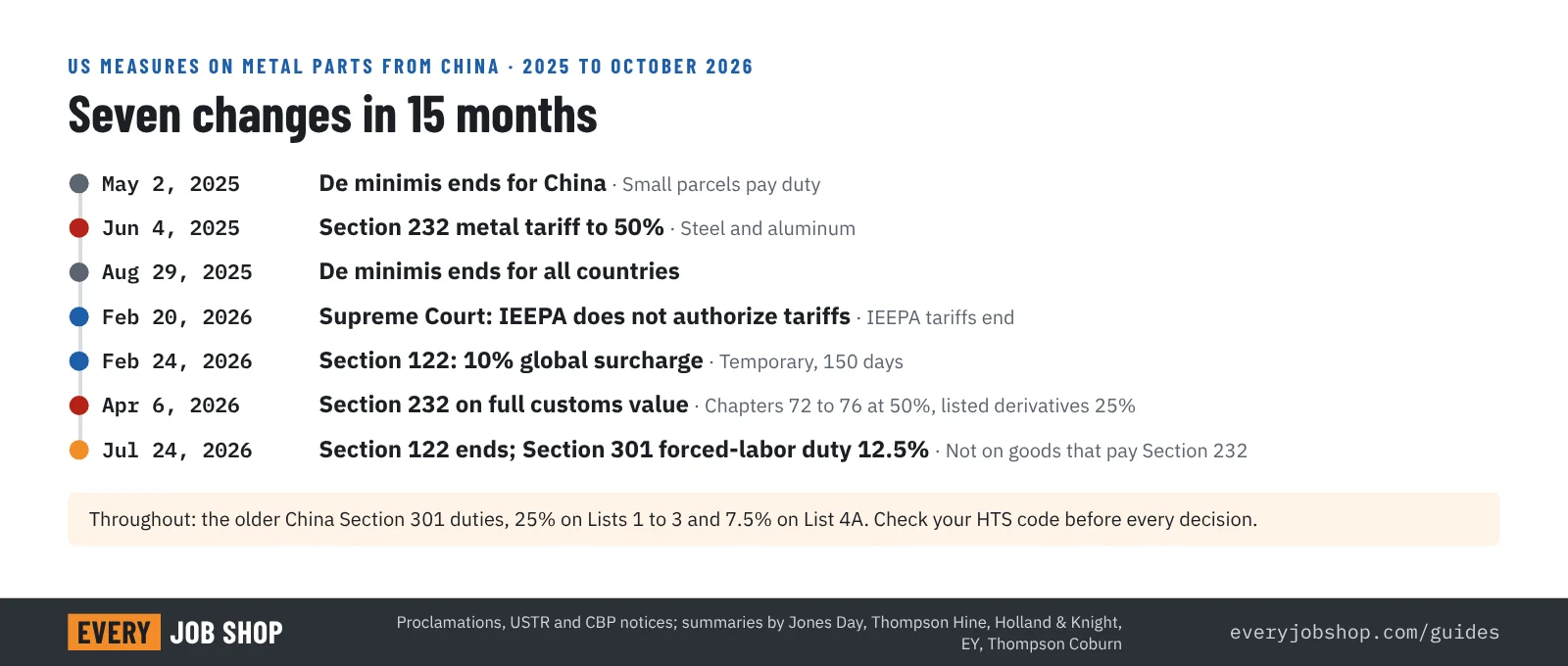
- Section 232 metal tariffs. Since April 6, 2026, goods in chapters 72, most of 73, 74 and 76 pay 50% on their full customs value, regardless of metal content; a list of derivative products pays 25%. Before April, the tariff on derivatives applied only to the value of the metal they contained.
- The older China Section 301 duties. In place since 2018 and 2019: 25% on Lists 1 to 3 and 7.5% on List 4A, depending on the code. Your broker can tell you whether your code is on a list.
- The new Section 301 forced-labor duty. Since July 24, 2026, 12.5% on most goods from China, on top of the existing China Section 301 duties. Articles subject to Section 232 are excluded, so a steel article pays the 50% metal tariff or the 12.5%, not both.
What no longer applies: the IEEPA tariffs. The Supreme Court held on February 20, 2026 that IEEPA does not authorize tariffs, and the temporary 10% Section 122 surcharge that replaced them ran from February 24 to July 24, 2026. Duty-free entry of small parcels (de minimis) ended for China on May 2, 2025 and for every country on August 29, 2025, so even a box of samples by courier now pays duty.
A worked example: 1,000 steel brackets
This is our own example to show how landed cost is built, not a real offshore quote. Every assumption is stated.
The part: the 11 gauge mild steel bracket from our laser cutting cost guide: laser cut, two bends, deburred, 1.83 lb.
The US quote: $6.66 a part at 1,000 pieces, built line by line in that guide at a 25% margin.
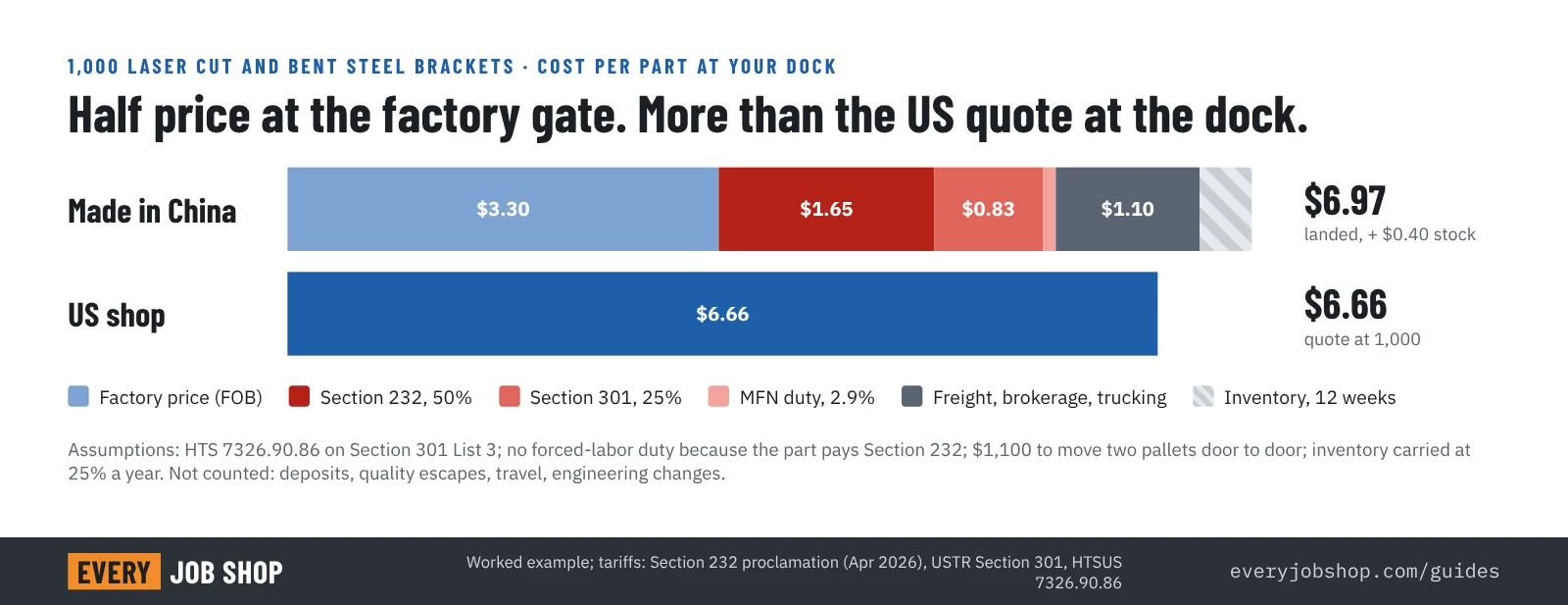
The overseas quote: we assume $3.30 a part FOB China, half the US price.
Assumptions for landing it:
- Tariff code 7326.90.86: MFN 2.9%, Section 232 at 50% of full value, and an older Section 301 duty of 25% (we assume the code is on List 3; check yours). No forced-labor duty, because the part pays Section 232.
- About 1,830 lb on two pallets, shipped less than container load. Ocean freight, origin and destination charges, customs brokerage and fees, and trucking to your door: $1,100 in total, $1.10 a part. Container rates are high this autumn: Drewry put Shanghai to Los Angeles at $8,007 per 40-foot container on October 22, 2026.
| Cost per part | China | US shop |
|---|---|---|
| Price at the factory | $3.30 | $6.66 |
| Section 232 (50% of $3.30) | $1.65 | |
| Older Section 301 (25%) | $0.83 | |
| MFN duty (2.9%) | $0.10 | |
| Freight, brokerage, trucking | $1.10 | included |
| Landed cost | $6.97 | $6.66 |
The duties alone add 78% to the factory price. Freight adds another third. And this is before the costs that rarely make the comparison spreadsheet.
The costs that are not on the quote
- Inventory. An offshore order ships in large batches with weeks at sea, so you hold months of stock. At a carrying cost of 25% a year, holding 12 extra weeks of stock costs about 6% of the landed value, $0.40 a part in our example. A US shop can deliver monthly releases against a blanket order.
- Deposits and payment terms. Offshore suppliers often ask for a deposit with the order and the balance before shipment. US shops usually invoice on delivery with 30-day terms.
- Quality escapes. A batch with a wrong hole position is found when the container arrives. Rework, scrap, line stoppages and air freight for the replacement are all yours.
- Engineering changes. Every revision means new samples crossing an ocean.
- Travel and audits. Visiting a supplier abroad costs days and airfare; visiting one two states away costs a morning.
- Policy risk. The metal tariffs alone changed five times in 15 months. A price that works today can be wrong when the next shipment lands.
The Reshoring Initiative publishes a free Total Cost of Ownership Estimator for exactly this comparison. Its count of announced US manufacturing jobs from reshoring and foreign investment was about 247,000 in 2025, with about 309,000 projected for 2026.
Which parts to bring back first
| Part profile | Reshore? | Why |
|---|---|---|
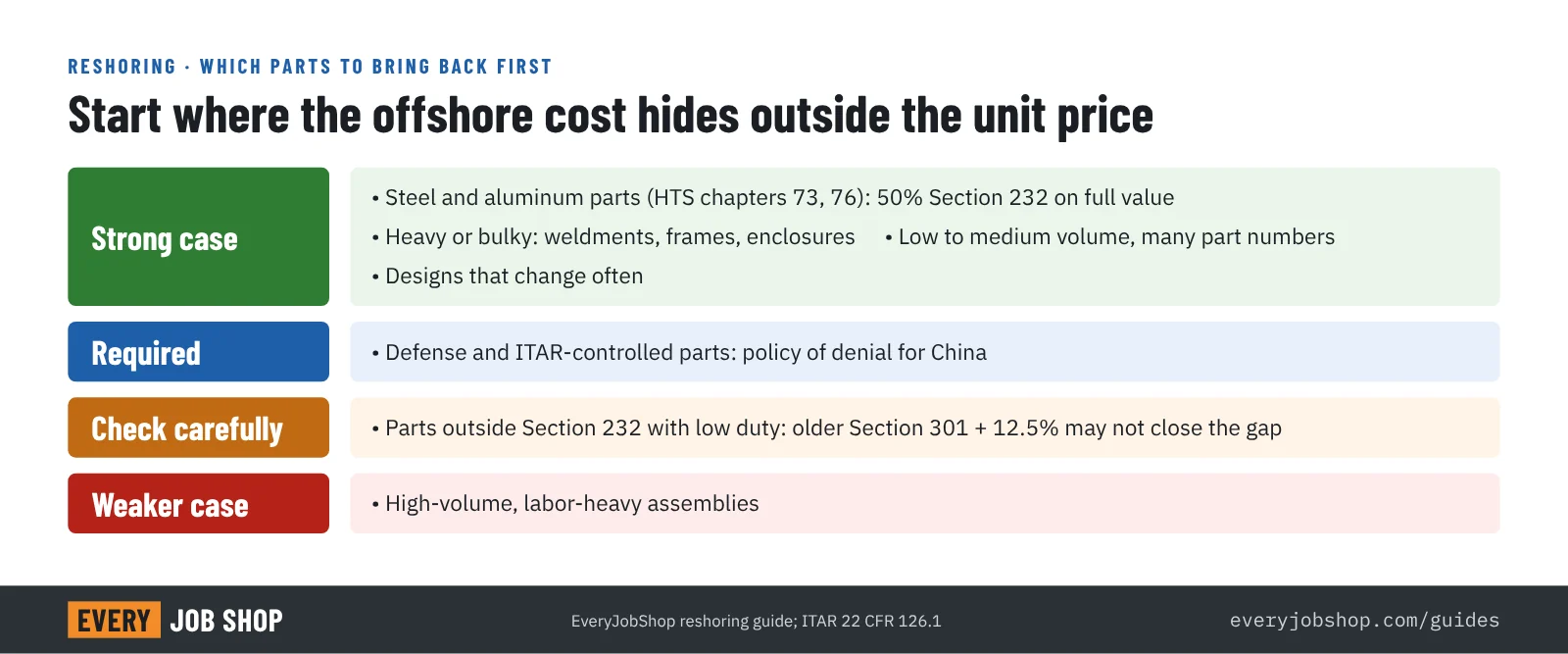
| Steel and aluminum parts in chapters 73 and 76 | Strong case | 50% Section 232 on full value, plus Section 301 |
| Heavy or bulky parts: weldments, frames, enclosures | Strong case | Freight per part is high, and grows with every shipment |
| Low to medium volume, many part numbers | Strong case | Offshore minimum orders and months of stock weigh most at these quantities |
| Parts that change often | Strong case | Every change crosses an ocean twice |
| Defense and ITAR-controlled parts | Required | Exports of defense articles to China fall under a policy of denial (22 CFR 126.1) |
| High-volume, labor-heavy assemblies | Weaker case | Labor is the largest cost and tariffs may not close the gap |
| Parts outside Section 232 with low duty | Check carefully | Older Section 301 plus the 12.5% may not be enough on its own |
How to run a reshoring RFQ
US shops price differently from offshore suppliers, so ask in the way that shows their best number:
- Send the real annual volume and the release pattern. "1,000 a year in four releases" prices very differently from "1,000 once".
- Ask for quantity breaks, including the quantity you would hold as stock and the quantity per release.
- Ask what the shop would change. A US shop with a fiber laser and a robotic press brake may suggest a design that cuts bends or welds.
- Send the same package to every shop, with the drawing, material and finish, so the quotes are comparable. Our guide on what to send with an RFQ has a template.
- Compare landed cost, not price. Put the offshore duties, freight, inventory and deposit terms in the same spreadsheet as the US quote.
Find US shops for the parts you bring back
EveryJobShop lists 3,770 US machine shops, fabricators and foundries in 50 states, searchable by process, material, state and certification. Start with laser cutting, CNC milling, welding or casting, check our guide on how to vet a new shop, and send one RFQ to up to 30 shops to compare US quotes with your landed cost.
Questions people ask
- What tariffs apply to metal parts imported from China in October 2026?
- It depends on the part's tariff code. Steel and aluminum articles in chapters 72, 73 and 76 pay the Section 232 metal tariff, 50% on the full customs value since April 6, 2026. Most Chinese goods also pay the older Section 301 duties (7.5% or 25% depending on the list) and the normal MFN duty. Goods outside Section 232 pay the new 12.5% Section 301 forced-labor duty since July 24, 2026. The IEEPA tariffs ended with the Supreme Court ruling of February 20, 2026. Check the exact rate for your code with a customs broker.
- Is it cheaper to make parts in the US than in China now?
- For many steel and aluminum parts it is close. In our worked example a bracket quoted at $3.30 in China lands at $6.97 after duties and freight, against $6.66 from a US shop at 1,000 pieces, before counting inventory, deposits, quality risk and travel. Labor-heavy assemblies in high volume often still favor offshore production; heavy, bulky, low-volume and fast-changing parts often favor the US.
- Does the 12.5% forced-labor tariff stack with Section 232?
- No. Articles subject to Section 232 tariffs are excluded from the Section 301 forced-labor duties, so a steel article that pays the 50% metal tariff does not also pay the 12.5%. It does still pay the older China Section 301 duty if its code is on one of those lists.
- How many jobs are being reshored?
- The Reshoring Initiative counted about 247,000 US manufacturing jobs announced through reshoring and foreign direct investment in 2025, nearly the same as in 2024, and projects about 309,000 for 2026 based on first-half announcements.
- Which parts should I reshore first?
- Start with parts where offshore costs hide outside the unit price: heavy or bulky parts with high freight, low and medium volumes with frequent design changes, parts with quality problems or long lead times that force large safety stock, and anything defense-related, which cannot be made in China under ITAR.