Ask ten shop owners for their hourly rate and you will hear ten numbers, and most of them were set years ago by looking at what the shop down the road charges. That works until the material bill doubles, the second shift goes away or a $450,000 5-axis machine arrives. Then the old number quietly starts losing money on every job.
So how do you calculate a machine shop hourly rate?
Add up what the machine and its operator cost in a year and divide by the hours you can actually bill. Everything else is detail, and the detail that matters most is the second number: billable hours. This guide builds a rate line by line for a 3-axis machining center, using public wage, benefit and power data and stated assumptions you can replace with your own.
The formula
Rate per billable hour = (yearly cost of owning the machine ÷ billable hours) + running cost per cutting hour + (yearly operator cost ÷ billable hours)
Then price = rate ÷ (1 − margin). A 15% margin means dividing by 0.85.
Three groups of cost go in:
- Owning the machine, paid whether it runs or not: depreciation, cost of the money tied up in it, maintenance contracts and repairs, floor space, software, and the machine's share of shop overhead (office, estimating, quality, insurance, utilities not metered to the machine).
- Running it, paid only while it cuts: cutting tools and inserts, coolant, power.
- The operator, paid for every hour on the clock, billable or not.
A worked example: a 3-axis machining center
This is our example, not a benchmark. The assumptions are stated so you can swap in your own invoices, wages and hours.
The machine: a new 3-axis vertical machining center, $150,000 installed with tooling, workholding and a probe. Vendor price guides put the most common job shop purchase, a 3-axis VMC, at $80,000 to $150,000 installed (vendor source).
Owning it, per year:
| Cost | Assumption | Per year |
|---|---|---|
| Depreciation | 10-year life, 15% resale value: $127,500 ÷ 10 | $12,750 |
| Cost of capital | 7% on the average amount invested (half the price) | $5,250 |
| Maintenance and service | About 3.3% of the price | $5,000 |
| Floor space | 300 sq ft at $12 per sq ft | $3,600 |
| CAM software and programming tools | Share per machine | $2,500 |
| Shop overhead | $240,000 a year spread over 8 machines | $30,000 |
| Total | $59,100 |
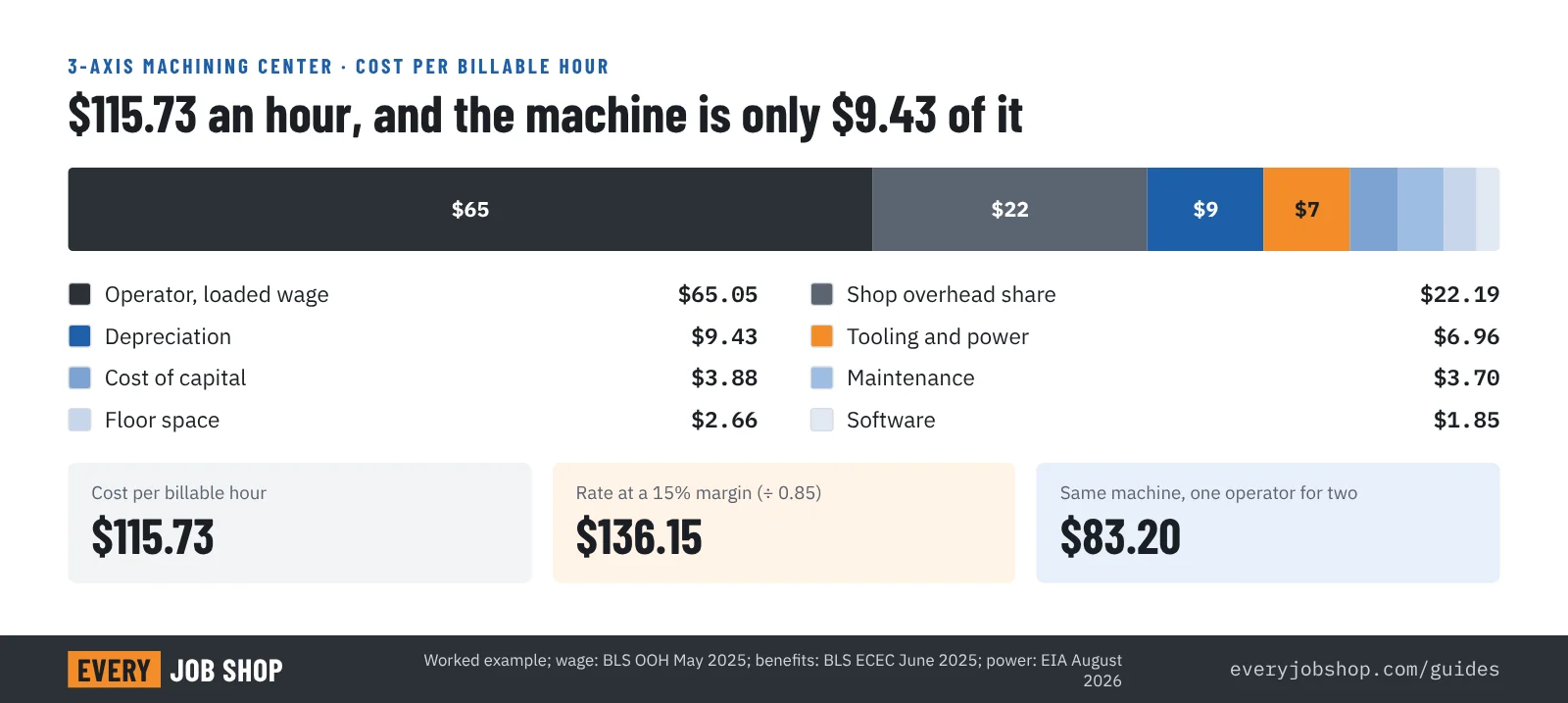
Running it, per cutting hour: cutting tools, inserts and coolant at $6.00, plus power. At an average draw of 10 kW and the US industrial electricity price of 9.64 cents per kWh in August 2026 (EIA), power is $0.96. Total $6.96.
The operator: the median machinist wage was $58,750 a year in May 2025 (BLS), $28.25 an hour over 2,080 paid hours. In manufacturing, benefits were 33.2% of total compensation in June 2025 (BLS), so the loaded cost is $28.25 ÷ 0.668 = $42.28 per paid hour, $87,949 a year.
Billable hours: one shift is 2,080 paid hours. Not all of them can be billed: warm-up, waiting for material, first-article questions, cleanup, breakdowns, an empty schedule. We assume 65%, or 1,352 billable hours. In Modern Machine Shop's Top Shops survey, typical shops reported a median spindle utilization of 65% and the top shops 75% (survey of 2014 performance).
The rate:
| Line | Arithmetic | Per billable hour |
|---|---|---|
| Owning the machine | $59,100 ÷ 1,352 h | $43.71 |
| Running it | tooling $6.00 + power $0.96 | $6.96 |
| Operator | $87,949 ÷ 1,352 h | $65.05 |
| Cost per hour | $115.73 | |
| Rate at 15% margin | $115.73 ÷ 0.85 | $136.15 |
Two things stand out:
- The operator is the largest line, more than half the cost, because the shop pays for 2,080 hours and bills 1,352.
- The machine itself is only $9.43 an hour of depreciation. Overhead ($22.19 an hour) costs more than twice as much as the machine. A shop that looks only at the machine's price underestimates its rate by a wide margin.
Billable hours decide the rate
Every line except tooling and power is divided by billable hours. That makes utilization the most powerful number in the calculation:
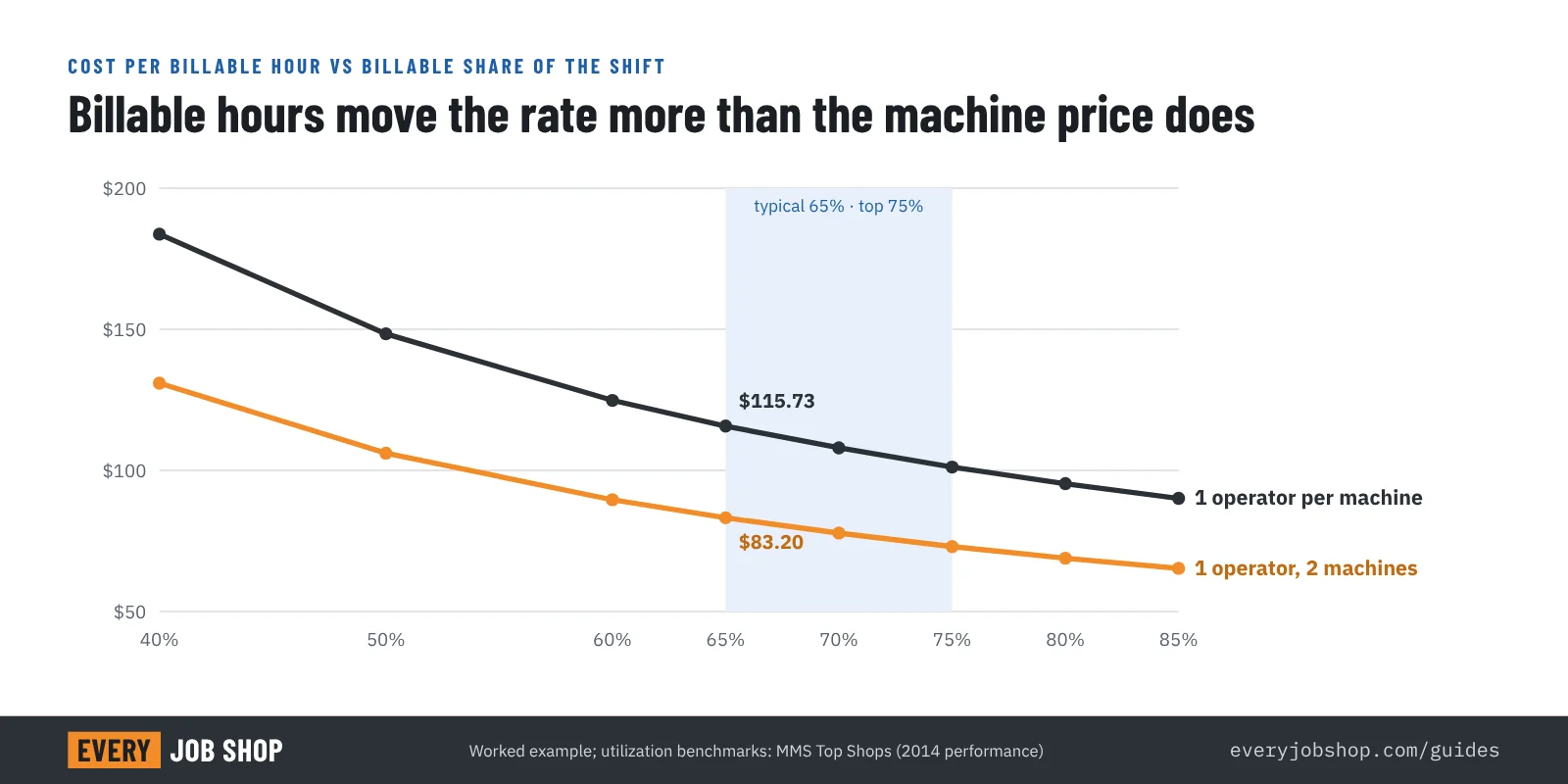
| Billable share of a shift | Billable hours | Cost per hour, one operator per machine | One operator for two machines |
|---|---|---|---|
| 50% | 1,040 | $148.40 | $106.10 |
| 65% | 1,352 | $115.73 | $83.20 |
| 75% | 1,560 | $101.20 | $73.00 |
| 85% | 1,768 | $90.10 | $65.30 |
Three ways shops bring the cost down, all of them about hours, not about the machine:
- Staffing. An operator who loads one machine while another cuts halves the operator line. On our example that takes the cost from $115.73 to $83.20 an hour.
- A second shift. The machine's yearly cost is spread over twice the hours. With one operator per shift, the cost falls to $93.90 an hour.
- Setup reduction. Quick-change workholding, presetting tools away from the machine and standard fixtures turn setup hours into cutting hours.
The reverse is also true: when the schedule thins out, the true cost per billable hour rises. A rate set in a busy year is too low in a slow one.
One rate per machine, not one rate per shop
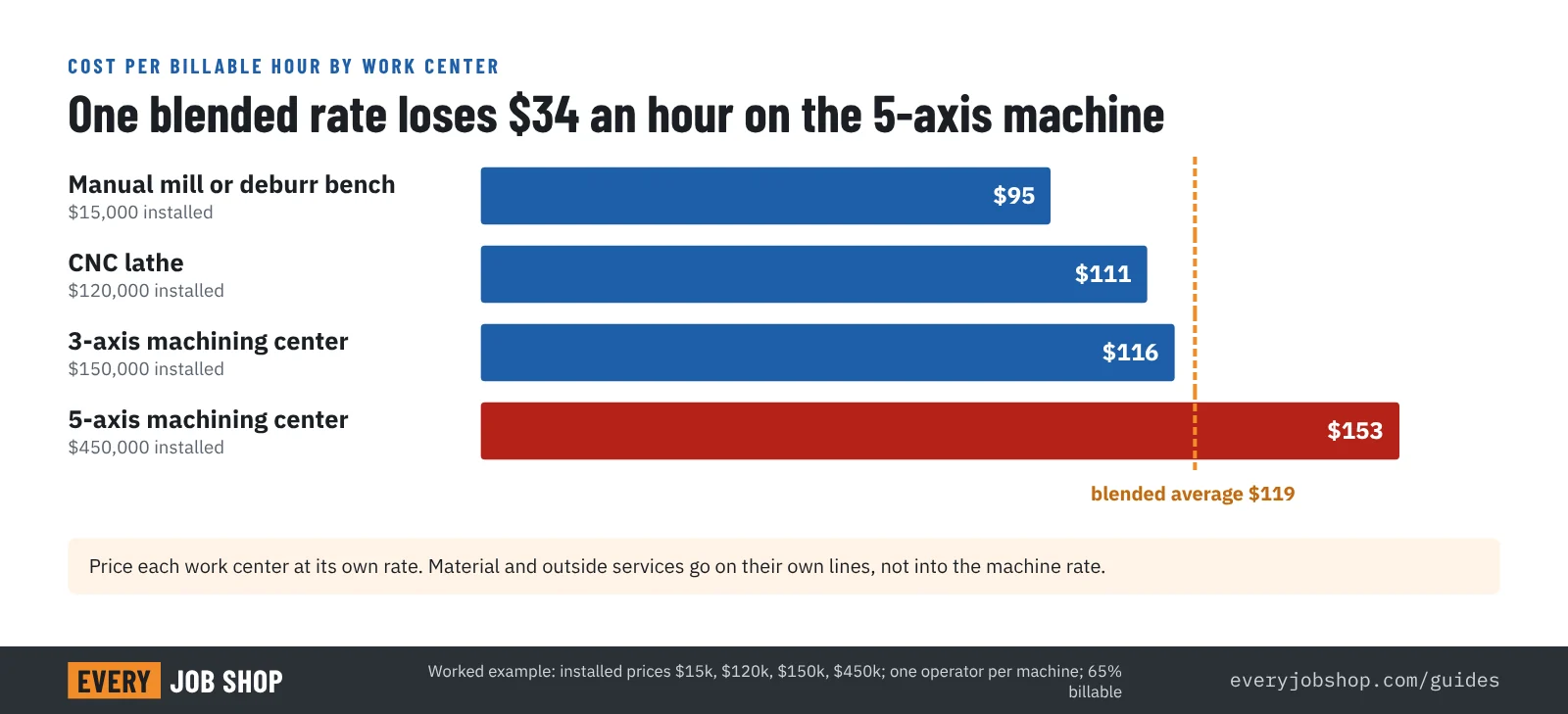
Many shops quote everything at one blended rate. It is simple, and it is wrong in both directions. Using the same method and the same overhead share for four kinds of work centers:
| Work center | Price installed | Cost per billable hour |
|---|---|---|
| Manual mill or deburr bench | $15,000 | $95.10 |
| CNC lathe | $120,000 | $111.10 |
| 3-axis machining center | $150,000 | $115.70 |
| 5-axis machining center | $450,000 | $153.20 |
The average is about $119. A shop that charges that everywhere:
- Loses about $34 an hour on the 5-axis machine, its most expensive asset, often on the most complex work.
- Overcharges simple work such as deburring and manual operations, which pushes simple jobs to competitors who price them correctly.
Published benchmarks show the same ranking. Protolabs Network (Hubs) uses about $65 an hour for turning, $75 for 3-axis milling and $120 to $150 for 5-axis (vendor source, used in our CNC cost guide). Marketplace rates are lower than our example because their partner shops run more hours and more machines per operator.
Check the rate against your books
A rate built from assumptions should be checked against what the shop actually earns:
- Revenue per machine. In the same MMS survey, the median sales per CNC machine were $123,900 for typical shops and $277,000 for top shops. At 1,352 billable hours, $123,900 is about $92 per machine hour, all costs and profit included.
- Quoted hours versus actual hours. Compare the hours you quoted with the hours on the job ticket for the last 20 jobs. If jobs run 20% over, the rate is effectively 20% lower than you think.
- Material and outside services. Keep them out of the machine rate. Quote them as separate lines with their own markup, so a change in metal prices changes one line, not the rate. Our guide to metal prices and tariffs shows why that matters in 2026.
Taxes change cash, not the rate
Since 2025, 100% bonus depreciation is available again for qualifying equipment acquired after January 19, 2025, and the Section 179 limit rose to $2.5 million (BDO summary of the One Big Beautiful Bill Act). Writing a machine off in the first year lowers the tax bill and helps cash flow. It does not change what the machine costs to own over its life, so the rate should still carry depreciation over the years the machine actually works. Ask your accountant about your case.
Ten steps to your own rate
- List every work center: each machine, the deburr bench, inspection if you bill it.
- For each one, write down the installed price, expected life and resale value.
- Add financing, maintenance, floor space and software per machine.
- Total the shop overhead for a year and decide how to share it (by floor space, by machine value, or evenly).
- Take the real wage and benefits of the people who run each machine.
- Count paid hours per shift and how many machines one operator runs.
- Measure billable hours for three months: hours charged to jobs, including setup.
- Divide, and add tooling and power per cutting hour.
- Set the margin and divide by (1 − margin).
- Repeat every year, and whenever a shift, a machine or a key wage changes.
Once the rates exist, quoting is arithmetic: hours times rate, plus material and outside services. That arithmetic is what a quote calculator automates. Our guide on automatic quoting for job shops shows how a calculator turns a DXF or STEP file into a price on your own rates, and buyers increasingly find shops through AI assistants that read those numbers from shop websites (see why ChatGPT can't recommend your shop).
Questions people ask
- What is a typical machine shop hourly rate?
- There is no official survey. Protolabs Network (Hubs) uses about $75 an hour for 3-axis milling as a baseline, $65 for turning and $120 to $150 for 5-axis. In our worked example, a $150,000 3-axis machining center with one operator, one shift and 65% billable time costs $115.73 an hour to run, or $136 with a 15% margin. With one operator running two machines it costs $83.20.
- How do you calculate a machine hourly rate?
- Add up the yearly cost of owning the machine (depreciation, cost of capital, maintenance, floor space, software and its share of shop overhead) and divide it by the hours you can bill. Add the running cost per cutting hour (tooling, power) and the operator's loaded wage divided by the same billable hours.
- What utilization should I assume?
- Use your own numbers if you track them. In Modern Machine Shop's Top Shops benchmarking survey, typical shops reported a median spindle utilization of 65% and the top shops 75%. In our example, going from 50% to 75% billable time lowers the cost from $148 to $101 an hour.
- What does a machinist cost per hour with benefits?
- The median wage for machinists was $58,750 a year in May 2025 (BLS), about $28.25 an hour. In manufacturing, benefits were 33.2% of total compensation in June 2025 (BLS Employer Costs for Employee Compensation), so the loaded cost is about $42.28 per paid hour. Paid hours that are not billed to a job, such as cleanup and waiting, raise the cost per billable hour further.
- Should a shop use one rate for all machines?
- Usually not. A blended rate overcharges simple work and undercharges the expensive machines. In our example, the costs per hour range from $95 for a manual mill or deburr bench to $153 for a 5-axis machining center. A single average of about $119 loses about $34 an hour on the 5-axis machine and prices the simple work out of the market.