Grinding is the step a drawing calls for without naming it. A tolerance of a few tenths of a thousandth, a flatness callout on a hardened plate, a bearing seat with a fine finish: none of that comes off a lathe or a mill reliably, and the shop that quotes your part either grinds it in house or sends it out. 944 US job shops in our index list grinding, a quarter of the whole index.
So which kind of grinding does your part need, what can it hold, and what does it add to the price?
This guide answers that with published figures (labelled as vendor or reference figures), a worked cost example with its assumptions stated, and our data on the 944 shops in the EveryJobShop index as of November 20, 2026.
Key numbers
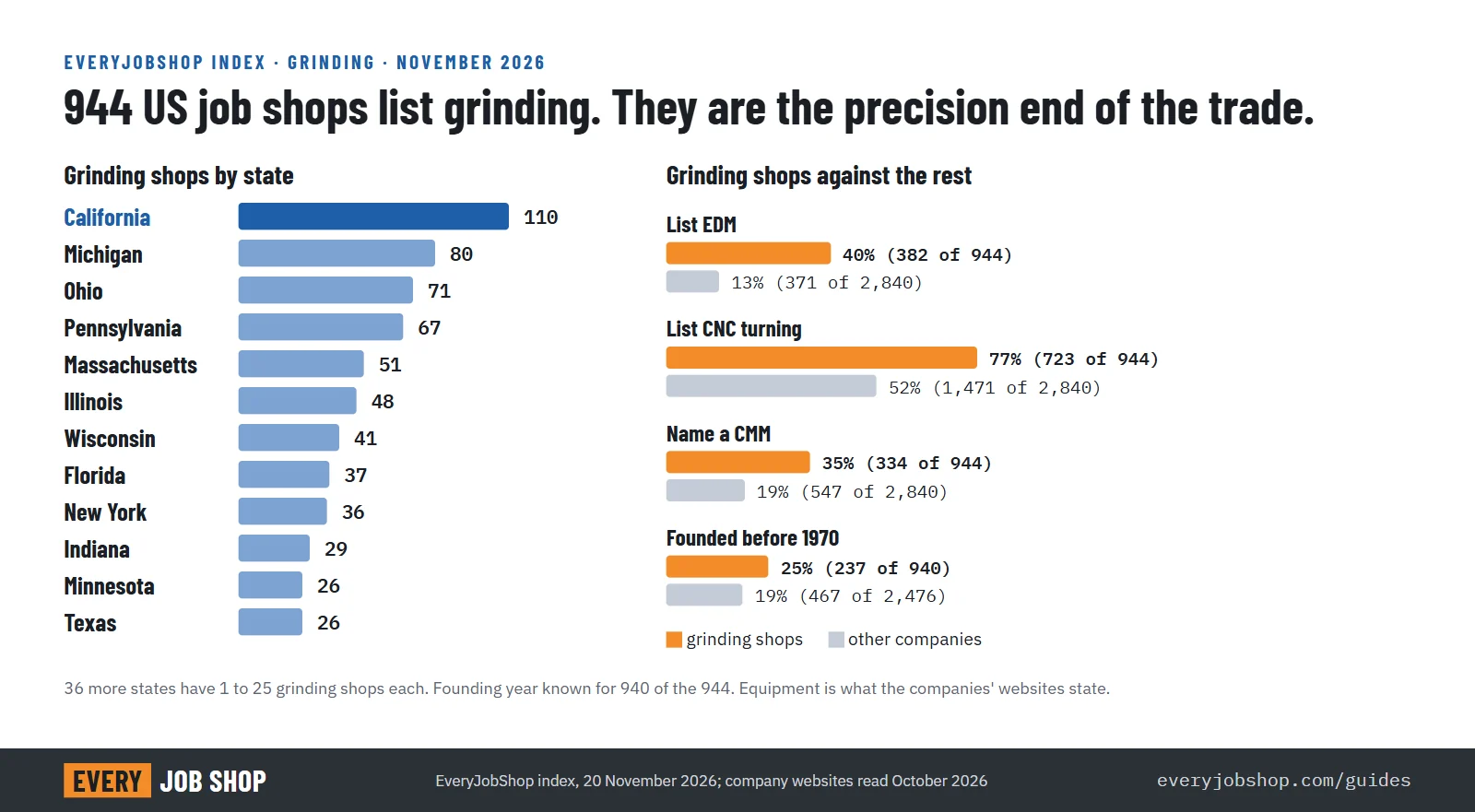
- 944 of 3,784 US job shops (25%) list grinding, in 48 states. California has 110, then Michigan (80), Ohio (71), Pennsylvania (67) and Massachusetts (51).
- Highest share: in Virginia 25 of 59 companies list grinding (42%), in Massachusetts 51 of 124 (41%), in Kansas 16 of 40 (40%) and in Michigan 80 of 213 (38%). In Texas it is 26 of 235 (11%).
- They are precision machine shops. 88% also list CNC milling (66% of the other companies), 77% turning (52%) and 40% EDM (13%). 35% name a CMM on their website, against 19% of the others.
- Machines named: Hardinge by 85 grinding shops (9%, against 2% of the others; Hardinge builds lathes as well as Kellenberger grinders, so not every mention is a grinder), Haas by 194, wire EDM by 213.
- Certifications: 437 state ISO 9001 (46%, against 39%), 202 AS9100 (21%), 196 ITAR (21%) and 34 ISO 13485 (4%).
- Older than average: median founding year 1985, against 1995 for the rest of the index; 25% were founded before 1970.
Processes come from our index; equipment, certifications and founding years are what the companies' own websites state, read by our crawler in October 2026. We have not checked them.
The four kinds of grinding
| Kind | How the part is held | What it makes | Typical parts |
|---|---|---|---|
| Surface grinding | On a magnetic chuck, under a wheel that passes back and forth | Flat, parallel faces and square edges | Die plates, mold plates, gauge blocks, wear plates, shims |
| Cylindrical grinding (OD and ID) | Between centers or in a chuck, turning while the wheel grinds | Round diameters, shoulders, tapers, bores that run true | Shafts, spindles, bearing seats, bushings, punches |
| Centerless grinding | Not held: it rests on a blade between the grinding wheel and a regulating wheel | Plain diameters in volume | Pins, dowels, rods, rollers, valve stems, ground bar stock |
| Jig grinding | On a precise table under a small wheel that orbits inside the hole | Holes and contours located to tenths in hardened plate | Die sets, mold inserts, fixtures, gauge holes |
Two variants you will see in quotes: Blanchard (rotary surface) grinding takes a lot of stock off large plates quickly and leaves a swirl pattern, flat but not to precision grinding limits; creep-feed grinding takes a deep cut in one slow pass and is used for forms such as turbine blade roots.
Centerless grinding works because nothing holds the part. In Wikipedia's description, "the workpiece is held between two wheels, rotating in the same direction at different speeds, and a work-holding platform". Through-feed centerless (the part passes straight through) only works for plain cylinders; in-feed centerless grinds shoulders and simple forms one at a time. It is the process of choice when many parts must be ground in a short time.
What grinding holds: published figures
These are reference and vendor figures for the process or the machine under good conditions:
| Process | Published figure | Source |
|---|---|---|
| Surface grinding | plus or minus 0.002 mm (0.0001 inch) "should be achievable on most surface grinders" | Wikipedia, Surface grinding |
| Jig grinding (contract service) | jig ground holes plus or minus 0.000060 inch true position, 0.000080 inch repeatability | Moore Tool Company (vendor) |
| Jig boring, same shop, for comparison | bored holes plus or minus 0.00025 inch true position, 0.00015 inch repeatability | Moore Tool Company (vendor) |
Moore Tool builds jig grinders and also runs them as a contract shop, so its page compares the two methods on the same machines: grinding locates a hole about four times more precisely than boring (0.000060 against 0.00025 inch true position). Cylindrical grinder builders such as Studer sell machines by distance between centers (400 to 1,600 mm on the S31 and S33) and precision; what a shop holds on your shaft depends on its length, stiffness and material.
Two practical points:
- Tight tolerance and fine finish come together. A ground surface is smoother than a turned or milled one, which is why grinding is specified for bearing seats and sealing faces as much for the finish as for the size.
- Grinding is slow, so it is used only where needed. A shop leaves a few thousandths of grinding stock on the features that need it and turns or mills the rest to final size. Our tolerance guide shows how each step down in tolerance adds a process and cost.
When a part needs grinding
- It is hardened. Heat treatment distorts a part and hardened steel is hard to cut. Rough machine soft, harden, then grind the critical diameters and faces.
- The tolerance is tighter than turning or milling holds. Bearing fits, gauge dimensions, press fits in steel.
- Flatness, parallelism or roundness is in the function: die and mold plates that must close without light, shafts that must run true, sealing faces.
- It is tooling. Punches, die buttons, ejector pins, mold inserts: the work of the EDM shops, which is why 40% of the grinding shops in our index also list EDM.
- It is ground stock. Precision ground rod and plate bought ready to size saves a step; some of the shops in our index sell exactly that.
When it does not: soft material with tolerances a CNC lathe or mill holds comfortably. Asking for a ground finish on every surface turns a cheap turned part into an expensive one.
What drives the cost of grinding
- Which features need it. Each ground diameter, face or hole is a separate operation with its own setup.
- The kind of grinding. Centerless is fast per part once set up; cylindrical and jig grinding are one part at a time.
- Tolerance and finish. Tighter limits mean more spark-out passes, more frequent wheel dressing and more measuring.
- Material and hardness. Hardened tool steels, stainless and carbide grind slower and may need special wheels (CBN or diamond).
- Stock left by the previous operation. Too much grinding stock costs time; too little leaves a part that does not clean up.
- Heat treatment between operations, usually done outside, and the extra handling and freight it brings.
Worked example
Assumptions, made up for illustration and not a quote: a 20 mm diameter, 80 mm long steel pin; a batch of 200; a shop rate of $90 an hour ($1.50 a minute). Turning takes 3 minutes a part plus 60 minutes of setup. For the ground versions the pin is turned with grinding stock, through-hardened outside at $1.00 a part, then ground: cylindrical grinding between centers takes 4 minutes a part plus 45 minutes of setup; through-feed centerless grinding takes 0.5 minutes a part plus 90 minutes of setup. Material, inspection and freight are left out.
| Route | Tolerance on the diameter (assumed) | Time per part | Heat treat | Price per part, 200 pins | Price per part, 2,000 pins |
|---|---|---|---|---|---|
| Turned only, soft | plus or minus 0.025 mm | 3.3 min | none | $4.95 | $4.55 |
| Turned, hardened, cylindrical ground | plus or minus 0.005 mm | 7.5 min | $1.00 | $12.29 | $11.58 |
| Turned, hardened, centerless ground | plus or minus 0.005 mm | 4.3 min | $1.00 | $7.38 | $6.36 |
Hardening and grinding more than doubles the price of the pin on a cylindrical grinder. On a plain pin, centerless grinding gets the same tolerance for about 40% less, and the gap widens with quantity. The catch: through-feed centerless needs a plain cylinder. Add a shoulder or a groove that must run true to the diameter and the part goes back on the cylindrical grinder.
What to send for a grinding quote
- A drawing that marks which features are ground, with their tolerance, finish (Ra) and geometric callouts (flatness, roundness, runout).
- Material and hardness, and whether the part arrives hardened or the shop arranges heat treatment.
- The state of the part when it arrives, if you supply it: turned with grinding stock, how much, or finished elsewhere and only ground here.
- Quantity, per batch and per year: it decides between cylindrical and centerless.
- How it will be measured: which features you will check and how, so the shop measures the same way.
Our RFQ guide covers the rest of a complete request.
Where the grinding shops are
| State | Grinding shops | Share of the state's shops | Also list EDM | State AS9100 | State ISO 13485 |
|---|---|---|---|---|---|
| California | 110 | 19% | 43 | 32 | 2 |
| Michigan | 80 | 38% | 27 | 9 | 3 |
| Ohio | 71 | 33% | 27 | 14 | 3 |
| Pennsylvania | 67 | 33% | 30 | 13 | 1 |
| Massachusetts | 51 | 41% | 10 | 8 | 3 |
| Illinois | 48 | 32% | 15 | 8 | 2 |
| Wisconsin | 41 | 29% | 15 | 5 | 0 |
| Florida | 37 | 25% | 15 | 8 | 2 |
| New York | 36 | 28% | 20 | 12 | 0 |
| Indiana | 29 | 21% | 12 | 3 | 2 |
| Minnesota | 26 | 28% | 17 | 11 | 5 |
| Texas | 26 | 11% | 12 | 7 | 0 |
Fourteen more states have 10 or more grinding shops, each with its own page: Connecticut and Virginia (25 each), Arizona (21), Washington, Kansas, Missouri and North Carolina (16 each), New Jersey (15), Oregon (14), Tennessee (13), Colorado (12), New Hampshire (11), Alabama and Maryland (10 each).
By city, the most grinding shops are in Phoenix, Arizona and Dayton, Ohio (9 each), then Sterling Heights, Michigan and Meadville, Pennsylvania (7 each), and San Jose, Minneapolis and Mentor, Ohio (6 each).
Seven shops that list grinding have confirmed their listing with us ("Verified with the shop"), among them two grinding specialists in Chicago: Aden Grinding and Precision Ground Rods. The others are Mozaic Precision Metals in Schaumburg, Illinois, Sierra Machinery and Engineering in Sparks, Nevada, Diamond Machine Works in Seattle, American Metal Products in Orlando and FoxFab Laser and Machine in Layton, Utah. Verified means the shop confirmed its details, not that we audited its work.
How to vet a grinding shop
- Ask which kinds of grinding it does in house: surface, OD/ID, centerless, jig. Many machine shops do surface grinding and send cylindrical and centerless work out.
- Ask about the machines' size limits: distance between centers, swing, chuck size, table size. A long shaft needs a long grinder.
- Ask what it holds on your part, at your length and hardness, and how it measures it: air gauges, roundness tester, CMM, surface roughness tester. 35% of the grinding shops in our index name a CMM.
- Ask who does the heat treatment and how distortion is handled before grinding. For aerospace work, ask whether the heat treater is Nadcap accredited and check AS9100 in OASIS; our AS9100 and ITAR guide explains both.
- Ask about grinding burn, the overheating that softens or cracks a hardened surface, and how the shop checks for it on critical parts.
- Start with a first article. Compare the inspection report with your drawing before releasing a batch. The vetting guide has the full question list.
Find grinding shops
Browse all 944 grinding shops on a map, or narrow the list: grinding shops with AS9100, with ISO 13485, and compare with the EDM shops for tooling work. With a drawing ready, send one RFQ to up to 30 shops and mark which features are ground.
Questions people ask
- What is precision grinding?
- Precision grinding removes a thin layer of metal with an abrasive wheel to reach a tighter size, flatness, roundness or surface finish than a lathe or mill can hold, usually after the part has been hardened. The main kinds are surface grinding for flat faces, cylindrical grinding for round diameters held between centers or in a chuck, centerless grinding for pins and shafts in volume, and jig grinding for precisely located holes in hardened plates.
- What tolerance can grinding hold?
- Wikipedia's surface grinding article says plus or minus 0.002 mm (0.0001 inch) should be achievable on most surface grinders. Moore Tool quotes its contract jig grinding at plus or minus 0.000060 inch true position for jig ground holes, against plus or minus 0.00025 inch for bored holes. These are reference and vendor figures; a shop quotes what it can hold on your part, material and size.
- What is the difference between centerless and cylindrical grinding?
- Cylindrical grinding holds the part between centers or in a chuck and grinds diameters, shoulders and tapers, one part at a time. Centerless grinding holds nothing: the part sits on a work rest between a grinding wheel and a regulating wheel, which lets plain cylindrical parts such as pins, rods and shafts be fed through one after another. Centerless is much faster in volume; cylindrical handles shoulders, faces and features that must run true to centers.
- When does a part need grinding?
- When the material is hardened, when a diameter or face needs a tolerance tighter than a lathe or mill holds reliably, when flatness, roundness or a fine finish is part of the function (bearing seats, sealing faces, gauge surfaces, mold plates), and for punches, dies and precise hole positions in hardened tooling.
- How many grinding shops are there in the US?
- In the EveryJobShop index, 944 of the 3,784 US job shops (25%) list grinding as of November 2026, in 48 states. California has 110, then Michigan (80), Ohio (71), Pennsylvania (67) and Massachusetts (51). Grinding shops list EDM three times as often as the rest of the index (40% against 13%).