China is where most buyers look first when a machined part costs too much at home. It has the largest number of CNC shops of any country, very fast prototyping, and suppliers that make the mold, mold the part, machine it and anodize it under one roof. Since 2025 it also has the highest US tariff stack on metal parts, and the same sourcing risks it always had: middlemen, certificates that do not check out, and deposits paid to the wrong company.
So when is a Chinese CNC shop the right source?
For prototypes, complex parts that need several processes, and medium volumes where tooling and machining go together, China is often the fastest and cheapest quote even after duty. For steel and aluminum parts in volume, the 50% metal tariff on the full value can erase the price gap, and our reshoring guide shows a bracket that lands above its US quote. This guide shows where Chinese shops are, how to check one before you pay, what the US charges at the border as of November 2026, and how to ask for a quote they will answer.
What Chinese CNC shops are strong at
Our index shows the typical profile. Of the 1,817 Chinese companies EveryJobShop lists as of November 2026, 1,294 name CNC machining. Most of them do far more than mill:
- Machining plus tooling. 723 of the 1,294 CNC shops also make molds (mold making), 540 do EDM and 452 run injection molding. One supplier can build the mold, mold the housing and machine the inserts.
- Turning, including Swiss-type. 462 also do CNC turning and 81 Chinese companies list Swiss turning for small precision pins and shafts.
- Prototypes in days. 357 of the CNC shops list prototyping; many quote from a STEP file within a day.
- Finishing in house or next door. Anodizing, plating, die casting and grinding are common in the same company or the same street.
The materials they name most often are aluminum (554 of the CNC shops), stainless steel, brass and copper; 158 name titanium. Of the 981 Chinese companies in our index that state a founding year, the median is 2005: many are 15 to 25 years old, not start-ups.
Where they cluster
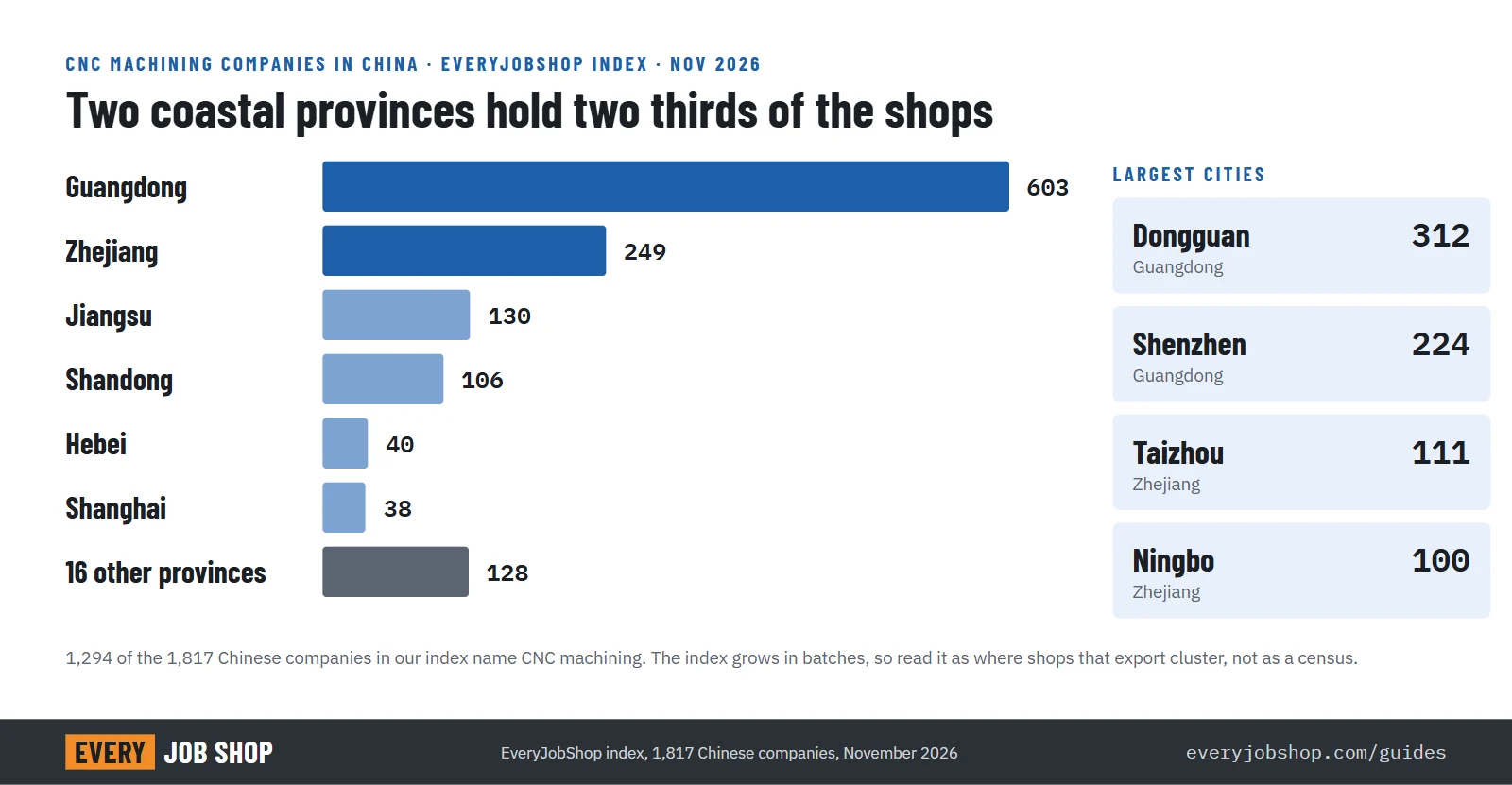
| Province | CNC companies in our index (Nov 2026) | Largest cities (CNC) | Other processes named most often in the province |
|---|---|---|---|
| Guangdong | 603 | Dongguan 312, Shenzhen 224 | Mold making, injection molding, EDM |
| Zhejiang | 249 | Taizhou 111, Ningbo 100 | Mold making, injection molding, EDM |
| Jiangsu | 130 | Kunshan 30, Suzhou 29 | Mold making, CNC turning, EDM |
| Shandong | 106 | Qingdao 42, Dongying 19 | Investment casting, mold making, sand casting |
| Hebei | 40 | Shijiazhuang 11, Baoding 7 | Sand casting, mold making, investment casting |
| Shanghai | 38 | Shanghai 37 | Mold making, injection molding, stamping |
The Pearl River Delta between Shenzhen and Dongguan is the densest pocket in our data: 536 CNC companies in two cities. Examples from our index: 3Q Machining in Dongguan, a direct CNC shop for prototypes and small to mid volumes that says about 70% of its output goes to Japan, and China Swiss CNC Machining in Shenzhen, which states ISO 13485 and AS9100.
Taizhou in Zhejiang is the mold town. Its Huangyan district has a mold industry park that China Daily reported held 137 mold companies with 6.8 billion yuan of output in 2021; of the 228 Taizhou companies in our index, 225 make molds. Ningbo, an hour north, adds casting: Besser Casting does investment casting, machining and grinding under IATF 16949.
Certifications you will see
| Certificate | What it covers | Chinese companies in our index | Where to check it |
|---|---|---|---|
| ISO 9001 | Quality management, any industry | 687 (542 of the CNC shops) | IAF CertSearch, or the CNCA database for Chinese certifiers |
| IATF 16949 (formerly ISO/TS 16949) | Automotive production quality | 280 under either name | IATF validity check |
| ISO 14001 | Environmental management | 162 | IAF CertSearch |
| ISO 13485 | Medical device quality | 78 | The certification body named on the certificate |
| AS9100 | Aerospace quality | 21 | OASIS database |
A certificate in China needs the same check as anywhere, and a little more. IAF CertSearch only holds certificates that certification bodies submit, and many Chinese certificates come from Chinese bodies listed with the national regulator CNCA, whose database is hard to use without knowing what you are looking for. If you cannot find the certificate, ask the certification body named on it to confirm the status and the site in writing. ACTKEY Tech and JingZhan in Kunshan are examples in our index that state ISO 13485 together with IATF 16949. Our certification guide explains what each certificate proves and what it does not.
Check the company before you pay
Most money lost in China sourcing is lost before the first chip is cut: a deposit paid to a company that is not the one on the quote. Five checks take an hour.
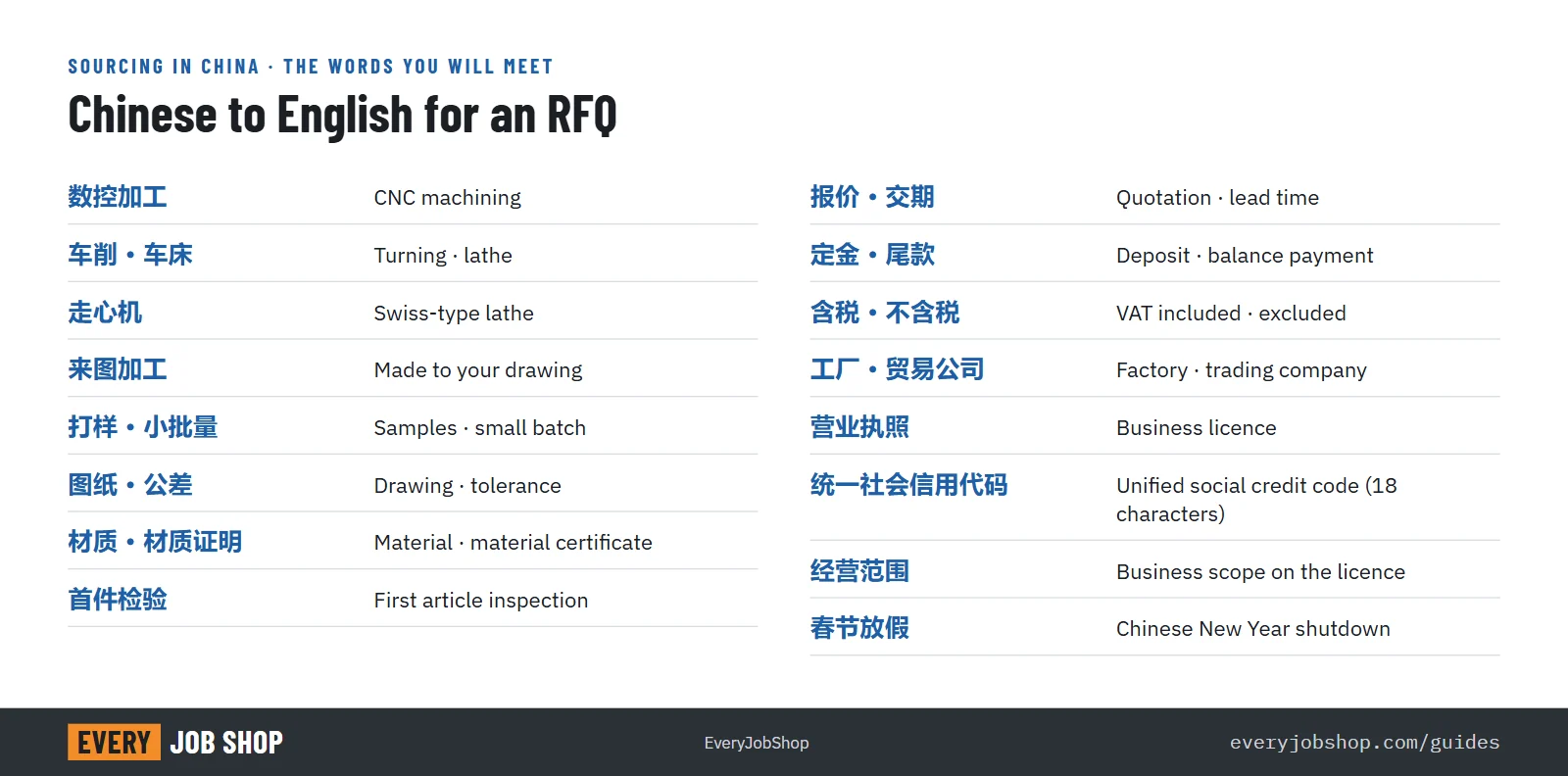
- Look up the business licence. Every Chinese company has a business licence (营业执照) with an 18-character unified social credit code. Search the code or the exact Chinese name on gsxt.gov.cn, the National Enterprise Credit Information Publicity System run by the State Administration for Market Regulation. Read the status, the registered capital, the legal representative and the abnormal operation list (经营异常名录). The site is in Chinese; a browser translator is enough.
- Read the business scope (经营范围). It lists what the company is licensed to do, and a factory's scope must include words like manufacture or produce; a scope with only sales, wholesale or import and export points to a trading company. Scopes can be broad, so this is a hint, not proof.
- Match the names. The company on the licence, the quote, the contract and the bank account must be the same legal entity. A request to pay a personal account or a "partner company" in Hong Kong is a reason to stop.
- See the shop floor. Ask for a live video walk past the machines that will run your part, or a third-party factory audit. A supplier that refuses or hesitates when asked for an audit is likely a trading company; then match the company name on the audit report to the licence.
- Sign an NNN agreement before you send drawings. China lawyers recommend a non-disclosure, non-use and non-circumvention agreement instead of a standard NDA, because a Western NDA is aimed at the wrong risk: with a factory the danger is less that your drawing leaks than that the factory uses it for itself or sells around you to your customers. An NNN covers the quoting stage; production needs a manufacturing contract.
Our general checklist for vetting a new machine shop applies on top.
US duty on Chinese machined parts, November 2026
Four layers can apply, and whether each one does depends on the part's tariff (HTS) code:
- The normal duty (MFN), usually low for metal parts.
- Section 232 metal tariffs. Since April 6, 2026, goods in chapters 72, most of 73, 74 and 76 pay 50% on their full customs value; listed derivative products pay 25%.
- The older China Section 301 duties: 25% on Lists 1 to 3 and 7.5% on List 4A, in place since 2018 and 2019.
- The Section 301 forced-labor duty: 12.5% on most Chinese goods since July 24, 2026, but not on articles that pay Section 232.
The IEEPA tariffs ended with the Supreme Court ruling of February 20, 2026. Small parcels get no relief: duty-free de minimis entry ended for China on May 2, 2025, so samples by courier pay duty too.
What that means for one part with a customs value of $40.00 (our example; we assume each code is the right one and that it is on Section 301 List 3, and leave out the small merchandise processing fee):
| Part and HTS code | Normal duty | Section 232 | Section 301 | Total duty |
|---|---|---|---|---|
| Machined aluminum housing, 7616.99.51 | 2.5%: $1.00 | 50%: $20.00 | List 3, 25%: $10.00 | $31.00 (77.5%) |
| Machined steel bracket, 7326.90.86 | 2.9%: $1.16 | 50%: $20.00 | List 3, 25%: $10.00 | $31.16 (77.9%) |
| Molded plastic part, 3926.90.99 | 5.3%: $2.12 | none | 25% + 12.5%: $15.00 | $17.12 (42.8%) |
The same aluminum housing from Germany pays $21.00 in our German sourcing guide, and from Mexico it can enter duty free under USMCA if it qualifies (see our Mexico guide). A machined part classified as a machine component in chapter 84 can fall outside Section 232 entirely, so classification is worth a broker's hour.
What a Chinese shop hour costs
Chinese labour is no longer as cheap as the reputation. The National Bureau of Statistics puts the average 2025 wage in manufacturing at 76,055 yuan a year in private companies and 113,594 yuan in non-private units, about 6,300 and 9,500 yuan a month. Machines, energy and overhead make up the rest of a shop rate. In our index the advantage shows up as breadth: most Chinese CNC shops also list molds, EDM, molding or finishing, so one quote can cover what would take three suppliers elsewhere.
How to write an RFQ a Chinese shop answers
The basics are the same as anywhere (our RFQ checklist lists twelve items). What changes for China:
- Send a STEP model and a PDF drawing with tolerances. Chinese shops quote from the model and program from it; the drawing is where the tolerances, threads and finish live. Use metric or state clearly that the drawing is in inches.
- State the material grade and ask which Chinese GB grade the shop will use for it, and ask for a material certificate (材质证明) with the shipment.
- Ask for samples first. Order a sample run (打样) and a first article inspection report (首件检验) before the batch, and approve the batch against them.
- Agree the Incoterms rule. Most Chinese quotes are FOB a Chinese port or EXW the factory; the ICC's Incoterms 2020 define who carries which costs and risks. With FOB, freight, US customs and the duty above are yours.
- Agree payment terms that keep leverage. The common structure is 30% deposit and 70% before shipment; tie the 70% to a pre-shipment inspection by a third party, not only to a bill of lading. Prices "含税" include Chinese VAT, "不含税" exclude it; export quotes should be the second.
- Plan around Chinese New Year. In 2027 it falls on February 6; output slows weeks before and ramps up slowly after, with reduced staff into March, so confirm each shop's shutdown dates and get anything that must ship before it booked in early January.
- Ask who makes it. If the quoting company is a trader or an agent, ask for the name of the factory, and check that one too.
Red flags
- A business licence that does not match the company on the quote or the bank account.
- A scope with only trade and sales from a company that says it owns the machines.
- A certificate you cannot find, or one issued for another site of the group.
- A price with no questions about tolerance, material or quantity, far below the others.
- Pressure to pay more before shipment than the contract says.
- No video of the shop floor after the second request.
Find Chinese CNC shops
Start with the Chinese CNC machining list, or narrow it to CNC turning, Swiss turning, EDM or mold making. Each company page shows what the company says it does, its certificates and where we read it. To compare a Chinese quote with shops elsewhere, look at Mexico, Europe or the US list, where you can send one RFQ to up to 30 US shops.
Questions people ask
- How do I check that a Chinese machine shop is a real company?
- Ask for the business licence (营业执照) and look up its 18-character unified social credit code, or the exact Chinese name, on gsxt.gov.cn, the National Enterprise Credit Information Publicity System run by the State Administration for Market Regulation. Check that the status is active, that the business scope names production or processing and not only trade, that the company is not on the abnormal operation list, and that the name matches the one on your contract, the bank account and the invoices.
- What US tariff applies to CNC machined parts from China in November 2026?
- It depends on the part's HTS code. Steel and aluminum articles in chapters 72, most of 73 and 76 pay the Section 232 metal tariff, 50% on the full customs value since April 6, 2026, plus the normal duty and, if the code is on one of the 2018 and 2019 lists, the older China Section 301 duty of 25% or 7.5%. Goods outside Section 232 pay the 12.5% Section 301 forced-labor duty in force since July 24, 2026 instead. Duty-free de minimis entry ended for China on May 2, 2025. Check your code with a customs broker.
- How do I know if a Chinese supplier is a factory or a trading company?
- Read the business scope on the licence: production, processing or manufacturing point to a factory, while sales, wholesale and import and export alone point to a trader. Check that the registered address is an industrial zone, ask for a video walk through the shop floor with the machines you need, and ask for a third-party audit. A trader is not wrong to use, but you should know who makes the part.
- What payment terms do Chinese machine shops ask for?
- The usual structure is a 30% deposit with the order and the 70% balance before shipment, by bank transfer. Tie the balance to a pre-shipment inspection or to the first article report rather than to shipping documents alone, and on a larger order consider a letter of credit. Repeat customers often get better terms.
- When is Chinese New Year 2027 and how long do factories close?
- Chinese New Year falls on February 6, 2027. Many factories reduce output and close lines several weeks before it, and capacity can take several weeks to return to normal, with reduced staff into March. Confirm the shutdown dates with each shop and get anything that must ship before the holiday confirmed in early January.