Search "cnc machining italy" and you get a few large contract manufacturers with English websites and a long tail of family shops whose sites say "lavorazioni meccaniche conto terzi" and little else. The second group is most of the industry, and it is where the turned parts, molds and welded frames come from.
So is it worth sourcing parts from an Italian machine shop?
For precision turned parts, molds and dies, small series of complex machined parts and sheet metal assemblies, often yes: Italian shops are specialists, labour costs a third less than in Germany, and many already export. For plain steel or aluminum parts in the US, the 50% Section 232 tariff usually ends the conversation. This guide shows where the shops are, what they are good at, what lands in the US at what duty, and how to write an RFQ they answer.
Where Italian job shops cluster
Italian manufacturing is organised in industrial districts (distretti industriali): areas where hundreds of small firms specialise in one stage of one trade and buy from each other. ISTAT identified 141 districts in its 2011 census; mechanics is the largest specialisation at 27.0%, and 45 of the districts are in the Northeast and 37 in the Northwest. Districts held over a third of Italy's manufacturing employment.
The areas you will meet most often:
| Area | Known for |
|---|---|
| Brescia and its valleys (Val Trompia, Lumezzane) | Metals, turned parts, valves and fittings, molds, die casting |
| Brianza, Como and Lecco | Machining, sheet metal, metalworking, plastic molding |
| Bergamo and Milan | Machinery and instrumental mechanics |
| Veneto: Padua, Vicenza, Treviso | Machining, molds, sheet metal, thermomechanics |
| Emilia-Romagna: Bologna, Imola, Modena | Packaging machinery supply chain, precision machining, sheet metal |
| Piedmont: Turin, Cuneo, Novara | Automotive supply chain, turning, die casting |
District names follow the Intesa Sanpaolo monitor below; the processes are those of the companies in our index in each area.
Intesa Sanpaolo's district monitor, published in September 2026, tracks these districts by exports. The Metals of Brescia district exported 4.9 billion euros in 2025 and grew 7.4% in the first half of 2026; the taps, valves and cookware district of Lumezzane exported 4.0 billion euros; the instrumental mechanics district of Bergamo fell 10.8%. All Italian districts together exported 161.3 billion euros in 2025, 17.4 billion of it to the United States; exports to the US fell 2.9% in the first half of 2026, and Germany remains their largest market.
The Italian shops in our index
As of November 2026, EveryJobShop lists 113 Italian companies: 69 in Northwest Italy and 44 in Northeast Italy. 20 of them are in the province of Brescia, and another dense group sits in Brianza between Monza, Como and Lecco. Processes and certifications come from each company's own website.
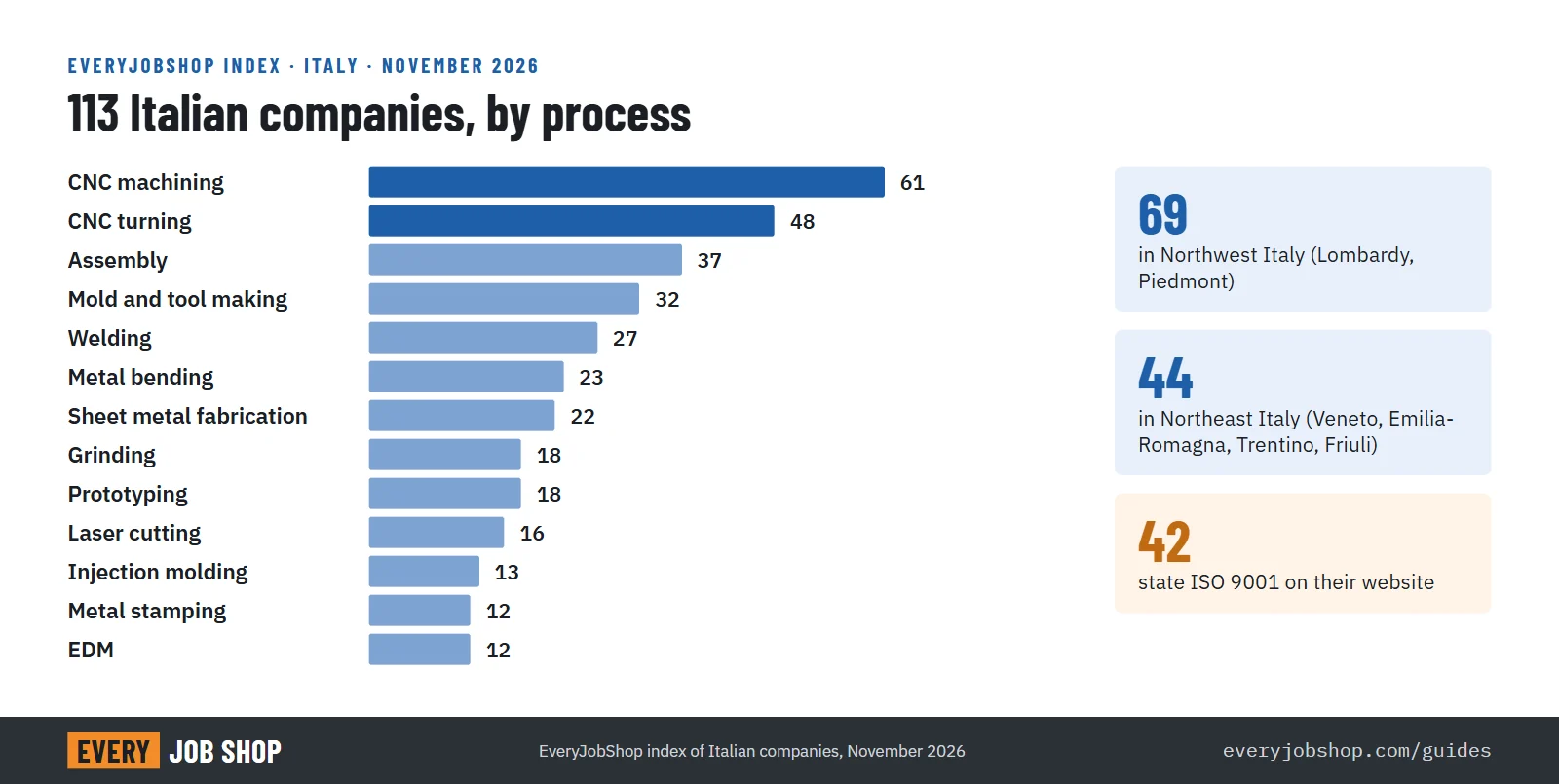
| Process | Companies | List |
|---|---|---|
| CNC machining | 61 | /italy/cnc-machining |
| CNC turning | 48 | /italy/cnc-turning |
| Mold and tool making | 32 | /italy/mold-making |
| Welding | 27 | /italy/welding |
| Metal bending | 23 | /italy/metal-bending |
| Sheet metal fabrication | 22 | /italy/sheet-metal-fabrication |
| Grinding | 18 | /italy/grinding |
| Injection molding | 13 | /italy/injection-molding |
They are old and specialised: 71 state a founding year, the median is 1976 and 40 were founded before 1980. Typical examples: 3L Sarca, a bar turning shop in Nave in the Val Trompia; Miroglio in Turin, founded in 1898, IATF 16949 certified for automotive work; Carpenteria Metallica G.T. near Padua, certified to EN 15085-2 CL1 for welding rail vehicles. Compare the rest of Europe on the same filters.
What Italian shops are good at
The counts below are from our index, November 2026.
- Turned parts in volume. A torneria automatica runs rows of bar-fed cam and CNC lathes; minuteria metallica means small turned and stamped parts by the thousand. 48 of our Italian companies offer CNC turning, 8 of them in the province of Brescia.
- Molds and dies. 32 make molds (stampi) for plastic injection, die casting or stamping; 11 of them also run the injection molding.
- Machined parts with assembly. The machinery districts of Bergamo, Bologna and Vicenza in the Intesa Sanpaolo monitor buy from shops like these: 24 of our companies combine CNC machining with assembly.
- Sheet metal and weldments. Carpenteria metallica covers laser cutting, press brake bending and welding, from enclosures to frames; 17 companies do both sheet metal fabrication and welding.
Certifications to ask for
| Certificate | What it covers | Where to check |
|---|---|---|
| ISO 9001 | Quality management system | Accredia, the Italian accreditation body, or IAF CertSearch |
| IATF 16949 | Automotive production | IATF validity check |
| EN 9100 | Aerospace; the European publication of AS9100 | OASIS, see our certification guide |
| EN 1090 | Load-bearing steel and aluminum structures | The certificate from the notified body |
| EN 15085-2 | Welding of rail vehicles, levels CL1 to CL3 | EN 15085 register |
EN 1090 matters for anything structural: since 1 July 2014 only load-bearing steel or aluminum structures that comply with the EN 1090 series and carry the CE mark may be sold in Europe, and the structural engineer sets the execution class (EXC1 to EXC4) (TÜV Austria, a certification body). EN 15085-2 sets three levels for rail welding, with CL1 for components of high safety relevance (TÜV Rheinland, a certification body). In our index, 42 Italian companies state ISO 9001 on their website and 3 state IATF 16949 or its predecessor ISO/TS 16949; we have not checked them with the registrars, so verify before you order.
Labour cost: Italy against Germany and the EU
Eurostat's hourly labour cost in manufacturing, 2025, in euros per hour (wages plus social contributions and taxes, firms with 10 or more employees):
| Country | Manufacturing, 2025 |
|---|---|
| Germany | 49.5 |
| France | 47.1 |
| Euro area | 40.8 |
| EU | 35.0 |
| Italy | 32.8 |
| Spain | 28.2 |
| Poland | 17.1 |
Source: Eurostat, labour cost levels by NACE activity (lc_lci_lev). Across the whole economy, Eurostat puts the EU average at 34.9 euros an hour in 2025.
Italian manufacturing labour costs about a third less than German. That does not make every Italian quote a third cheaper: the machine hour also carries the machine, tooling, energy and overhead, which do not scale with wages. Our guide on what CNC machining costs shows what goes into the number.
US tariffs on parts from Italy, November 2026
Two regimes apply, and the part's tariff (HTS) code decides which:
- Section 232 metal tariffs. Since April 6, 2026, steel, aluminum and copper articles on the main list pay 50% of their full customs value, listed derivative products 25%, and a temporary 15% applies to a short list of derivatives through 2027. No special rate for the EU is listed. A steel bracket, an aluminum machined housing or a brass fitting can all fall here. This is the same regime as in our China landed cost guide.
- Section 301, for everything else. Since July 24, 2026, EU goods pay a Section 301 duty sized to bring the normal (MFN) duty plus Section 301 to 10%, with no extra duty if the normal rate is already 10% or more. Goods that pay Section 232 are exempt, so the two do not stack.
The EU-US framework of August 2025 promised an all-inclusive 15% ceiling on EU goods but left steel and aluminum and their derivatives at 50%. The EU's own regulation lets the Commission suspend its tariff cuts if the US still charges more than 15% on steel and aluminum derivatives after December 31, 2026, so expect this to move. Small parcels pay duty too: de minimis ended for every country on August 29, 2025.
In practice: a part outside Section 232, such as a molded plastic part, lands at 10% all in when its normal duty is below 10%, while a plain steel or aluminum article carries 50%. Check your code with a customs broker before you compare quotes.
August, lead times and the calendar
The national contract for metalworking firms says holidays are normally collective, by plant or department, and a collective block may run up to three consecutive weeks unless the company agrees otherwise. Most shops take it around Ferragosto (August 15); economists discount Italy's August production data because of plant holiday closures. Practical rules:
- Ask every shop for its closing dates (chiusura estiva) when you order.
- Orders that must ship in August go out by June, before the shop's summer schedule fills.
- Ask about the Christmas closing as well when an order spans the year end.
- Confirm whether the lead time is ex works or delivered, and in working weeks.
How to write an RFQ an Italian shop answers
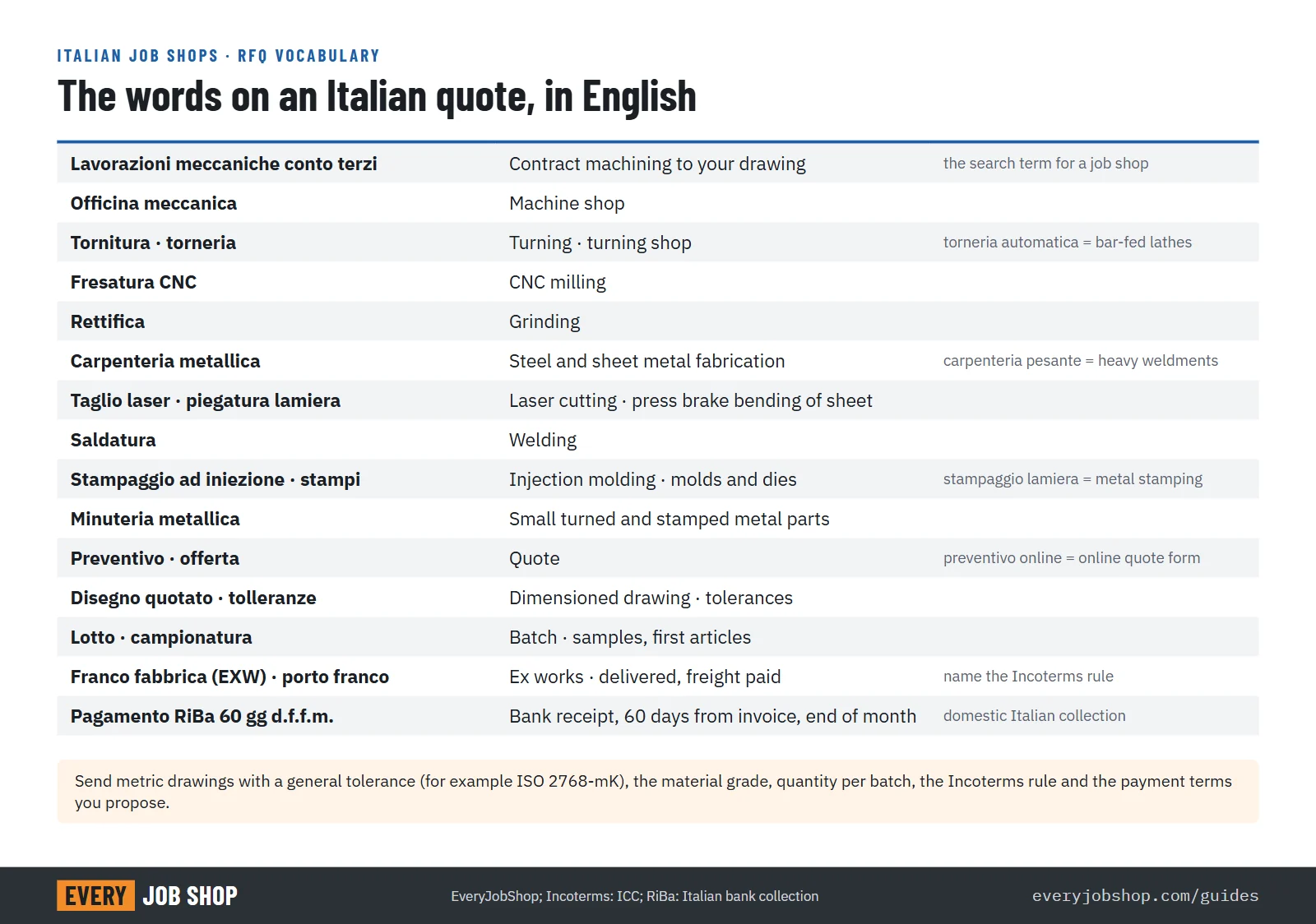
- Write in plain English, and add a one-paragraph summary in Italian. Exporting shops read English; the owner of a 15-person torneria may not, and a short Italian summary gets the RFQ read.
- Send metric drawings (PDF plus STEP) with a general tolerance such as ISO 2768-mK in the title block. Our tolerance guide explains the classes. Use EN material grades (for example 1.4404 or S355) or give the equivalent.
- State quantity per batch and per year, and whether you want samples (campionatura) first.
- Name the Incoterms rule, usually EXW or FCA from the shop, or DAP to your door, and who books the freight.
- Propose payment terms. Italian firms invoice each other on RiBa, a bank collection at 30, 60 or 90 days from the invoice that runs between the two companies' Italian banks. Without an Italian account you will pay by wire transfer (bonifico); agree the term in writing. In the EU, payment between businesses is due within 60 days unless expressly agreed otherwise and not grossly unfair.
- Ask for the certificates you need and for an inspection report with the first batch.
Our RFQ guide has a full checklist, and the sheet metal cost guide shows what goes into a laser and bending quote.
Red flags
- No company registry entry. Every Italian company has a VAT number (partita IVA); check it in the EU's VIES database and the company in the Registro Imprese.
- A certificate you cannot find in Accredia or IAF CertSearch, or one issued to another site.
- A trading company presented as a shop. Some Italian websites resell parts made elsewhere; ask which machines will run your part and ask for a video call from the floor.
- No answer about August. A shop that cannot tell you its closing dates has not planned your order.
- A quote with no questions on a complex part. Our guide on how to vet a machine shop has twelve to ask.
Find an Italian shop
Browse the 113 Italian companies in our index by process, starting with CNC turning, metal bending or mold making, or compare them with shops across Europe. For parts that carry the 50% metal tariff, search US shops and compare the quotes landed at your dock.
Questions people ask
- What does lavorazioni meccaniche conto terzi mean?
- Contract machining: a shop (officina meccanica) makes parts to the customer's drawing and material specification instead of selling its own products. It is the phrase Italian job shops use on their websites, together with tornitura (turning), fresatura CNC (CNC milling), carpenteria metallica (metal fabrication) and stampaggio ad iniezione (injection molding).
- Is CNC machining in Italy cheaper than in Germany?
- Labour is. Eurostat puts the hourly labour cost in Italian manufacturing at 32.8 euros in 2025, against 49.5 euros in Germany and 35.0 euros on EU average, about a third less than Germany. The machine hour also carries the cost of the machine, energy and overhead, so compare quotes, not wage tables.
- What US tariff applies to machined parts from Italy in November 2026?
- It depends on the tariff code. Parts that are steel, aluminum or copper articles under Section 232 pay 50% of their full value since April 6, 2026, and listed derivative products pay 25% or a temporary 15%. Most other EU goods pay a Section 301 duty that brings the normal duty plus Section 301 to 10% since July 24, 2026, with nothing added when the normal duty is already 10% or more. Check your code with a customs broker.
- Do Italian machine shops close in August?
- Many do. The national contract for metalworking firms makes holidays normally collective, by plant or department, with up to three consecutive weeks of collective holidays unless agreed otherwise, and most firms take them around Ferragosto (August 15). Place orders that must ship in August by June, and ask each shop for its closing dates.
- How many Italian job shops does EveryJobShop list?
- As of November 2026, 113 Italian companies: 69 in Northwest Italy and 44 in Northeast Italy. 61 offer CNC machining, 48 CNC turning, 32 mold and tool making and 22 sheet metal fabrication, and 42 state ISO 9001 on their website.