A waterjet is the one cutting machine in a shop that does not care what the material is. The same table that cuts a 2 inch titanium plate in the morning cuts a rubber gasket after lunch, without heat and without changing a tool. That flexibility is why 493 US job shops in our index list it, and why it is rarely the fastest or cheapest way to cut any one material.
So when is waterjet the right process for your part, what can it hold, and what decides the price?
This guide answers that with the machine builders' own figures (labelled as vendor figures), a worked cost example with its assumptions stated, and our data on the 493 shops in the EveryJobShop index as of November 17, 2026.
Key numbers
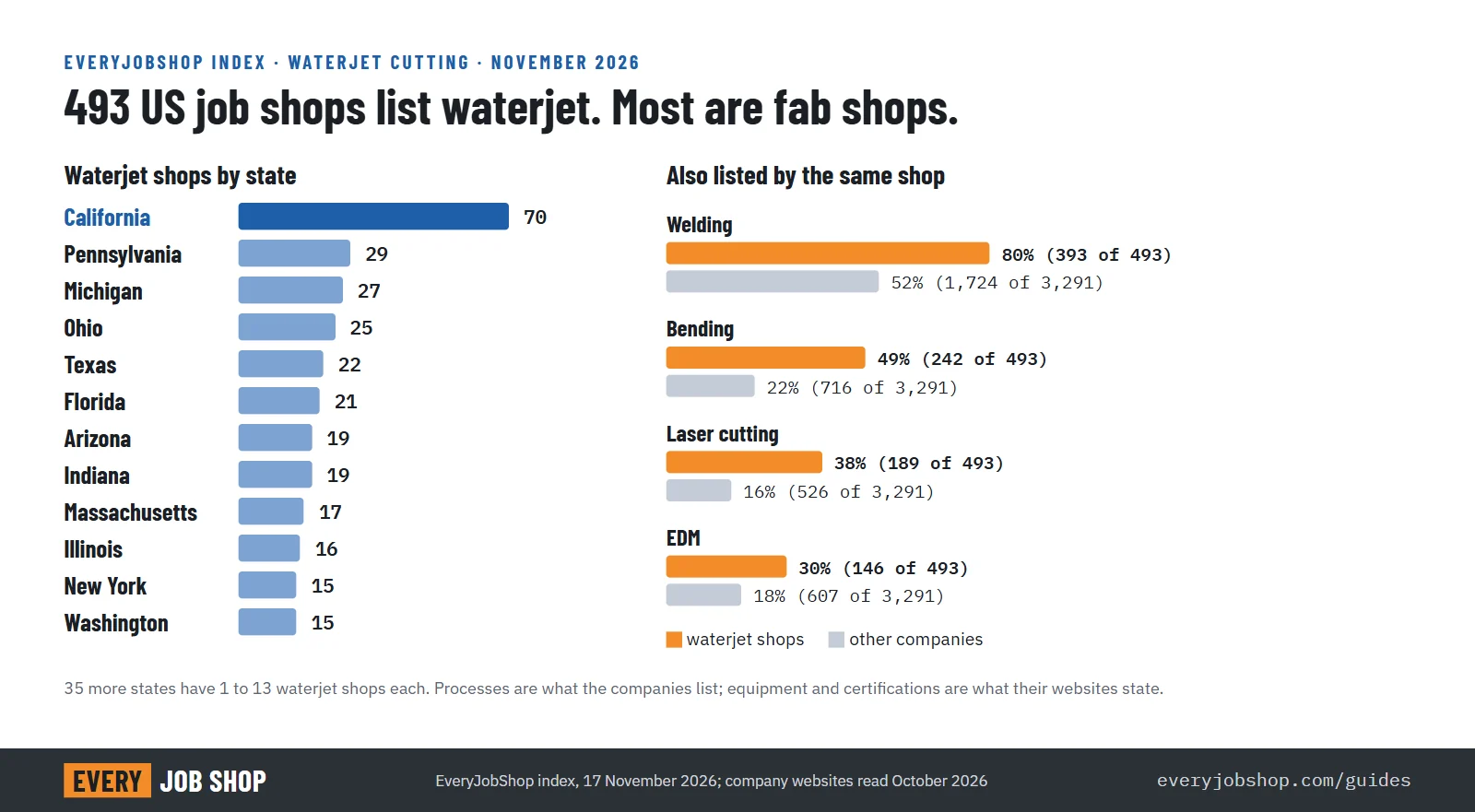
- 493 of 3,784 US job shops (13%) list waterjet cutting, in 47 states. California has 70, then Pennsylvania (29), Michigan (27), Ohio (25) and Texas (22).
- Highest share: in New Mexico 9 of 27 companies list waterjet (33%), in Georgia 12 of 39 (31%), and in Arizona and Virginia one in five.
- They are fab shops. 80% also list welding (52% of the other companies), 49% bending (22%) and 38% laser cutting (16%). 30% list EDM (18%), the other cold, contactless way to cut a profile.
- Machines named: 296 shops mention a waterjet on their website and 52 name OMAX, by far the most named builder. 82 name a press brake and 41 a fiber laser.
- Certifications: 101 state AS9100 (20%, the same share as the other companies), 91 ITAR (18%) and 188 ISO 9001 (38%). Waterjet is not an aerospace niche; it is everywhere.
- Materials stated: steel 51% (against 39% of the others), stainless 48% (40%), aluminum 52% (46%), plastics 39% (32%), titanium 23% (21%).
Processes come from our index; equipment, materials and certifications are what the companies' own websites state, read by our crawler in October 2026. We have not checked them.
How a waterjet cuts
A high-pressure pump (an intensifier) drives water through a jewel orifice a few thousandths of an inch across. For soft materials the water alone cuts. For metal, stone and glass the machine pulls garnet sand into the stream in a mixing tube, and the abrasive does the cutting: it is a very fast, very narrow sandblaster.
Pressures run high. OMAX recommends 60,000 psi (4,137 bar) or less as the most economical and reliable range and warns that more maintenance is required above it, while Flow's HyperJet pump generates up to 94,000 psi and operates at up to 87,000 psi, which Flow sells as faster cutting (vendor pages). Higher pressure cuts faster and wears the pump and nozzle faster; it is the shop's trade-off, not yours, but it is one reason two shops quote the same part differently.
Four things follow from the physics:
- No heat. Waterjet is a cold process. OMAX says it creates no heat-affected zone (vendor page), so a hardened or heat-treated part keeps its properties right to the edge, and there is no hardened skin to make the next machining step harder.
- No cutting force to speak of. The part sits on slats and is only lightly held, so thin and delicate parts do not distort.
- Almost any material. Metal, plastic, rubber, foam, composite, stone, glass and ceramic. The exceptions OMAX lists are tempered glass, which may shatter, and food, because of the abrasive.
- The jet lags and spreads. The stream loses energy as it goes down through the part, so the cut is a little wider at one side than the other (taper), and on fast cuts the bottom of the cut lags behind the top. The builders correct taper by tilting the cutting head (OMAX's version is called TiltaJET); slowing down also helps. Both cost time.
When waterjet beats laser, plasma and EDM
| You need | Best first choice | Why |
|---|---|---|
| Thin steel, stainless or aluminum sheet, many parts | Fiber laser | Much faster than a waterjet on thin sheet; see our laser cutting guide |
| Thick plate, rough profile, low cost | Plasma | Cheapest machine and fast on thick steel; heat-affected edge and dross |
| Thick plate, accurate profile, no heat | Waterjet | Cuts thick metal cold, with no hardened edge |
| Hardened steel, titanium, Inconel, tool steel | Waterjet or wire EDM | Both cut cold; waterjet is faster, wire EDM is more accurate |
| Plastics, rubber, gaskets, foam, composites | Waterjet | No melting, no burnt edge, no fumes |
| Stone, glass, tile, ceramic | Waterjet | Nothing else in a job shop cuts them in shapes |
| Tight profile tolerance, sharp inside corners, punches and dies | Wire EDM | Accuracy in microns; see our wire EDM guide |
Flow's own comparison (a waterjet builder, so not neutral) puts laser at typically up to about an inch thick, EDM at up to 12 inches but for conductive materials only and the slowest of the four, and plasma as the least expensive but the least accurate.
A common route for accurate parts in thick or hard material: waterjet the blank close to size, then finish the critical features on a mill or by wire EDM. 30% of the waterjet shops in our index also list EDM, and 74% list CNC milling, so many can do both in one place.
Accuracy, kerf and thickness: the vendor figures
All of these are vendor figures, the best the machine does under the builder's conditions:
| Builder and machine line | Stated accuracy | Source |
|---|---|---|
| OMAX and OptiMAX | plus or minus 0.001 inch part tolerance | OMAX tolerances |
| OMAX GlobalMAX and MAXIEM | plus or minus 0.003 inch | OMAX tolerances |
| OMAX ProtoMAX (small machine) | plus or minus 0.005 inch | OMAX tolerances |
| OMAX MicroMAX | plus or minus 0.0001 inch, "ultra precision" | OMAX tolerances |
| OMAX lines, table repeatability | plus or minus 0.001 inch | OMAX FAQ |
What else the builders say:
- Kerf. OMAX gives a kerf of about 0.020 inch (0.5 mm) for its Mini-Jet nozzle and 0.015 inch (0.38 mm) for its finest MAXJET5 nozzle, and its standard nozzle cuts about 0.010 inch wider than the Mini-Jet. The kerf decides the smallest inside radius (half the kerf) and the narrowest slot. The kerf grows as the mixing tube wears, so a shop that holds tight tolerances measures it and updates the offset.
- Thickness. OMAX says up to 12 inches of most materials, with most abrasive cutting at 3 inches or less; Flow says most of its precision cuts are 4 inches or less. A thick cut is possible; a thick accurate cut is slow.
- Thickness costs accuracy. OMAX's own tolerance page says thicker material makes tolerances harder to hold. The University of California, Berkeley mechanical engineering department's OMAX protocol gives plus or minus 0.005 inch on half-inch 6061-T6 aluminum as an example of what to expect, and says thicker cuts hold less and take longer.
The brochure number is for the machine. What a shop will promise on your drawing depends on its machine line, its nozzle, the material and the thickness. Put the tolerance you need on the drawing and ask what it holds; our tolerance guide explains why a tighter number costs more on every process.
What drives the cost of waterjet cutting
A waterjet quote is mostly machine time at the shop's hourly rate, plus material. Machine time follows a few things you can see on your drawing:
- Cut length. The total length of every profile and hole on the part.
- Material and thickness. The jet cuts aluminum several times faster than steel, and speed drops steeply as thickness grows.
- Edge quality. Shops set a quality level per cut: a fast cut leaves a rougher, striated lower edge and more taper; a fine cut runs at a fraction of the speed. Ask for the fine edge only where it matters.
- Pierces. Every internal feature starts with a pierce, and piercing thick or brittle material is slow (some materials need a pre-drilled hole).
- Setup and nesting. Loading the sheet, setting zero, and how many parts fit on one sheet. Several parts nested on one plate share the setup.
Running costs matter less than you might think. OMAX puts the operating cost of a waterjet at roughly $25 to $35 an hour before labor (vendor figure, depending on pump, abrasive and water). The shop's rate also covers the operator, the machine itself, floor space and profit; our hourly rate guide shows how one is built.
Worked example
Assumptions, made up for illustration and not a quote: a plate part with 40 inches of total cut length and 5 pierces at 0.2 minutes each; 20 minutes of setup shared by a batch of 10 parts (2 minutes a part); a shop rate of $120 an hour ($2 a minute); cutting speeds of 25 inches a minute for 1/4 inch aluminum, 12 for 1/2 inch aluminum, 6 for 1/2 inch steel, 3 for 1/2 inch steel at a fine edge and 2.5 for 1 inch steel. Real speeds depend on the machine, pump, abrasive and edge quality. Material is left out.
| Case | Cutting time | Pierces and setup | Time per part | Price per part at $120/h |
|---|---|---|---|---|
| 1/4 inch aluminum | 1.6 min | 3 min | 4.6 min | $9.20 |
| 1/2 inch aluminum | 3.3 min | 3 min | 6.3 min | $12.67 |
| 1/2 inch steel | 6.7 min | 3 min | 9.7 min | $19.33 |
| 1/2 inch steel, fine edge | 13.3 min | 3 min | 16.3 min | $32.67 |
| 1 inch steel | 16 min | 3 min | 19 min | $38.00 |
Two things to take from the table. Material and thickness change the price more than anything else on the drawing: the same shape costs four times as much in 1 inch steel as in 1/4 inch aluminum. And asking for a fine edge on the whole profile adds 70% to the 1/2 inch steel part; ask for it only on the edges that need it.
What to send for a waterjet quote
- A DXF or DWG of the flat profile, at 1:1 scale, with closed contours and no duplicate lines, plus a PDF drawing with tolerances. A 3D model if the part is machined afterwards.
- Material, grade and thickness, and whether you supply the material.
- Quantity, per order and per year.
- Edge requirements: which edges need a fine finish or a tight tolerance, and whether taper matters (it does on thick parts that mate with something).
- Secondary operations: deburring, tapping, machining of critical features, bending, finishing.
- Anything about the material that matters: heat treated, coated, laminated, or a material the shop may not have cut before.
Our RFQ guide covers the rest of a complete request.
Where the waterjet shops are
| State | Waterjet shops | Share of the state's shops | Also laser cut | Also bend | State AS9100 |
|---|---|---|---|---|---|
| California | 70 | 12% | 34 | 38 | 25 |
| Pennsylvania | 29 | 14% | 7 | 7 | 6 |
| Michigan | 27 | 13% | 12 | 13 | 1 |
| Ohio | 25 | 12% | 9 | 15 | 1 |
| Texas | 22 | 9% | 11 | 9 | 5 |
| Florida | 21 | 14% | 3 | 10 | 7 |
| Arizona | 19 | 20% | 7 | 9 | 5 |
| Indiana | 19 | 14% | 9 | 9 | 0 |
| Massachusetts | 17 | 14% | 11 | 7 | 1 |
| Illinois | 16 | 11% | 5 | 5 | 0 |
| New York | 15 | 12% | 3 | 8 | 3 |
| Washington | 15 | 13% | 2 | 7 | 5 |
Five more states have 10 or more waterjet shops, each with its own page: Wisconsin (13), Oregon, Georgia and Virginia (12 each) and Colorado (10).
By city, the most waterjet shops are in Albuquerque, New Mexico (8) and Dayton, Ohio (7), then Phoenix, Tucson and Chandler in Arizona, Anaheim, Colorado Springs and Houston (5 each).
Three shops that list waterjet have confirmed their listing with us ("Verified with the shop"): Five Star Welding & Fabrication in Dalton, Georgia, which also laser cuts, bends and welds; RapidMade in Tualatin, Oregon, which pairs it with CNC milling and 3D printing; and Prototek Digital Manufacturing in Menomonie, Wisconsin. Verified means the shop confirmed its details, not that we audited its work.
How to vet a waterjet shop
- Ask which machine and which pump. Builder, table size, pressure, and whether it has a tilting head for taper correction. A big table matters for full plates; a tilting head matters for thick parts that must be square.
- Ask what it holds on your material and thickness, not the brochure number, and at which edge quality.
- Ask about materials it has cut before, especially for composites, laminates, glass and stone, which can delaminate or chip on the pierce.
- Ask what happens after the cut. Deburring, machining critical features, bending, welding, finishing. A shop that does the next step avoids a second quote and a second freight leg; half of the waterjet shops in our index also bend.
- Ask how it measures. 22% of the waterjet shops in our index name a CMM on their website.
- For aerospace or defense work, check the AS9100 certificate in OASIS and ITAR registration; our AS9100 and ITAR guide explains both. The vetting guide has the full question list.
Find waterjet cutting shops
Browse all 493 waterjet shops on a map, or narrow the list: waterjet shops with AS9100, with ITAR, and compare with the laser cutting shops for thin sheet. With a drawing ready, send one RFQ to up to 30 shops and say the material, thickness and which edges matter.
Questions people ask
- What can a waterjet cut?
- An abrasive waterjet cuts almost any material that is not tempered glass: steel, stainless, aluminum, titanium, copper, brass, tool steel, plastics, composites, rubber, foam, stone, ceramic and plain glass. OMAX, one of the builders, lists aluminum, brass, carbon fiber, ceramic, copper, fiberglass, glass, granite, Kevlar, marble, stainless steel, titanium and tungsten, and warns against tempered glass, which may shatter. Soft materials like rubber and foam are often cut with pure water, without abrasive.
- How thick can a waterjet cut?
- OMAX says its machines cut up to 12 inches of most materials and that most abrasive cutting is done at 3 inches or less. Flow says most precision cuts on its machines are 4 inches or less, with rough cuts well beyond that. These are vendor figures. In practice the cutting speed drops steeply with thickness, so a thick part is possible but slow and expensive.
- How accurate is waterjet cutting?
- OMAX publishes part tolerances of plus or minus 0.001 to 0.005 inch depending on the machine line, setup, material and thickness: plus or minus 0.001 inch on its OMAX and OptiMAX lines, 0.003 inch on MAXIEM and GlobalMAX, 0.005 inch on the ProtoMAX. These are the builder's figures for the machine. A job shop quotes what it holds on your part and thickness, which is usually looser, and the jet leaves a slight taper on thick parts unless the machine tilts the head to correct it.
- Is waterjet better than laser cutting?
- Not in general. A fiber laser is much faster on thin steel, stainless and aluminum sheet, which is why most sheet metal parts are laser cut. Waterjet wins when the material is thick, heat sensitive, reflective or not a metal, when a heat-affected zone or hardened edge is not allowed, and when one machine has to cut many different materials. Many fab shops run both.
- How many waterjet cutting shops are there in the US?
- In the EveryJobShop index, 493 of the 3,784 US job shops (13%) list waterjet cutting as of November 2026, in 47 states. California has 70, then Pennsylvania (29), Michigan (27), Ohio (25) and Texas (22). Half of them also bend sheet metal and 38% also laser cut.