China has thousands of mold makers, and a buyer with a plastic part can get several mold quotes within days. The difficulty is not finding a mold maker; it is comparing quotes for tools that are not the same, getting the first good parts on time, and keeping control of a mold that sits in someone else's factory on the other side of the world.
This guide shows where Chinese mold makers and molders are, how to specify the tool so the quotes compare, what happens between the first DFM report and approved samples, what the US charges at the border as of November 2026, and the contract terms that keep the mold yours.
Who makes molds in China: our index in numbers
EveryJobShop lists 1,817 companies in China as of November 2026, read from their own websites. Of these, 1,121 name mold and tool making and 681 name injection molding; 635 do both, so one company designs the mold, builds it and runs your parts. Many of them do more: 764 of the 1,167 that make molds or molded parts also list CNC machining, 447 EDM, 240 die casting and 254 assembly.
The quality systems they state:
| Certificate (stated on their website) | Companies, of 1,167 mold makers and molders |
|---|---|
| ISO 9001 | 421 |
| IATF 16949 (or the older TS 16949) | 186 |
| ISO 14001 | 97 |
| ISO 13485 (medical devices) | 55 |
| None stated | 708 |
A missing certificate on a website does not mean a shop has none, and a logo on a website does not mean the certificate is valid for the site that will build your mold. Check it: ISO certificates in IAF CertSearch, IATF 16949 with the IATF validity check. Our certification guide explains what each one proves.
Where they cluster
Two provinces hold most of the industry. Of the 1,167 mold makers and molders in our index, 529 are in Guangdong and 347 in Zhejiang.
| City | Mold makers and molders in our index (Nov 2026) | Known for |
|---|---|---|
| Dongguan, Guangdong | 260 | Molds and molded parts for electronics, appliances and automotive; Chang'an and Hengli are the two centers of the city's mold industry |
| Taizhou, Zhejiang | 225 | Large molds for automotive parts, housewares, crates and PET preforms, centered on Huangyan |
| Shenzhen, Guangdong | 188 | Precision and medical molding, two-shot and overmolding, fast tooling for hardware startups |
| Ningbo, Zhejiang | 71 | Plastic and die casting molds; with Yuyao (11) and Cixi (10) next door |
Huangyan, a district of Taizhou, calls itself a national hub for molds and plastics. China Daily reported 226 mold companies above designated size in the district in November 2021, and 137 companies in its Smart Mold Town park alone, with ¥6.8 billion of output in 2021. Examples from our index: Anomould, which builds two and three color molds for headlamps and taillamps, and DEBODI Mould, which makes PET preform molds with 2 to 96 cavities.
Ningbo was named China's Mold Capital in 2005, and the city government's own profile lists its specialties by district: large plastic molds in Ninghai, die casting molds in Beilun, precision plastic molds in Yuyao and appliance molds in Cixi. In Beilun, APEX builds preform, cap and thin wall molds with up to 96 cavities.
In Shenzhen and Dongguan, many shops serve electronics and medical customers. HanKing Mould Engineering in Shenzhen states ISO 13485 and IATF 16949 and runs molding, painting, pad printing and ultrasonic welding after the mold; ABIS Mold states that about 60% of its 400 molds a year go to Europe and North America. In Dongguan, A-TorchMould builds molds and runs production for automotive, appliance and medical customers.
How to specify the mold so quotes compare
Two quotes for "a mold for this part" can differ by a factor of three and both be fair, because they are for different tools. Put these in the RFQ:
- The SPI class, which sets how long the mold must last. The classes, as Fictiv summarizes the SPI standard:
| SPI class | Built for | Typical use |
|---|---|---|
| 101 | Over 1 million cycles | High volume, tight tolerances; cavities and cores at least 48 HRC |
| 102 | Medium to high volume, up to about 1 million | Abrasive or glass-filled resins, tight tolerances |
| 103 | Fewer than 500,000 cycles | Medium volume; the usual choice for a first production run |
| 104 | Fewer than 100,000 cycles | Low volume, non-abrasive resins |
| 105 | Fewer than 500 cycles | Prototype molds only |
- The steel for cavities and cores. Chinese quotes name steels by grade: P20 (pre-hardened, roughly 50,000 to 100,000 shots), 718H (a little harder than P20), H13 (hardened, 500,000 to 1 million shots) and S136 (stainless, 1 million shots or more). Ask which steel the mold base uses as well, not only the cavities and cores.
- Cavities and runner. A one-cavity mold costs less but makes parts slower; a four-cavity mold with a hot runner costs more and wastes less resin. Ask for a price per part at your volume for each option.
- The resin by grade, not just "ABS": the maker and grade, color and any UL flame rating. Shrinkage differs between grades, and the mold is cut for one.
- Surface finish by SPI or VDI code for each surface, texture by supplier and number.
- Volume and timing: parts per year and the date you need approved samples, not just "ASAP".
Our design for manufacturing guide lists the part features that drive mold cost: undercuts that need slides, missing draft, thick walls that sink.
From DFM to approved samples
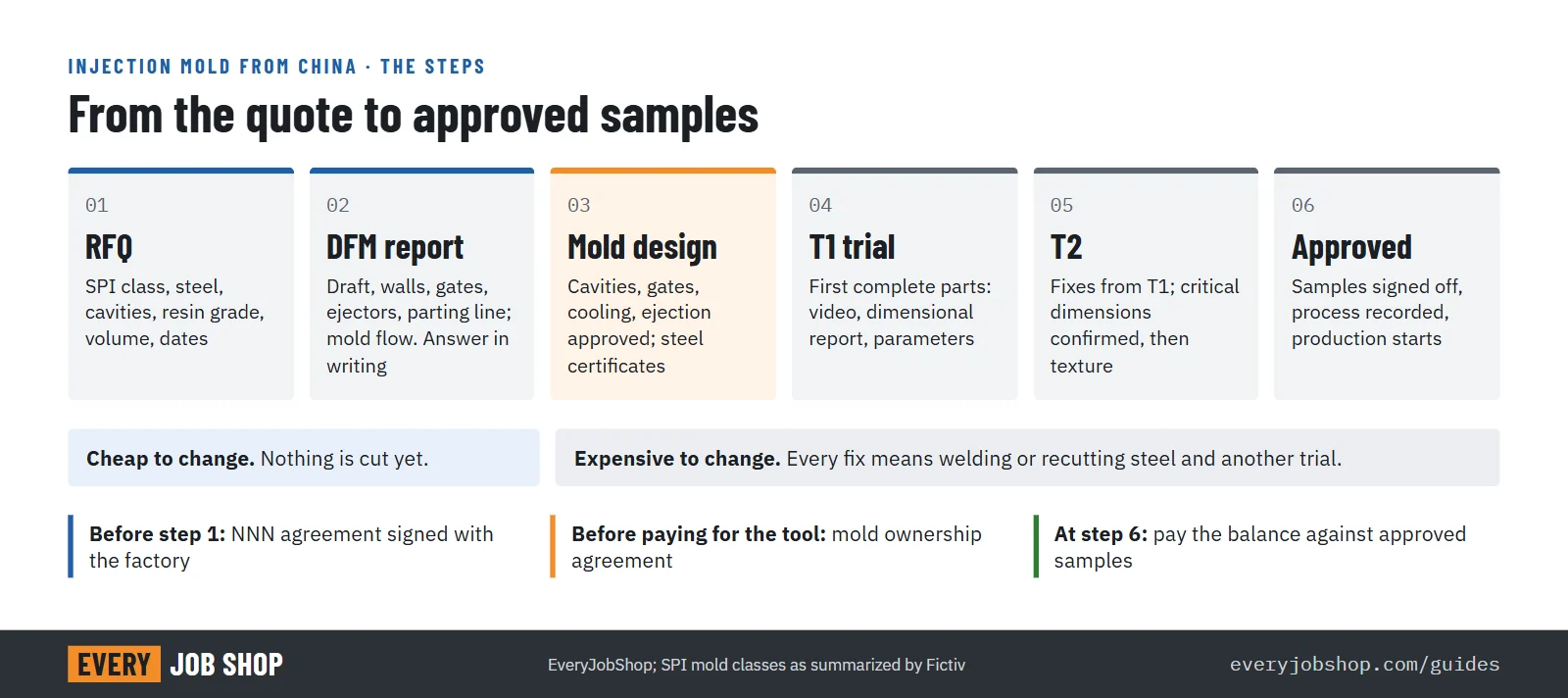
- DFM report. Before cutting steel, the mold maker sends a design for manufacturing review: draft, wall thickness, gate and ejector pin locations, parting line, slides and lifters. Often with a mold flow simulation that shows weld lines, air traps and sink. Answer it in writing; every change after steel is cut costs time and money.
- Mold design (3D). You approve the mold design: number of cavities, gates, cooling, ejection. Ask for the steel certificates at this stage.
- T0 or T1 trial. The first shots. T1 samples are the first complete parts from the mold, and they are expected to show defects. Ask for a video of the trial, a dimensional report on the critical features and the molding parameters.
- Corrections and T2. The mold maker fixes what T1 showed; at T2 the critical dimensions are confirmed. Texture and polishing usually come after the dimensions are right.
- Approval and first production. You approve samples, the shop records the process, and the mold is ready.
Ask for the dates of DFM, design approval, T1 and T2 in the quote, and tie part of the payment to approved samples rather than paying the whole tool up front.
Who owns the mold, and how to get it out
A mold sits in the factory that built it. If you change molder, run into a quality dispute, or want to move production to Mexico or the US, you need the mold and its design files back. The tooling invoice alone does not settle that. The China Law Blog's guide to mold ownership recommends a separate written agreement, signed before you pay, that says:
- The factory holds the mold as custodian, not as owner, and storing, maintaining or using it creates no rights.
- Each mold carries a permanent plate marking it as your property, and a schedule lists each tool with photos and number.
- The mold does not move to another plant or subcontractor without your written approval.
- Release on notice: the physical mold plus native CAD files and drawings within a set number of days, with no release fees.
- No copies, no extra production, no sales to others from your mold.
Shipping a mold out is ordinary freight, but it needs export documents from the factory, so agree in the same contract who packs it, who books the freight and under which Incoterms rule.
Protect the design before you send it
An NDA written for US courts does little in China. The usual advice is a China-specific NNN agreement: non-disclosure, non-use (the factory may not use your design for anything but your order) and non-circumvention (it may not sell to your customers or around you). It is drafted under Chinese law, in Chinese, enforceable in a Chinese court. Sign it with the factory before the CAD files go out.
Before you sign anything, check that the company exists and is the one you are paying. Every Chinese company has an 18-character Unified Social Credit Code on its business license; search it in the national enterprise credit system (gsxt.gov.cn, in Chinese) and compare the name, address and business scope. The bank account for the deposit should be in the same company name.
US duty on molds and molded parts from China, November 2026
China pays more duty than most countries, and the tool and the parts are taxed separately. The parts of the stack, as our reshoring guide explains in detail:
- The older China Section 301 duties: 25% on Lists 1 to 3 and 7.5% on List 4A, depending on the code.
- The Section 301 forced-labor duty: since July 24, 2026, 12.5% on most goods from China, except articles that pay the Section 232 metal tariff.
- No more IEEPA tariffs: the Supreme Court held on February 20, 2026 that IEEPA does not authorize tariffs.
- No more de minimis: duty-free entry of small parcels ended for China on May 2, 2025, so even a box of T1 samples by courier pays duty.
What that means for a $20,000 mold and a molded part with a customs value of $1.20 (our example; we assume each code below is the right one and that the mold does not pay Section 232, and leave out the small merchandise processing fee):
| Item and HTS code | Normal duty | Section 301 | Forced-labor duty | Total |
|---|---|---|---|---|
| Steel injection mold, 8480.71.8045 | 3.1%: $620 | 25% (List 1): $5,000 | 12.5%: $2,500 | $8,120 (40.6%) |
| Molded plastic part, 3926.90.99 | 5.3%: $0.064 | 7.5% (List 4A): $0.090 | 12.5%: $0.150 | $0.30 (25.3%) |
The mold rates come from CBP ruling N348968 of June 3, 2025, which classified steel injection molds from China under 8480.71.8045 with a 3.1% normal duty and the 25% Section 301 duty. If the mold stays in China and only parts are imported, the mold itself is not imported and pays no US duty; if you bring it to a US molder later, it is entered then. Ask a customs broker to confirm both codes before you choose where the mold is built.
Compare that with Mexico: goods that qualify under the USMCA rules of origin enter duty free, and our Mexico guide shows the molders there.
Plan around Chinese New Year
Chinese New Year falls on February 6, 2027. Many factories reduce capacity several weeks before and run short-staffed into March. A mold ordered in early December will often have its T1 trial only after the holiday. Order early enough to see T1 samples by mid-January, or plan your launch on samples in March.
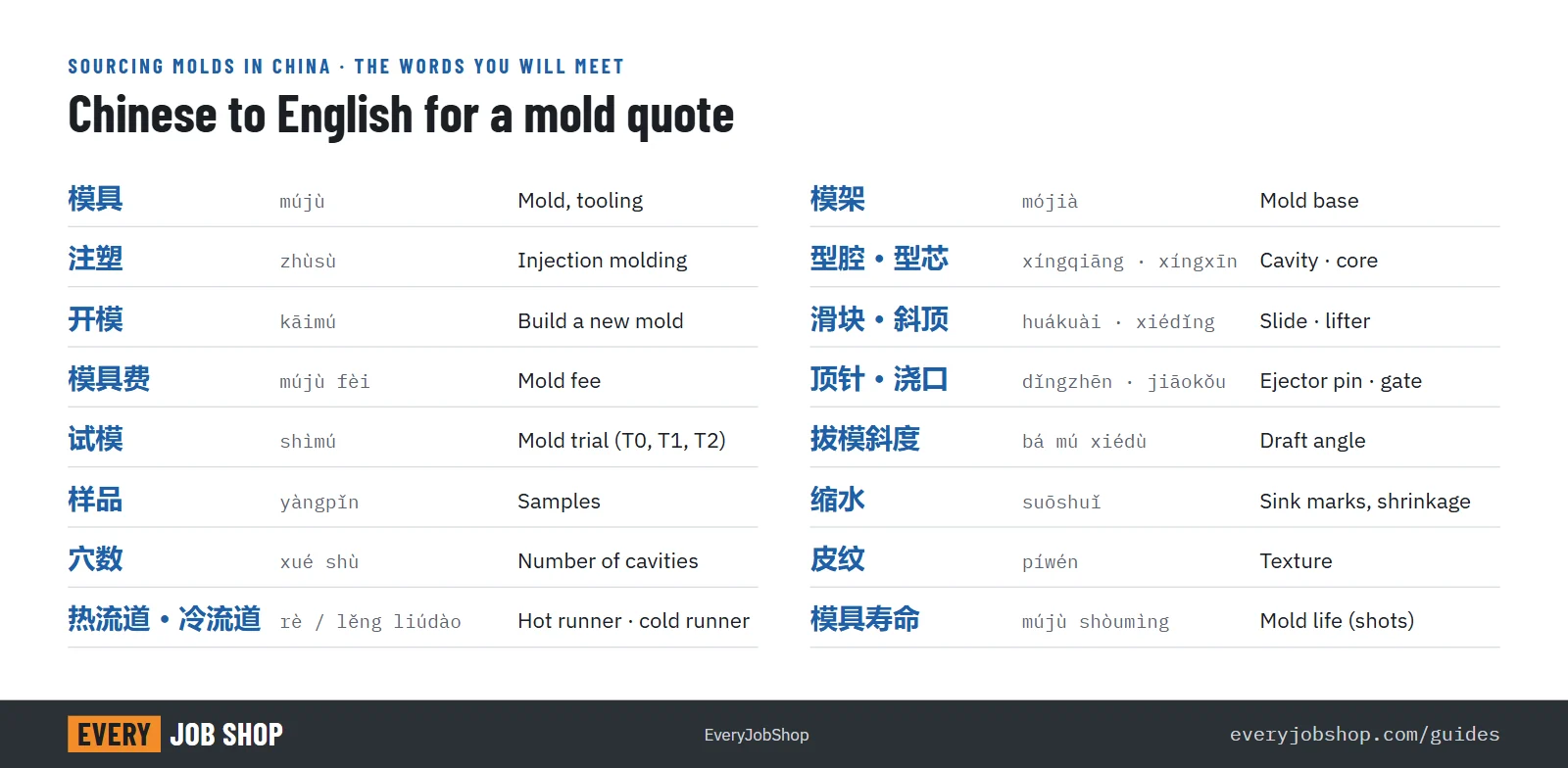
The Chinese words on a mold quote
Red flags
- A mold price far below the others, with no steel named, no SPI class and no cavity count. It is a different tool.
- No DFM report, or a factory that starts cutting steel the day the deposit arrives.
- A trading company presenting itself as the factory. Legitimate, but you should know who builds the mold and where it sits; ask for the address and a video call from the shop floor.
- A bank account in another company's name, or in a person's name.
- No written mold ownership terms, or a "mold fee" that covers only part of the tool cost so the factory can claim the rest.
- T1 samples without a dimensional report.
Next step
Browse the mold makers and injection molders in China in our index, each with the processes, certifications and description read from its own website. Send three to five of them the same RFQ, with the SPI class, steel, cavities, resin grade and volume, and compare like for like. Our RFQ checklist lists what else to include. If you also want quotes closer to home, the US list and Mexico are one click away.
Questions people ask
- What US duty applies to an injection mold made in China in November 2026?
- A steel injection mold for plastics is classified under HTS 8480.71.80; CBP ruling N348968 (June 2025) put the normal duty for 8480.71.8045 at 3.1% and confirmed the 25% Section 301 duty under heading 9903.88.01. Since July 24, 2026 most Chinese goods also pay a 12.5% Section 301 forced-labor duty, unless the article pays the Section 232 metal tariff. On a mold that pays all three, that is about 40.6% of the customs value. Check your exact code with a customs broker before you pay for the tool.
- What duty applies to plastic molded parts from China?
- It depends on the code. For other articles of plastics, HTS 3926.90.99, the stack in November 2026 is the 5.3% normal duty, the 7.5% Section 301 duty under List 4A (heading 9903.88.15) and the 12.5% forced-labor duty (heading 9903.05.31): 25.3% of the customs value in total. Small courier shipments no longer enter duty free, because de minimis ended for China on May 2, 2025.
- What SPI mold class should I ask for?
- It depends on how many parts the mold must make. Class 101 is built for over 1 million cycles, Class 102 for medium to high volume up to about 1 million, Class 103 for fewer than 500,000, Class 104 for fewer than 100,000 and Class 105 is a prototype mold for fewer than 500 shots. State the class and the steel in the RFQ, or the quotes you compare will be for different tools.
- Who owns a mold made in China?
- Whoever the contract says, as long as you can get it back. Paying the tooling invoice does not by itself prove ownership. Sign a separate mold ownership agreement before you pay: the factory holds the mold as custodian, the mold carries a plate marking it as your property, it does not move without your written approval, and the factory must release it, with the design files, within a set number of days of your notice and without release fees.
- When do Chinese mold makers close for Chinese New Year 2027?
- Chinese New Year falls on February 6, 2027. Many factories reduce capacity several weeks before and run short-staffed into March, so a mold ordered in December may not have its first trial until March. Plan T1 samples either before mid-January or after the holiday.