Germany has the reputation every buyer of precision parts knows: tight tolerances, good documentation, machines built a few hours away. It also has some of the highest labour costs in Europe and, since 2025, a US tariff on many metal parts.
So when is a German job shop the right source?
For complex, tight-tolerance, low to medium volume parts, tooling and molds, and work that needs automotive or aerospace quality systems, Germany is often worth a quote. For simple steel or aluminum parts in volume, the labour cost and the 50% metal tariff usually make it the expensive option. This guide shows where German shops are, what they hold, what they cost, what the US charges at the border as of November 2026, and how to ask for a quote they will answer.
What German job shops are strong at
Many German job shops grew up supplying the machinery and automotive industries. Machinery is the largest industrial employer in Baden-Württemberg alone, with about 305,000 people in 2025, according to the state statistics office. That shapes what the shops do well:
- Precision machining and turning of steel, stainless and aluminum, often with grinding, EDM and heat treatment in house.
- Tool and mold making (Werkzeugbau, Formenbau) together with injection molding, so one supplier designs, builds and runs the mold.
- Assembly of machined and molded parts into ready modules.
- Documentation: shops that supply automotive customers are used to delivering material certificates, inspection reports and first article reports.
Our own index reflects this. Of the 126 German companies EveryJobShop lists as of November 2026, 79 name CNC machining, 68 assembly, 52 mold and tool making, 47 CNC turning, 44 prototyping, 36 injection molding, 29 welding and 27 grinding.
Where they cluster
All of the German companies in our index so far are in three states:
| State | Companies in our index (Nov 2026) | Known for |
|---|---|---|
| North Rhine-Westphalia | 46 | Turned parts, forming, plastics and molds in the Sauerland and Bergisches Land |
| Baden-Württemberg | 44 | Machinery and automotive supply, precision turning in the Black Forest and Swabian Jura |
| Bavaria | 36 | Automotive and aerospace supply, injection molding and mold making |
The densest pocket in our data is the Märkisches Sauerland and its neighbours: 6 companies in Radevormwald and 5 in Lüdenscheid. The SIHK Hagen counts 596 industrial firms with more than 20 employees in the Märkischer Kreis, and 46.8% of employees there work in production industries, against 26.4% in Germany as a whole (June 2025). Lüdenscheid is also home to the Kunststoff-Institut, a plastics cluster founded by regional companies in 1988 with over 400 members. Examples from our index: the mold maker and molder Mesenhöller Kunststofftechnik in Lüdenscheid and the turning and grinding shop Diesing Walzwerkstechnik in Radevormwald.
In Baden-Württemberg, the Schwarzwald-Baar-Heuberg region is a centre for turned parts: a regional association of turned-parts makers represented about 800 machining companies when the Schwäbische Zeitung reported on it in 2017.
Certifications you will see
| Certificate | What it covers | Where to check it |
|---|---|---|
| ISO 9001 | Quality management, any industry | IAF CertSearch |
| ISO 14001 | Environmental management | IAF CertSearch |
| IATF 16949 | Automotive production quality | IATF validity check |
| TISAX | Information security in the automotive supply chain | Shared by the company through the ENX portal, not public |
| EN 9100 | Aerospace quality; the European name of AS9100 | OASIS database |
In our index, 61 of the 126 German companies state ISO 9001, 20 ISO 14001 and 9 IATF 16949. Four state a TISAX label, which matters if you send CAD data for an unreleased vehicle part: Hujer Lasertechnik holds IATF 16949 and TISAX level 2. Two state EN 9100 or AS9100. Our certification guide explains what each one proves and what it does not.
What a German shop hour costs
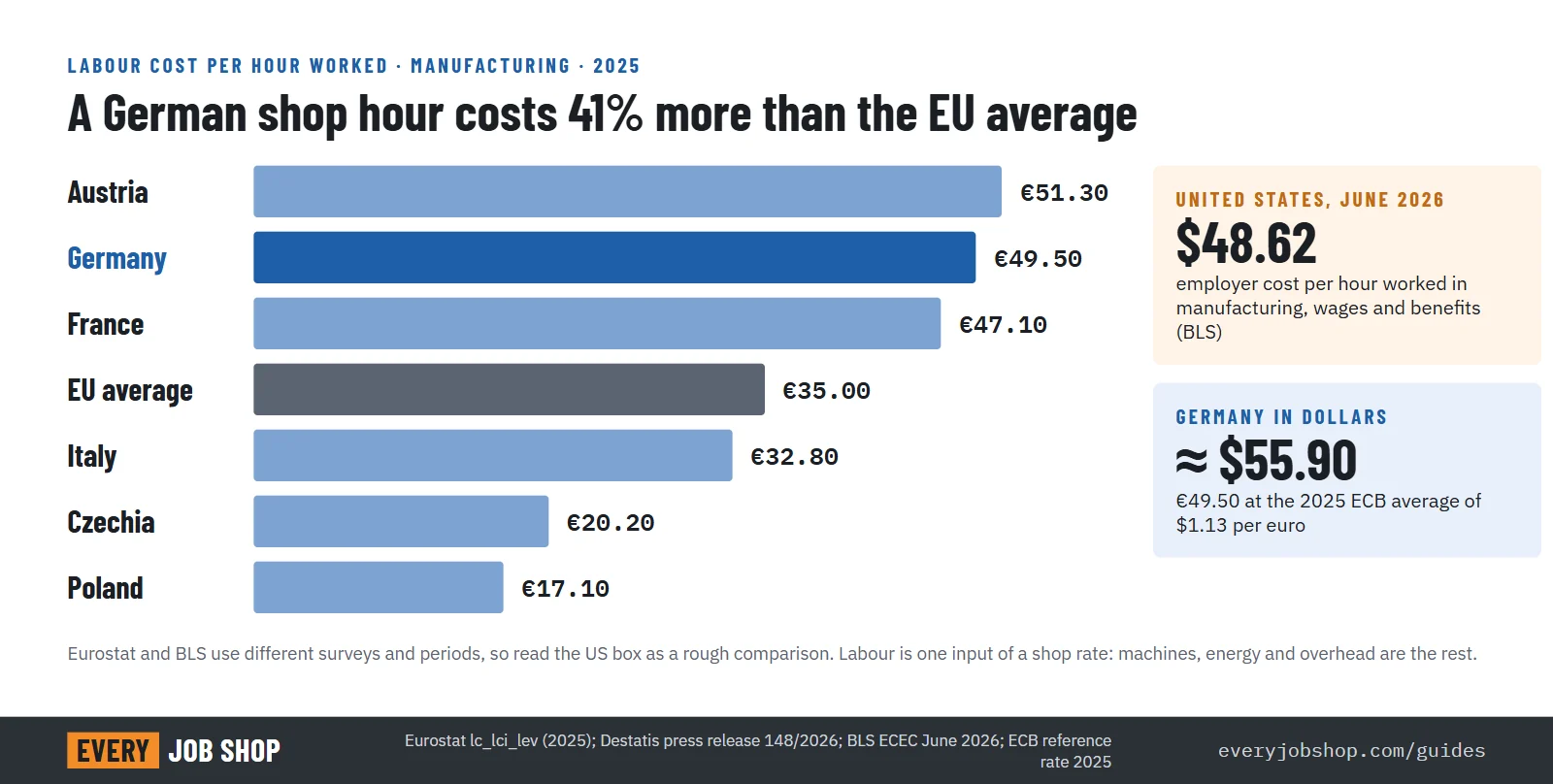
Destatis puts German manufacturing labour at €49.50 per hour worked in 2025, 41% above the EU average. The Eurostat figures for manufacturing show the spread inside Europe:
| Country, manufacturing, 2025 | Labour cost per hour |
|---|---|
| Austria | €51.30 |
| Germany | €49.50 |
| France | €47.10 |
| EU average | €35.00 |
| Italy | €32.80 |
| Czechia | €20.20 |
| Poland | €17.10 |
The closest US figure is the BLS employer cost of $48.62 per hour worked in manufacturing in June 2026. At the 2025 ECB average of $1.13 per euro, Germany's €49.50 is about $55.90. The surveys differ, so treat that as a rough comparison: labour in a German shop costs at least as much as in a US one. What German shops sell is not low cost but capability, so send them the parts where capability is the price driver. If price is the main driver within Europe, look at Italy and Poland, or the whole European list.
US duty on German parts, November 2026
US tariff law changed many times in 2025 and 2026. The path for EU goods: the US and EU announced a framework on July 27, 2025 with a 15% all-inclusive ceiling on most EU goods, while the 50% steel and aluminum tariffs stayed. That ceiling rested on IEEPA tariffs, which ended with the Supreme Court ruling of February 2026. A temporary 10% Section 122 surcharge followed, and since July 24, 2026 EU goods pay a Section 301 duty that brings the normal duty up to 10% in total, with nothing extra where the normal duty is already 10% or more. Goods that pay Section 232 are exempt from it.
For metal parts the Section 232 tariff is the one that matters. Since April 6, 2026 it applies to the full customs value: 50% for goods in chapter 72 and most of chapters 73, 74 and 76, 25% for listed derivative products, and a 15% cap including the normal duty for a short list of equipment until December 31, 2027. There is no EU discount on the 50% rate.
What that means for one part with a customs value of $40.00 (our example; we assume each code below is the right one and leave out the small merchandise processing fee):
| Part and HTS code | Normal duty | Extra duty | Total duty |
|---|---|---|---|
| Machined aluminum housing, 7616.99.51 | 2.5%: $1.00 | Section 232, 50%: $20.00 | $21.00 (52.5%) |
| Machined steel bracket, 7326.90.86 | 2.9%: $1.16 | Section 232, 50%: $20.00 | $21.16 (52.9%) |
| Molded plastic part, 3926.90.99 | 5.3%: $2.12 | Section 301, 4.7%: $1.88 | $4.00 (10%) |
A machined part classified as a machine component in chapter 84 can fall under the 25% derivative list or outside Section 232 entirely, so classification is worth a broker's hour. Small shipments get no relief: duty-free de minimis entry ended for every country on August 29, 2025. A steel part from Germany pays the same 50% as one from China, but not China's older Section 301 duty; our reshoring guide shows the Chinese stack.
How to write an RFQ a German shop answers
The basics are the same as anywhere (our RFQ checklist lists twelve items). What changes for Germany:
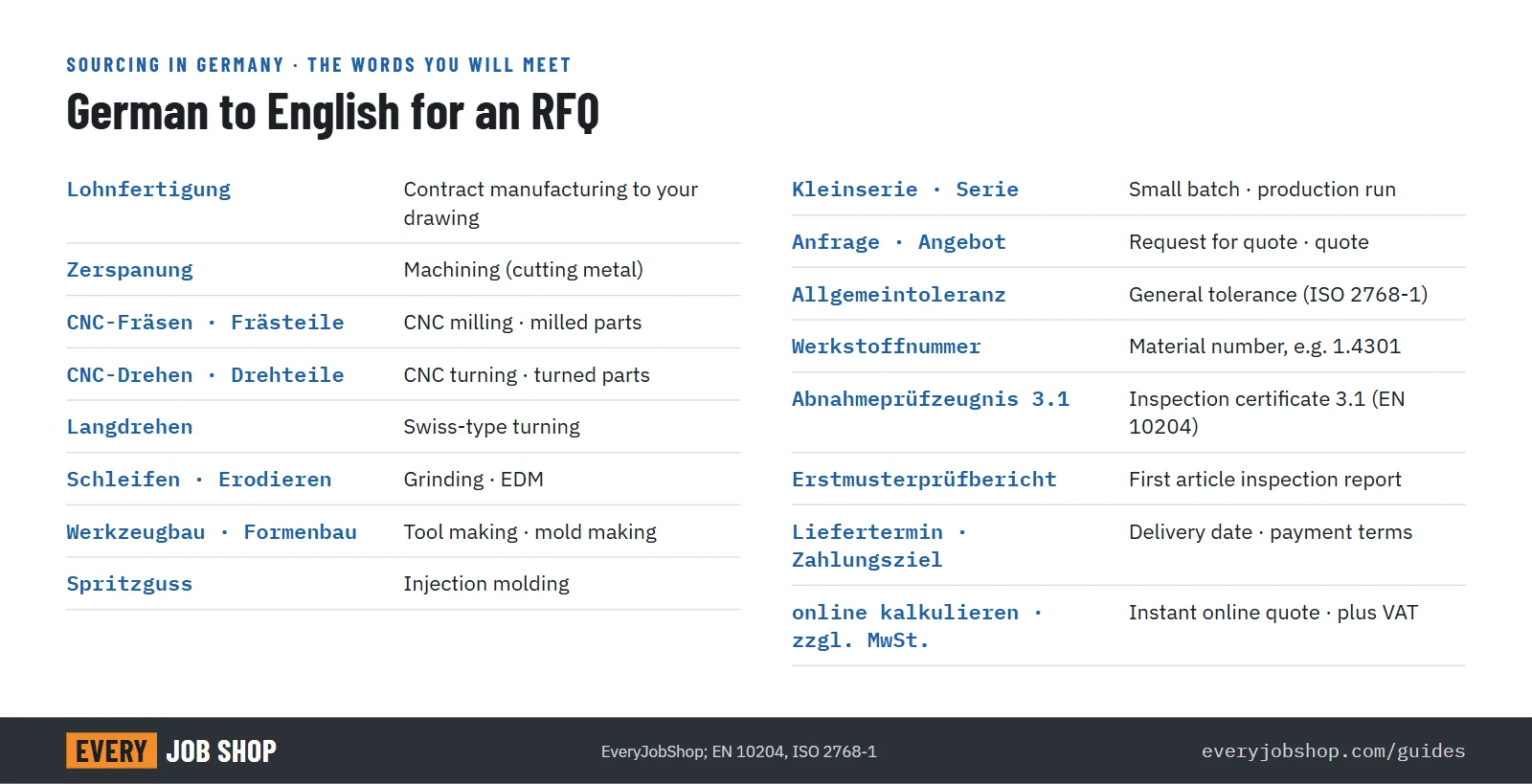
- Write in plain English, and use their words where it helps. Exporting shops answer in English; a subject line such as "Anfrage: CNC-Frästeile, Kleinserie 200 Stück" tells a small shop at once what you want.
- Send metric drawings, or a dimensioned STEP model. German shops measure, stock and program in millimetres. An inch drawing gets converted by someone, and that is where errors come in.
- State the general tolerance. ISO 2768-1 is the usual title block note; part 2 (the K in "mK") was replaced by ISO 22081, so ask which one the shop applies. Our tolerance guide gives the classes.
- Name the material both ways: the US grade and the EN or DIN designation (for 304 stainless, Werkstoffnummer 1.4301), and ask for an inspection certificate 3.1 to EN 10204 if you need traceability.
- Agree the Incoterms rule. The ICC's Incoterms 2020 define who carries which costs and risks. EXW and FCA leave export, freight and US customs to you; with DDP the German seller would have to clear US customs and pay the duty, so ask whether the shop really means it.
- Expect a net price and euros. German quotes state prices net, plus VAT ("zzgl. MwSt."). The 19% VAT does not apply to an export to a buyer outside the EU when the shop can prove the goods left. Agree the currency and payment terms (Zahlungsziel) in the quote.
- Ask for the delivery date and the inspection report together. Lead times depend on the shop's load, so ask for a date, not a number of weeks, and ask about company holidays (Betriebsurlaub) before you plan around it.
Online platforms that "kalkulieren" a price instantly from a CAD file exist in Germany too. They are useful for a first number on simple milled parts; for tight tolerances, molds or assemblies, a direct RFQ to a shop that runs the work gets the better answer.
Red flags
- No Impressum. German law requires business websites to name the company, its address, legal form, register number and VAT ID. Check the entry in the Handelsregister.
- A certificate you cannot find, or one issued for another site of the group.
- A price with no questions, far below the others, on a part with tight tolerances.
- DDP offered casually, with no word on who pays the 50% metal tariff.
- A broker presenting itself as the shop. Legitimate, but you should know who makes the part.
Our guide on how to vet a shop has twelve questions that work in any country.
Find German shops
Browse 126 German machine shops, mold makers and molders by process, starting with CNC machining, CNC turning, mold and tool making or injection molding, and compare them with the rest of Europe. Each company card shows what the shop's own website says it does, with the source and the date it was read.
Questions people ask
- What US tariff applies to machined parts from Germany in November 2026?
- It depends on the part's tariff (HTS) code. Steel and aluminum articles in chapters 72 and most of 73 and 76 pay the Section 232 metal tariff, 50% on the full customs value, plus the normal duty. Listed derivative products pay 25%, and a short list of equipment is capped at 15% including the normal duty until the end of 2027. Most other German goods pay a Section 301 duty that tops the normal duty up to 10% in total, in place since July 24, 2026. Goods that pay Section 232 do not also pay the Section 301 duty. Check the rate for your code with a customs broker.
- How much does an hour of labour cost in German manufacturing?
- €49.50 per hour worked in 2025, according to Eurostat and Destatis, 41% above the EU average of €35.00. Italy was €32.80, Czechia €20.20 and Poland €17.10. For a rough comparison, US manufacturing employers paid $48.62 per hour worked in June 2026 (BLS), and €49.50 was about $55.90 at the 2025 average exchange rate.
- Where are the machine shops in Germany?
- All 126 German companies in our index as of November 2026 are in Baden-Württemberg (44), Bavaria (36) and North Rhine-Westphalia (46). In North Rhine-Westphalia, Radevormwald (6) and Lüdenscheid (5) in and near the Märkisches Sauerland are the densest pocket, with molders, mold makers and turning shops; Lüdenscheid also hosts a plastics institute with over 400 members. In the Märkischer Kreis, 46.8% of employees work in production industries, against 26.4% in Germany as a whole.
- What does Lohnfertigung mean?
- Lohnfertigung is contract manufacturing: a shop makes parts to the customer's drawing and specification. Related words are Zerspanung (machining), Drehteile (turned parts), Frästeile (milled parts), Kleinserie (small batch), Werkzeugbau (tool making) and Spritzguss (injection molding).
- Do German shops quote in English and to inch drawings?
- Shops that export usually answer in English, but their drawings, standards and stock are metric. Send a metric drawing or a dimensioned STEP model, state the general tolerance (for example ISO 2768-1 m), name the material by its EN or DIN designation as well as the US grade, and agree the Incoterms rule and currency in the quote.