Europe is not one market for machined and fabricated parts. A shop hour in Denmark costs more than five times one in Bulgaria, the UK and Switzerland have their own deals with the US, and each country has its own specialties. This guide shows what the job shops in each country do, according to our index, what labour costs there, what the US charges at the border as of November 2026, and how to choose a country for a part.
Our numbers come from the EveryJobShop index: 3,008 European machining and fabrication companies in 26 countries as of November 12, 2026, each read from the company's own website. Germany is the deepest list so far; the other countries are added in batches, so a short list means fewer companies checked, not fewer shops in the country.
The country table
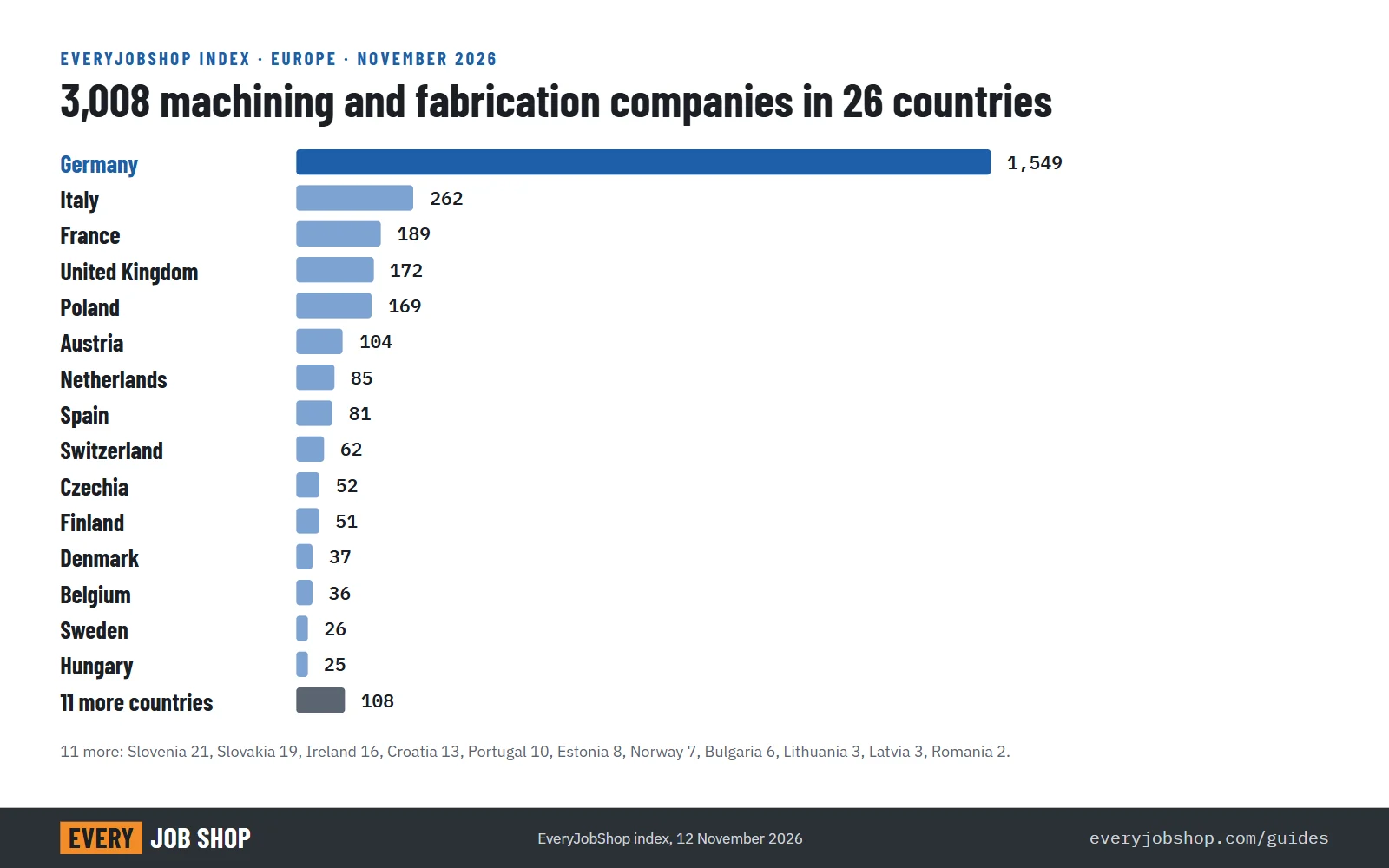
| Country | Companies in our index | Most common processes | Most common certificates |
|---|---|---|---|
| Germany | 1,549 | CNC machining 881, assembly 721, CNC turning 673 | ISO 9001 584, ISO 14001 125, IATF 16949 69 |
| Italy | 262 | CNC machining 131, CNC turning 107, assembly 83 | ISO 9001 90, ISO 14001 16, ISO 45001 13 |
| France | 189 | CNC machining 97, welding 95, sheet metal 83 | ISO 9001 53, EN 9100 or AS9100 10, ISO 14001 8 |
| United Kingdom | 172 | CNC machining 97, welding 84, CNC turning 73 | ISO 9001 67, AS9100 or EN 9100 13, ISO 14001 9 |
| Poland | 169 | CNC machining 101, welding 99, CNC turning 76 | ISO 9001 57, ISO 14001 19, IATF 16949 6 |
| Austria | 104 | Welding 54, CNC machining 52, assembly 45 | ISO 9001 28, ISO 14001 7 |
| Netherlands | 85 | Welding 53, CNC machining 44, sheet metal 39 | ISO 9001 16, EN 1090 5 |
| Spain | 81 | Welding 46, CNC machining 44, sheet metal 25 | ISO 9001 21, ISO 14001 6 |
| Switzerland | 62 | CNC machining 32, assembly 25, prototyping 22 | ISO 9001 17, ISO 14001 4 |
| Czechia | 52 | CNC machining 31, welding 26, CNC turning 22 | ISO 9001 20, ISO 14001 5 |
| Finland | 51 | CNC machining 33, welding 33, assembly 26 | ISO 9001 11, ISO 14001 4 |
| Denmark | 37 | Assembly 19, CNC machining 18, welding 18 | ISO 9001 16, ISO 14001 11 |
| Belgium | 36 | Welding 25, sheet metal 20, metal bending 18 | ISO 9001 5, EN 1090 5 |
| Sweden | 26 | Welding 16, CNC machining 15, metal bending 11 | ISO 9001 5, ISO 14001 3 |
| Hungary | 25 | CNC machining 15, welding 12, sheet metal 10 | ISO 9001 12, ISO 14001 5 |
Smaller lists so far: Slovenia 21, Slovakia 19, Ireland 16, Croatia 13, Portugal 10, Estonia 8, Norway 7, Bulgaria 6, Lithuania 3, Latvia 3 and Romania 2. The whole list is on the Europe page.
What each country is good for
Our data and the labour costs below point to a few patterns. They are starting points for a shortlist, not rules.
- Germany for precision machining and turning, tool and mold making (324 mold makers in our index, more than the rest of Europe together) and automotive quality: 69 of the 100 European companies stating IATF 16949 are German. Our Germany guide covers the regions, the vocabulary and the RFQ.
- Italy for turned and machined parts, molds (52 mold makers) and family-run shops that take small batches. Our Italy guide explains "lavorazioni conto terzi" and how Italian shops quote.
- France and the UK for aerospace and defence work: 10 French and 13 British companies in our index state EN 9100 or AS9100. Examples: Bazin Mécanum in Montrichard and Calip Group in Moult (France), Beverston Engineering in Knowsley and Croft Engineering in Derby (UK).
- Switzerland for small, tight-tolerance turned parts and medical work: Robert Ott AG in Seon and Winka AG in Selzach both state ISO 13485 and Swiss-type turning.
- Poland, Czechia, Slovakia and Hungary for machining, welding and sheet metal at a lower labour cost, often inside automotive supply chains: D&H Engineering in Gdańsk and Graform in Bydgoszcz (Poland) and ALBA-METAL in Ladná (Czechia) state IATF 16949.
- The Netherlands, Belgium and the Nordics for welded and sheet metal assemblies, often to EN 1090 for structural work: Conijn Metaalbewerking in Wormer and Machinefabriek Rinsma in Assen are examples.
- Spain for welding and heavy fabrication ("calderería"), for example Calderería Ibérica in Torrelavega. For Spanish words across the Atlantic, our Mexico guide compares Spain's and Mexico's shop vocabulary, and shows the nearshoring alternative.
What an hour of manufacturing labour costs
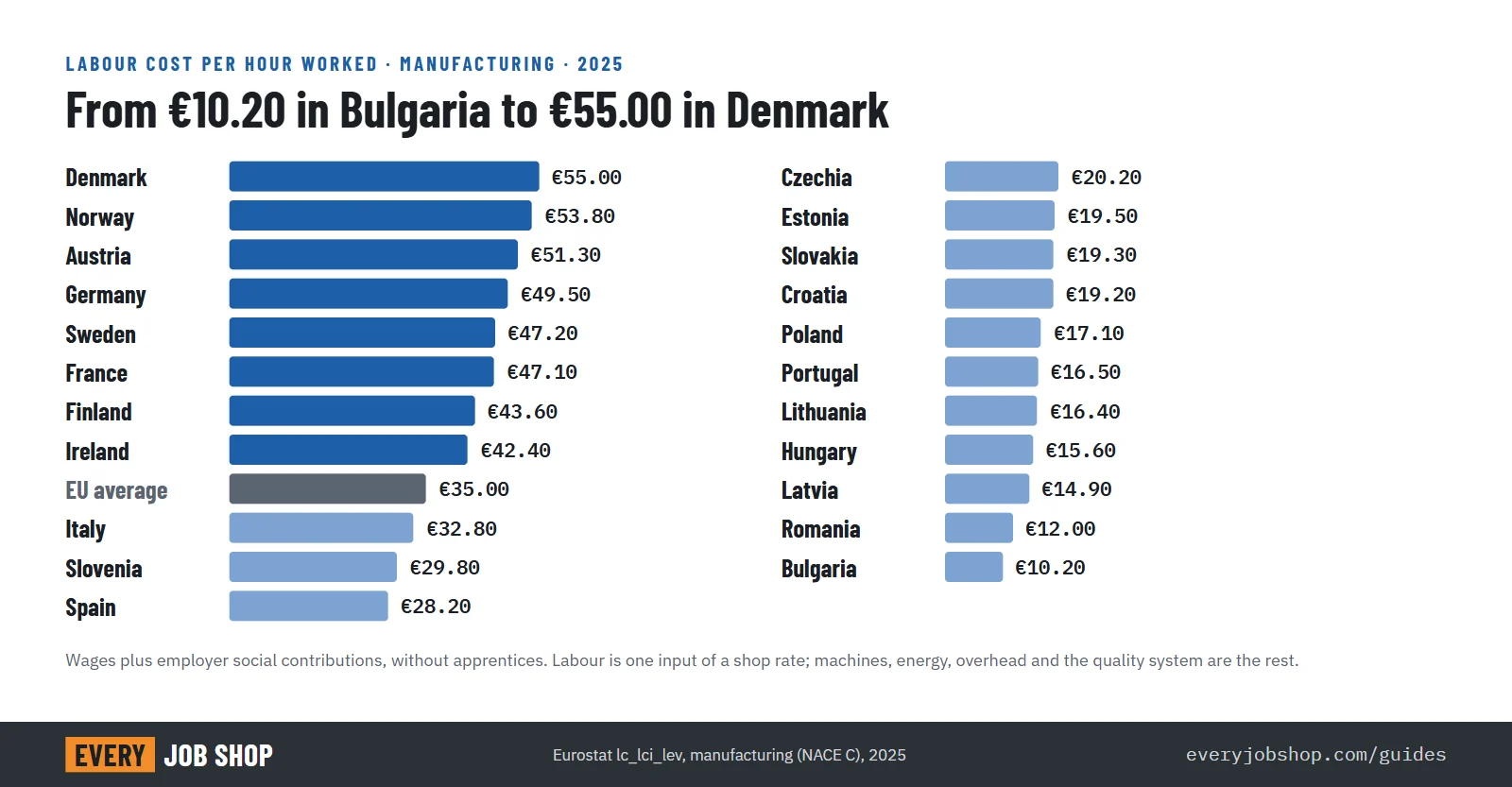
Eurostat publishes labour cost per hour worked in manufacturing for enterprises with 10 or more employees. The 2025 figures for the countries in our index:
| Country, manufacturing, 2025 | Labour cost per hour |
|---|---|
| Denmark | €55.00 |
| Norway | €53.80 |
| Austria | €51.30 |
| Germany | €49.50 |
| Sweden | €47.20 |
| France | €47.10 |
| Finland | €43.60 |
| Ireland | €42.40 |
| EU average | €35.00 |
| Italy | €32.80 |
| Slovenia | €29.80 |
| Spain | €28.20 |
| Czechia | €20.20 |
| Estonia, Slovakia, Croatia | €19.50, €19.30, €19.20 |
| Poland | €17.10 |
| Portugal, Lithuania | €16.50, €16.40 |
| Hungary, Latvia | €15.60, €14.90 |
| Romania, Bulgaria | €12.00, €10.20 |
The United Kingdom and Switzerland are not part of this series, and Eurostat had no 2025 figure for the Netherlands and Belgium when we read it. For comparison, US manufacturing employers paid $48.62 per hour worked in June 2026 (BLS); the surveys differ, so read it as a rough comparison.
Labour is one input of a shop rate. Machines, energy, the quality system and the shop's own margin are the rest, so a Polish shop is not three times cheaper than a German one for the same part. Where the part is simple and the volume is real, the labour gap usually shows in the quote; where the part needs a five-axis machine and a full inspection report, it shrinks.
US duty on European parts, November 2026
The rules changed many times in 2025 and 2026. After the Supreme Court ended the IEEPA tariffs in February 2026 and a temporary Section 122 surcharge expired, the US imposed Section 301 duties on 60 economies from July 24, 2026. For Europe:
- EU countries: a Section 301 duty that brings the normal duty up to 10% in total, with nothing extra where the normal duty is already 10% or more (USTR notice).
- Switzerland: the same netting at 12.5%: where the normal duty is below 12.5%, the two together make 12.5% (Holland & Knight).
- United Kingdom: a flat 10% on top of the normal duty, not netted against it (Global Trade Alert).
- Norway is one of the 60 economies too; check its rate for your code with a customs broker.
Goods that pay a Section 232 tariff are exempt from the Section 301 duty. For metal parts, Section 232 is the one that matters: since April 6, 2026 it applies to the full value, 50% for articles made entirely or mostly of steel, aluminum or copper and 25% for other listed derivatives. UK-origin goods pay 25% and 15% instead, when they meet the origin rule (steel melted and poured, aluminum smelted or cast, in the UK); otherwise the general rate applies. There is no EU or Swiss discount on the 50% rate.
One part with a customs value of $40.00 (our example; we assume the code is right and leave out the small merchandise processing fee):
| Part and HTS code | From the EU | From Switzerland | From the UK |
|---|---|---|---|
| Machined steel bracket, 7326.90.86, normal duty 2.9% | 50% + 2.9%: $21.16 | 50% + 2.9%: $21.16 | 25% + 2.9%: $11.16 (UK steel) |
| Molded plastic part, 3926.90.99, normal duty 5.3% | 10% in total: $4.00 | 12.5% in total: $5.00 | 5.3% + 10%: $6.12 |
So for steel parts the UK can be the cheapest European source at the border, if the shop buys British steel; for most other parts the EU is. Since August 29, 2025 there is no duty-free de minimis entry for small shipments from any country. A broker's hour on classification is money well spent.
Certificates you will see
| Certificate | What it covers | In our European index |
|---|---|---|
| ISO 9001 | Quality management, any industry | 1,038 companies |
| ISO 14001 | Environmental management | 243 |
| EN 1090 | Welded steel and aluminum structures; the basis of the CE mark under the EU Construction Products Regulation, in execution classes EXC1 to EXC4 | 103 |
| IATF 16949 | Automotive production quality | 100 |
| EN 9100 or AS9100 | Aerospace quality; EN 9100 is the European name of AS9100 | 60 |
| EN 15085-2 | Welding of railway vehicles and parts, levels CL1 to CL4 (Kiwa) | 53 |
| ISO 3834 | Quality requirements for fusion welding | 41 |
| ISO 13485 | Medical device quality | 26 |
Check an ISO certificate in IAF CertSearch and ask for the scope: a certificate issued to another site of the group, or one that ended last year, is a common surprise. Our certification guide explains what each one proves and what it does not.
How to choose a country for a part
- Start from the part, not the country. A tight-tolerance turned part, a mold, a welded frame and a laser-cut bracket point to different countries in the list above.
- Check the duty for its HTS code first. A steel part pays 50% from anywhere in the EU, so the labour gap between countries decides; a plastic or mixed part pays about 10%, so the distance and the shop's experience with US customers matter more.
- Ask the certificate you need, not the best one. IATF 16949 or EN 9100 cost a shop money every year; you pay for it in the price.
- Send the RFQ to three shops in two countries. One in a high-cost country with the capability, two in a lower-cost one. Our RFQ checklist lists what to send.
- Agree the Incoterms rule, currency and delivery date in the quote. Incoterms 2020 define who pays freight, export and US customs; with DDP the seller would have to clear US customs and pay the duty, so ask whether the shop really means it.
Red flags
- No company register entry. EU shops are in a national register (Handelsregister, Registro Imprese, KRS in Poland, Companies House in the UK); find it before you pay a deposit.
- A certificate you cannot find in the issuer's database, or one for another site.
- A price far below the others on a tight-tolerance part, with no questions about the drawing.
- DDP offered casually, with no word on who pays the metal tariff.
- A trading company presenting itself as the shop. Legitimate, but you should know who makes the part.
Find shops by country and process on the Europe page, or compare with Mexico and China.
Questions people ask
- Which European country is cheapest for machined parts?
- By labour cost, Bulgaria (€10.20 per hour worked in manufacturing in 2025), Romania (€12.00), Latvia (€14.90), Hungary (€15.60), Portugal (€16.50) and Poland (€17.10), against an EU average of €35.00 and €49.50 in Germany (Eurostat). Labour is only part of a shop rate, and the duty at the US border is the same for every EU country, so for simple parts the cheapest country by labour is usually also the cheapest landed.
- What US duty applies to machined parts from Europe in November 2026?
- It depends on the tariff (HTS) code and the country. Steel and aluminum articles pay the Section 232 tariff on their full value: 50% from the EU and Switzerland, 25% from the UK when the steel was melted and poured there (15% for other UK derivatives). Most other goods pay a Section 301 duty since July 24, 2026: up to 10% in total with the normal duty from the EU, 12.5% in total from Switzerland, and a flat 10% on top of the normal duty from the UK. Goods that pay Section 232 do not also pay the Section 301 duty.
- Where are the most machine shops in Europe?
- Germany has by far the largest base, and it is also the deepest country in our index: 1,549 of the 3,008 European companies we list as of November 2026. Italy (262), France (189), the United Kingdom (172), Poland (169) and Austria (104) follow.
- Which certifications should I expect from a European job shop?
- ISO 9001 is the most common (1,038 of the 3,008 European companies in our index state it). Automotive suppliers hold IATF 16949, aerospace suppliers EN 9100 (the European name of AS9100), medical suppliers ISO 13485. For welded steel structures sold in the EU, EN 1090 is the certificate behind the CE mark; ISO 3834 covers welding quality and EN 15085-2 welding of railway vehicles and parts.
- Do European shops quote in English and to inch drawings?
- Most shops that export answer in English, but they work in millimetres and to EN or ISO material grades. Send a metric drawing or a dimensioned STEP model, name the material by its EN designation as well as the US grade, state the general tolerance (for example ISO 2768-1 m) and agree the Incoterms rule and the currency in the quote.