A casting starts with a bill you pay before any metal is poured: the pattern, the core boxes or the die. After that, each part can cost a fraction of what it costs to machine the same shape from a solid block. Whether casting is right for your part is mostly a question of shape and quantity, and you can work out the quantity before you call a foundry.
So which casting process fits your part, what does it hold, and where is the break-even against machining?
This guide answers that with published figures (labelled by source), a worked break-even example with its assumptions stated, and our data on the 205 casting companies in the EveryJobShop index as of November 20, 2026.
Key numbers
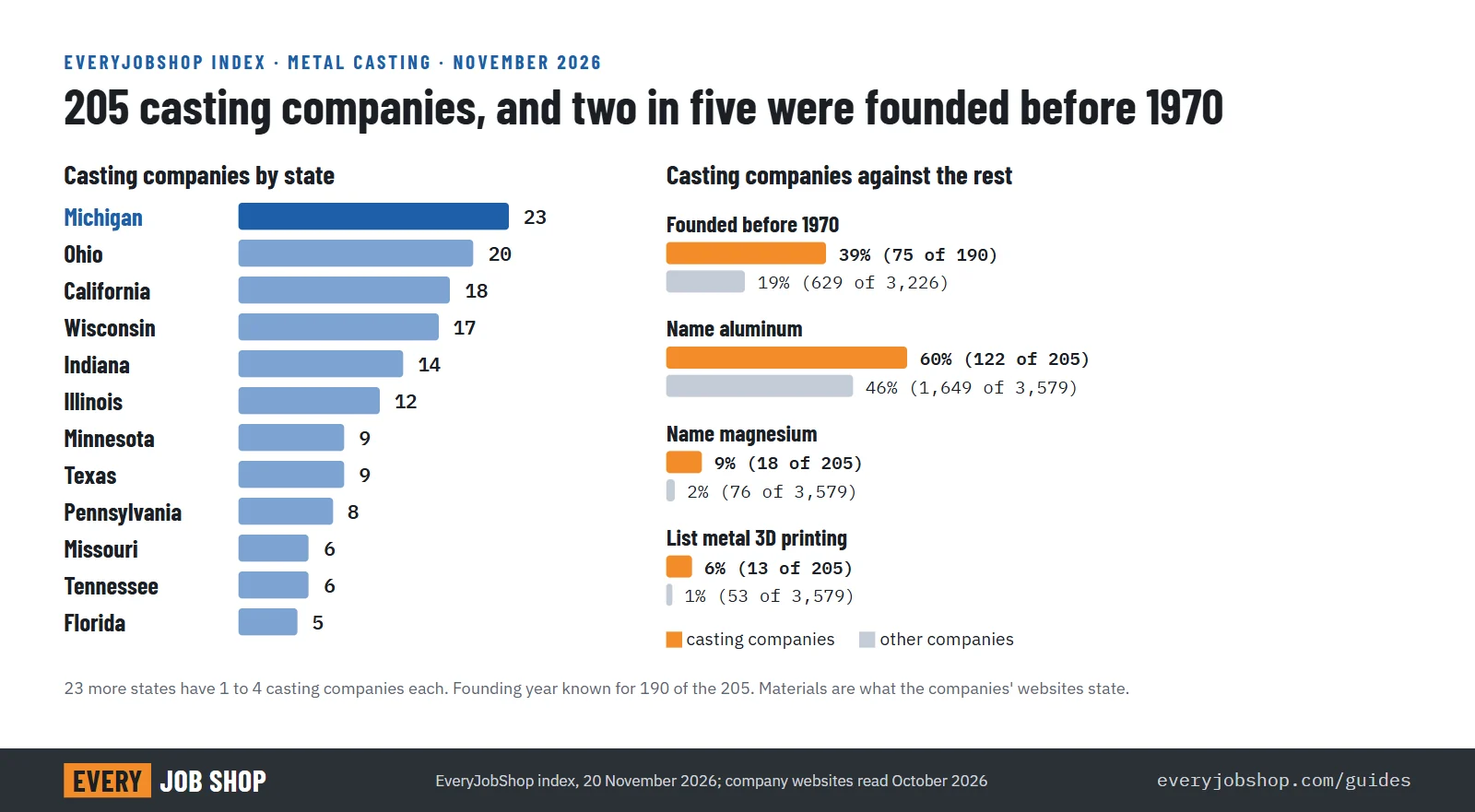
- 205 US companies in our index list casting, in 35 states: Michigan 23, Ohio 20, California 18, Wisconsin 17, Indiana 14 and Illinois 12. Michigan, Ohio, Wisconsin, Indiana, Illinois and Minnesota together hold 95 of the 205.
- Highest share: in Wisconsin 17 of 143 companies cast (12%), in Michigan 23 of 213 (11%) and in Indiana 14 of 139 (10%). California has 18 casting companies among 571 (3%).
- The oldest companies in the index. Median founding year 1979, against 1993 for the rest; 39% were founded before 1970, twice the share of the others (19%).
- Non-ferrous leads. 60% name aluminum (46% of the others), 36% copper or brass (26%) and 9% magnesium (2%).
- They machine what they cast. 66% also list CNC milling and 47% turning, so many deliver a finished part, not a raw casting. 6% list metal 3D printing (1% of the others).
- Certifications: 95 state ISO 9001 (46%), 41 AS9100 (20%), 18 Nadcap (9%, against 5%) and 8 IATF 16949 (4%, against 1%).
Processes come from our index; we list a company as casting only when its own site describes the casting process itself, not just machining of castings. Materials, certifications and founding years are what the companies' websites state, read by our crawler in October 2026. We have not checked them. Our 205 are a part of the US industry: the American Foundry Society puts US casting sales at about $53.7 billion in 2025, and its industry statistics rank the US third in casting production after China and India, with Ohio, California, Michigan, Pennsylvania and Wisconsin as the states with the most foundries (as of 2020).
The casting processes compared
| Process | How it works | Best for | What to expect |
|---|---|---|---|
| Sand casting | Metal poured into packed sand around a reusable pattern; the mold is broken to free the part | Low to medium volumes, large parts, iron and steel as well as aluminum and bronze | Cheapest tooling, roughest finish and loosest tolerances; over 60% of all castings in 2003 |
| Investment (lost wax) casting | A ceramic shell built around a wax copy of the part; the wax is melted out and metal poured in | Complex small and medium parts with fine detail, steels and superalloys | Tighter tolerances and a fine finish; 3 g to several hundred kilograms |
| Die casting | Molten aluminum, zinc or magnesium injected into a steel die under high pressure | High volumes of small and medium non-ferrous parts | Expensive dies, fast cycles, very good finish by casting standards |
| Permanent mold | Metal poured by gravity or low pressure into a reusable metal mold | Medium volumes of aluminum and copper alloy parts | Between sand and die casting in tooling cost and finish |
What the references say, in their own words:
- Investment casting: Wikipedia gives typical tolerances of 0.1 mm for the first 25 mm plus 0.02 mm for each additional centimeter, and a standard surface finish of 1.3 to 4 micrometers (50 to 125 microinches) RMS. MetalTek, a foundry that runs all three processes, says that low to medium volume projects are ideal for investment casting and that it comes in much larger sizes than die casting (vendor article).
- Die casting: Wikipedia says the dies are very expensive, which tends to limit the process to high-volume production, and that most die castings are made from non-ferrous metals: zinc, copper, aluminum, magnesium, lead, pewter and tin alloys. MetalTek says die casting is typically limited to small to medium parts.
- Sand casting: MetalTek calls it ideal for parts that do not need tight tolerances or a lot of machining.
Whatever the process, the faces that mate, seal or locate are usually machined after casting. Put machining stock on those faces in the casting drawing and keep the tight tolerances on the machining drawing.
When casting beats machining from billet
Machining from a solid block has no tooling cost, but a housing or a bracket with pockets and ribs can turn most of the block into chips, and every minute of that is machine time. A casting comes out near its final shape and only the critical faces are machined. The pattern or die is the price of that head start.
break-even quantity = tooling cost ÷ (price per part without the tooling − price per part with it)
Worked example
Assumptions, made up for illustration and not a quote: an aluminum housing about the size of a hand. Machined from billet it costs $60 a part, mostly machine time and the block. As a sand casting it needs a $4,000 pattern and core box, and costs $18 to cast and $12 to machine the critical faces: $30 a part. As a die casting it needs a $40,000 die, and costs $4 to cast and $6 to machine: $10 a part. Finishing, inspection, freight and die maintenance are left out.
| Parts ordered | Machined from billet | Sand cast + machined | Die cast + machined |
|---|---|---|---|
| 10 | $60.00 a part | $430.00 | $4,010.00 |
| 100 | $60.00 | $70.00 | $410.00 |
| 1,000 | $60.00 | $34.00 | $50.00 |
| 10,000 | $60.00 | $30.40 | $14.00 |
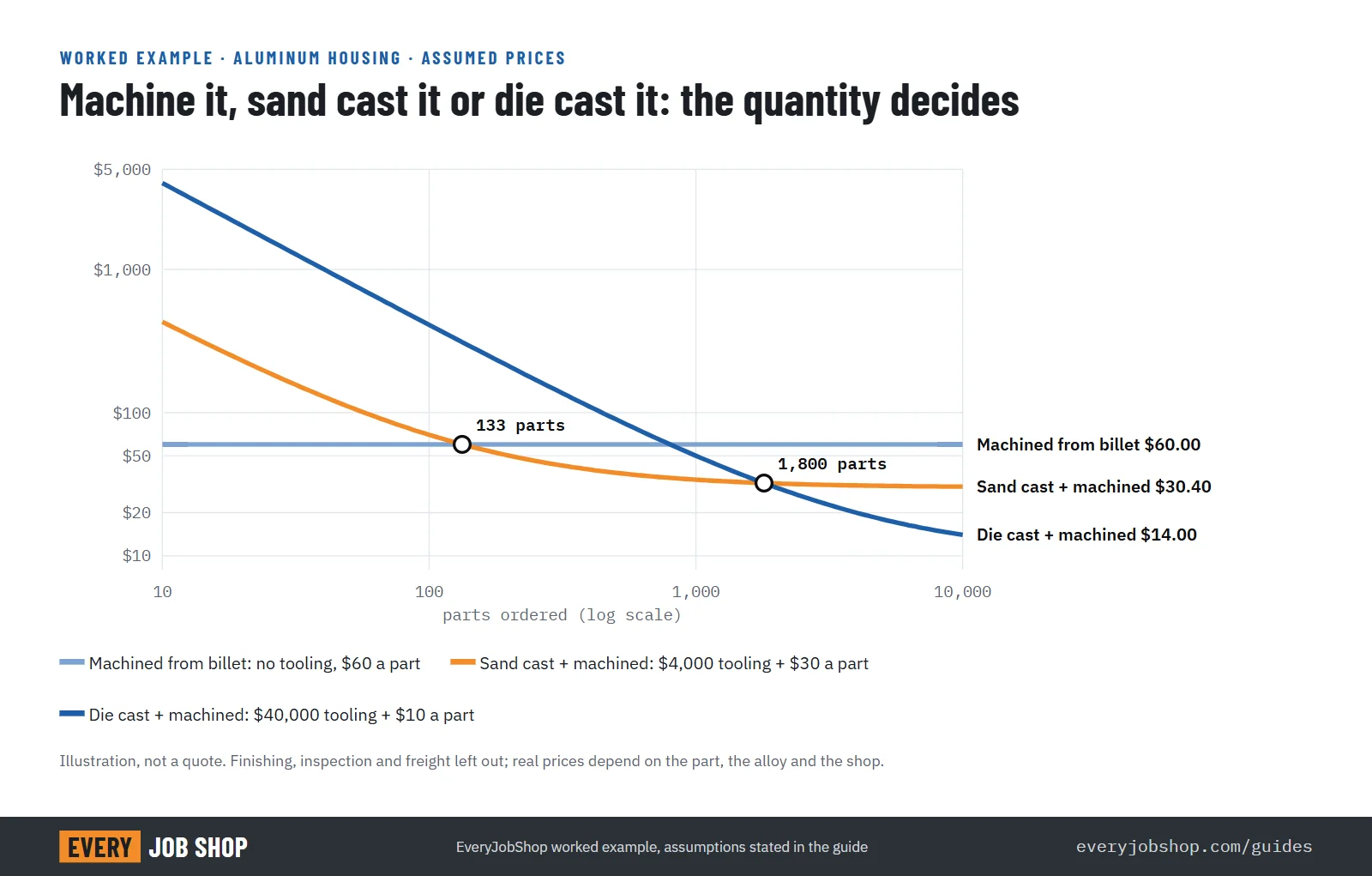
- Sand casting beats the billet at 4,000 ÷ (60 − 30) = about 133 parts.
- Die casting beats sand casting at (40,000 − 4,000) ÷ (30 − 10) = about 1,800 parts.
Practical points the arithmetic leaves out:
- Tooling takes time. A pattern, a core box or a die is designed and built before the first pour; ask the foundry for its tooling lead time and plan prototypes from billet or a 3D printed part in the meantime.
- First article. The first castings are measured and the pattern or die is often adjusted. Budget for it.
- Who owns the tooling. The buyer often pays for the pattern or die; agree in writing who owns it, where it is stored and what happens if you move the work. Our prototype to production guide covers the switch from machined prototypes to cast production.
What drives casting cost
Tooling:
- Process. Sand patterns cost least, die casting dies most, permanent molds and investment tooling sit between.
- Cores. Every internal passage needs a core and a core box.
- Complexity and size, and for dies, how many cavities and slides.
Each part:
- Alloy and weight. You pay for the metal poured, plus the gates and risers that are cut off and remelted.
- Yield and scrap. Porosity, shrinkage and misruns are scrapped or repaired; tight specifications raise the scrap rate.
- Cleaning and finishing: removing gates, grinding parting lines, shot blasting, heat treatment, impregnation for pressure tightness.
- Machining of the critical faces, and how the casting is held for it.
- Inspection: X-ray, dye penetrant, pressure testing, chemistry and mechanical test bars, when the drawing or the industry calls for them.
What to send a foundry for a quote
- A 3D model of the finished part and a drawing, and if you have it, a casting drawing with machining stock, draft and parting line.
- Alloy and any heat treatment, and the standard the alloy is bought to.
- Annual volume and release size. This decides the process more than anything else.
- Which faces are machined and who machines them (the foundry or you), and the tolerances on those faces.
- Quality requirements: acceptable porosity, X-ray or pressure test, certificates of conformance and test reports.
- Whether you need prototypes before the pattern or die is approved.
Our RFQ guide covers the rest of a complete request, and the DFM guide the design mistakes that add cost to any part.
Where the casting companies are
| State | Casting companies | Share of the state's shops | Also list CNC milling | Also list finishing | State ISO 9001 | State ITAR |
|---|---|---|---|---|---|---|
| Michigan | 23 | 11% | 12 | 3 | 14 | 1 |
| Ohio | 20 | 9% | 14 | 8 | 9 | 4 |
| California | 18 | 3% | 13 | 5 | 9 | 7 |
| Wisconsin | 17 | 12% | 14 | 5 | 10 | 6 |
| Indiana | 14 | 10% | 8 | 2 | 5 | 1 |
| Illinois | 12 | 8% | 6 | 1 | 6 | 3 |
Below the six states with their own casting page, Minnesota and Texas have 9 casting companies each, Pennsylvania 8, and Missouri and Tennessee 6 each. The whole list is on the casting page, with a map. By city, Minneapolis and Erie, Pennsylvania have 3 each.
One casting company has confirmed its listing with us ("Verified with the shop"): RapidMade in Tualatin, Oregon, which pairs casting with CNC milling and 3D printing. Verified means the company confirmed its details, not that we audited its work.
How to vet a foundry
- Ask which processes and alloys it pours, and the weight range. A bronze sand foundry, an aluminum die caster and a steel investment caster are different businesses.
- Ask who makes the patterns and dies and where the tooling lead time comes from.
- Ask what it does after the pour: heat treatment, machining, impregnation, finishing. Two thirds of the casting companies in our index also list CNC milling.
- Ask how it controls quality: melt chemistry, X-ray or CT, pressure testing, first article inspection, and its scrap rate on similar parts.
- Check certificates for your industry: IATF 16949 for automotive, AS9100 and Nadcap for aerospace (check them in OASIS and the Nadcap database). Our certifications guide explains what each one means.
- Ask about capacity and succession. Many casting companies are decades old; ask who runs the shop day to day and how long your tooling has been stored there, if you take over a part. The vetting guide has the full question list.
Find metal casting companies
Browse all 205 casting companies on a map, or narrow the list: with AS9100, with Nadcap, with IATF 16949, and compare with the CNC milling shops for prototypes from billet. With a drawing ready, send one RFQ to up to 30 shops and give the alloy and annual volume, so each foundry can tell you which process fits.
Questions people ask
- What are the main metal casting processes?
- Sand casting pours metal into a mold of packed sand around a pattern, and is used for everything from small brackets to castings of many tons; Wikipedia notes that over 60% of all metal castings were made in sand in 2003. Investment (lost wax) casting builds a ceramic shell around a wax copy of the part and gives finer detail and tighter tolerances. Die casting injects molten non-ferrous metal (mostly aluminum, zinc and magnesium) into a steel die at high pressure for high volumes. Permanent mold casting pours metal into a reusable metal mold by gravity or low pressure.
- How accurate are castings?
- It depends on the process. Wikipedia gives typical investment casting tolerances of 0.1 mm for the first 25 mm plus 0.02 mm for each additional centimeter, with a standard finish of 1.3 to 4 micrometers RMS. Sand castings are rougher and looser. Die castings have a very good finish by casting standards. Critical features are usually machined after casting in all three.
- When is casting cheaper than machining?
- When the quantity spreads the pattern or die cost thin enough. In our worked example an aluminum housing costs $60 machined from billet, $30 plus a $4,000 pattern as a sand casting, and $10 plus a $40,000 die as a die casting. Sand casting is cheaper than billet from about 133 parts and die casting is cheaper than sand from about 1,800 parts. Casting also wins on shapes that would waste most of a billet as chips.
- What is the difference between a foundry and a die caster?
- Both make castings. Foundry usually means a plant that pours metal into sand, investment shells or permanent molds, ferrous or non-ferrous. A die caster injects aluminum, zinc or magnesium into steel dies under pressure on die casting machines. Die casting tooling is expensive, so die casters work at higher volumes than most sand and investment foundries.
- How many metal casting companies are there in the US?
- The EveryJobShop index lists 205 US companies that cast metal as of November 2026, in 35 states, from Michigan (23), Ohio (20), California (18), Wisconsin (17) and Indiana (14). That is a part of the industry: the American Foundry Society puts US casting sales at about $53.7 billion in 2025 and ranks the US third in world casting production after China and India.