Most buyers think the fastest way to a quote is to send the CAD file to as many shops as possible and let them work out the rest. Then the replies come back over two weeks: three shops ask about the material, two quote a different finish, one prices it as a prototype, and the rest never answer.
What actually makes a shop quote fast and accurately?
A complete package. An estimator needs about a dozen facts to price a part. Every fact you leave out becomes an email, a guess with margin added for safety, or a reason to move your RFQ to the bottom of the pile. This guide lists what to send, explains the parts that are easy to get wrong, and ends with a template you can copy.
Why an incomplete RFQ costs you more than time
Shops cannot quote everything, so they choose. Modern Machine Shop described Advance CNC Machining, a shop that found it converted 40 to 50 percent of RFQs that fit it into orders, but only 4 percent of another class of RFQs. It began screening RFQs by quantity, value per piece and whether the buyer was prepared to issue an order, and cut RFQ processing by 20 percent with no drop in orders.
Many shops work this way. An RFQ that is clear about what, how many and by when gets attention. A vague one gets a late answer, a high one, or none.
The 12 things to send
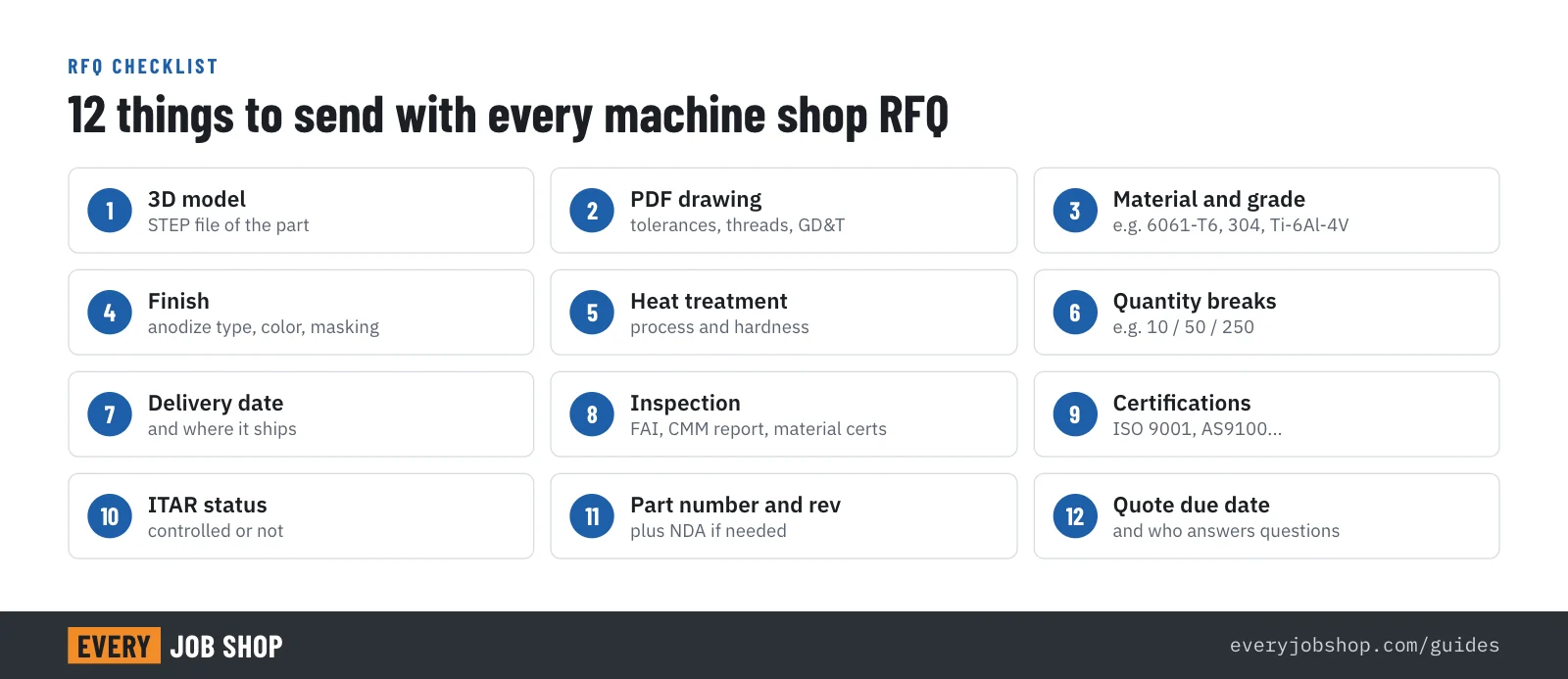
1. A 3D model in STEP format
STEP is the neutral format every CAM system reads. Native files (SolidWorks, Inventor, Fusion, NX) are useful as an extra, but not every shop runs the same CAD. Make sure the model matches the drawing revision.
2. A PDF drawing with tolerances
The model tells the shop the shape. The drawing tells it what matters: tolerances, threads, surface finish, critical features, notes. Include:
- A title block with part number, revision, material, finish and a general tolerance (for example ±0.005 in on three-place decimals and ±0.5° on angles). Features without their own tolerance fall under it.
- Specific tolerances only where function needs them. Tight tolerances add machining and inspection time; our CNC cost guide shows how.
- Thread callouts (for example 1/4-20 UNC-2B, with depth).
- Surface roughness where it matters (for example 63 µin Ra on a sealing face).
- A note on precedence, such as "drawing governs over model", so there is no argument about which one wins.
GD&T basics for buyers
Geometric dimensioning and tolerancing describes how features relate to each other, not only their size. In the US the governing standard is ASME Y14.5-2018, which ASME calls the "authoritative guideline for the design language of geometric dimensioning and tolerancing". The symbols you will see most:
| Control | What it controls | Typical use |
|---|---|---|
| Datum (A, B, C) | The reference surfaces everything is measured from | Mounting face, locating bore |
| Position | Where a hole or feature sits relative to the datums | Bolt hole patterns that must line up with a mating part |
| Flatness | How flat a surface is, by itself | Sealing faces, mounting pads |
| Perpendicularity | Squareness to a datum | Bores for shafts or bearings |
| Profile of a surface | The whole shape of a surface relative to the model | Complex contours, castings, aerodynamic surfaces |
| Runout | Wobble of a round feature when rotated | Shafts, pulleys, turned parts |
Two practical rules: choose datums that match how the part is mounted in the assembly, and do not apply GD&T to every feature. A shop reads heavy GD&T as heavy inspection and prices it that way.
3. Material and grade
Name the alloy and the condition, not just the family: 6061-T6 aluminum, 304 stainless, 4140 pre-hardened steel, Delrin 150 acetal. Say whether a substitute is acceptable (for example 6082 for 6061) and whether you need material certifications (mill test reports). A shop that has the material on the shelf can quote faster and cheaper.
4. Finish
Give the finish and the specification: Type II anodize, clear or black; Type III hardcoat with thickness; passivation; zinc plating; powder coat with color code. Mark surfaces to mask (threads, bores, electrical contact faces). Most finishes are done by outside vendors with lot minimums, which can be a large share of a small order.
5. Heat treatment and hardness
If the part is hardened, say to what (for example 58 to 62 HRC) and whether before or after machining. Note any hardness test location.
6. Quantity and quantity breaks
Give the quantity you will order now and two or three breaks (for example 10, 50, 250), plus the expected annual usage if the part will repeat. Setup and programming are fixed costs, so the unit price changes sharply with quantity. Breaks let you see the curve in one round.
7. Delivery date
Give a date, not "ASAP". Say whether partial shipments are acceptable and whether a faster date is worth paying for. Add the ship-to location (city and state), since freight and the shop's distance matter for large parts.
8. Inspection and documentation
State what you need with the parts:
- Certificate of conformance.
- Material certifications.
- First article inspection report (in aerospace usually in the AS9102 format).
- Dimensional report for critical features, or a full CMM report.
- For automotive programs, PPAP documentation at the level your customer requires.
Each of these takes time and shows up in the price, so ask only for what you or your customer will use.
9. Required certifications
If your customer requires AS9100, ISO 13485, IATF 16949 or a Nadcap-accredited special process, say so in the RFQ. It saves both sides from a quote that cannot be accepted. Our guide to job shop certifications explains what each one means and how to check it.
10. Export control (ITAR) status
If the part or its drawing is a defense article or technical data on the US Munitions List, the RFQ itself is controlled. Under 22 CFR 120.50, releasing technical data to a foreign person in the United States is a "deemed export", and 22 CFR 122.1 requires anyone in the business of manufacturing or exporting defense articles to register with the State Department's Directorate of Defense Trade Controls (DDTC). In practice:
- Mark the drawing and the RFQ clearly as ITAR-controlled.
- Send controlled data only to shops that say they are registered and can handle it, through a channel your company approves.
- Ask the shop to confirm its registration before you send the full package.
If the part is not controlled, say "not ITAR" in the RFQ, so shops do not have to ask.
11. Part number, revision and confidentiality
Use a clear part number and revision, and keep them consistent across model, drawing and RFQ. If you need an NDA, send it first or state that one is required, so the shop can sign before receiving files.
12. Quote due date and contact
Say when you need the quote and who answers technical questions. A named engineer with an email address resolves questions in hours instead of days.
How many shops to ask
A common rule of thumb is three to five shops whose machines, materials and certifications fit the part. Ask more when the part is unusual, the date is short or the quantity is outside what most shops run, because more shops will decline. Send everyone the same package, so the quotes are comparable.
How to compare the quotes
Lay the quotes side by side and normalize them:
| Compare | Why |
|---|---|
| Unit price at each quantity break | The cheapest at 10 is not always the cheapest at 250 |
| One-time charges (programming, fixtures, tooling) | Some shops include them in the unit price, others list them separately |
| Lead time from order (and from approval of first article) | A low price with a lead time past your date is not an option |
| What is included | Material certs, inspection reports, finish, packaging, freight |
| Exceptions and assumptions | A shop that quotes a different material, finish or tolerance is quoting a different part |
| Payment terms and quote validity | Material prices change; many quotes are valid for a limited time |
| Questions asked | A shop that asked good questions understood the part |
Be careful with an outlier far below the rest. It may be a shop with the right machine and open capacity, or it may have missed a requirement. Ask it to confirm the drawing revision, the tolerances and the finish before you order. Our CNC cost guide explains why honest quotes for the same part can differ by a factor of two.
A copy-paste RFQ template
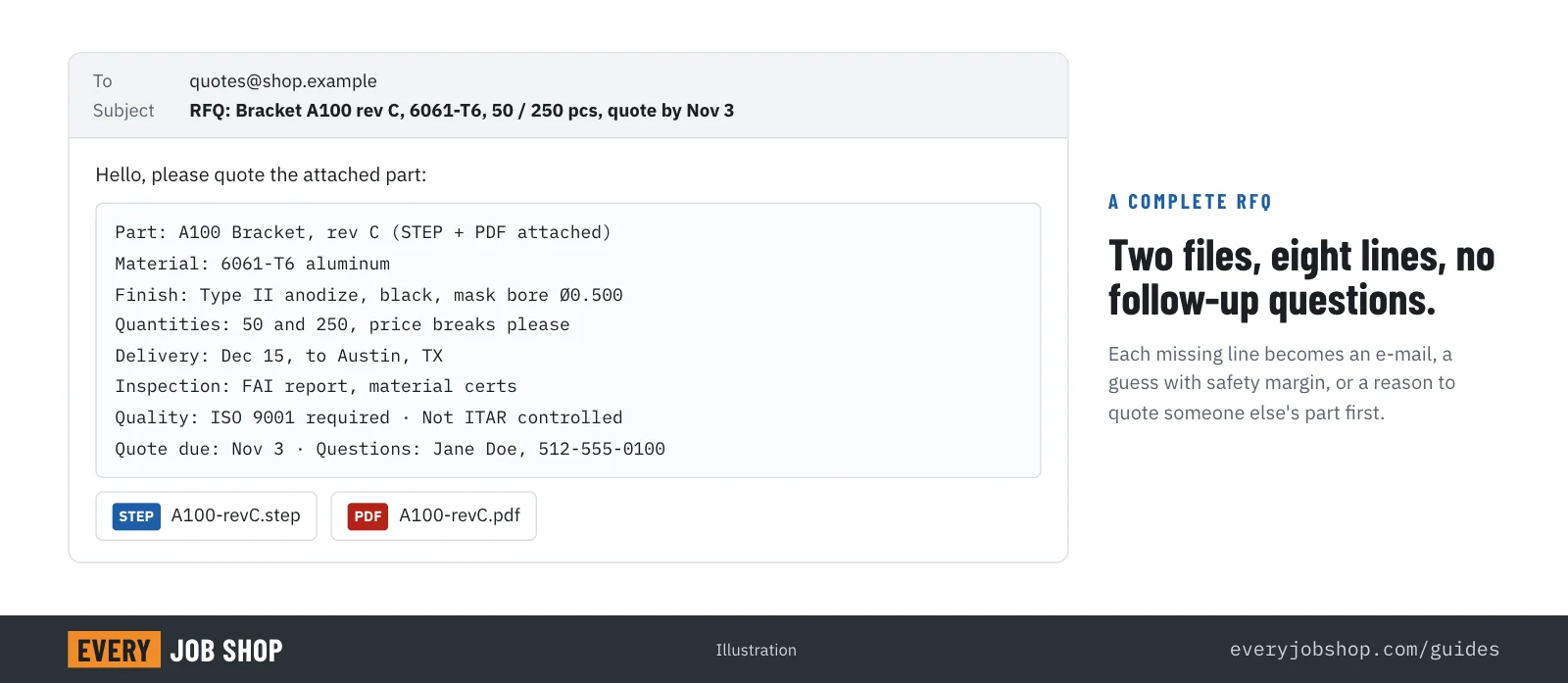
RFQ: [Part name], P/N [number] Rev [X]
Quote due: [date]   Contact: [name, email, phone]

Files: STEP model + PDF drawing (drawing governs over model)
Process: [CNC milling / turning / sheet metal / other, or "shop's choice"]
Material: [alloy and condition, e.g. 6061-T6]; substitutes: [allowed / not allowed]
Material certs required: [yes / no]
Finish: [e.g. Type II anodize, black]; masking: [features]
Heat treatment: [none / spec and hardness]
Critical features: [list, or "see drawing, marked with *"]

Quantities: [now] pcs, with price breaks at [x / y / z] pcs
Expected annual usage: [pcs/year, if repeat]
Required delivery: [date], ship to [city, state]; partial shipments [OK / not OK]

Inspection and documents: [CoC / FAI (AS9102) / CMM report / PPAP level]
Required certifications: [none / ISO 9001 / AS9100 / ISO 13485 / IATF 16949 / Nadcap process]
Export control: [Not ITAR / ITAR-controlled: registered shops only]
NDA: [not required / required before files]

Please list separately: unit price per quantity, one-time charges,
lead time, what is included, and any exceptions to the drawing.
Send one RFQ to up to 30 shops
EveryJobShop is a free index of 3,768 US job shops in 50 states, searchable by process, material, certification and state. Find CNC milling or CNC turning shops, filter for ISO 9001, AS9100 or ITAR, or browse all shops. When the package is ready, send one RFQ to up to 30 matching shops at once and compare the answers in one place.
Questions people ask
- Is a STEP file enough to get a quote?
- For a rough price, sometimes. For an accurate quote, send a PDF drawing too. The model shows the shape; the drawing shows the tolerances, threads, finish and inspection requirements that decide the price. Without it the shop has to guess or ask, and both cost you time or money.
- Do I need GD&T on my drawing?
- Not for every part. A general tolerance block covers most features. Use GD&T where the function depends on how features relate to each other, for example hole positions relative to a mounting face, flatness of a sealing surface, or perpendicularity of a bore.
- How many shops should I send an RFQ to?
- A common rule of thumb is three to five shops whose equipment and certifications fit the part. For unusual materials, tight tolerances or urgent dates, ask more, because more of them will decline or quote a long lead time.
- Can I send ITAR-controlled drawings to any shop?
- No. Under the ITAR, releasing controlled technical data to a foreign person, even inside the United States, counts as an export. Send controlled data only to shops that are registered with the State Department's DDTC and can handle it, and mark the RFQ clearly as ITAR-controlled.
- Why did a shop decline to quote?
- Usually because the part does not fit its machines, the quantity is too small or too large for it, the date is too short, or the RFQ is incomplete. Ask for the reason; it tells you whether to fix the package or look for a different kind of shop.
- Should I share a target price?
- It can help on repeat parts or when you have a budget. Some shops ask for one to judge whether the job is worth quoting. It is your choice; leaving it out does not make a quote less accurate.