A welded part often arrives with a drawing that says "weld all around" and a purchase order that says "certified welders". Both sound precise. Neither tells the shop which process, which weld size, which code or which inspection you expect, and those four decide most of the price.
So what should a buyer know before ordering welded parts?
Welding cost is mostly time, and time follows the process, the size and length of the welds, and the inspection you ask for. Codes and certifications decide who may weld and how the work is checked. This guide covers both, with the questions to ask a shop and what to put on the drawing.
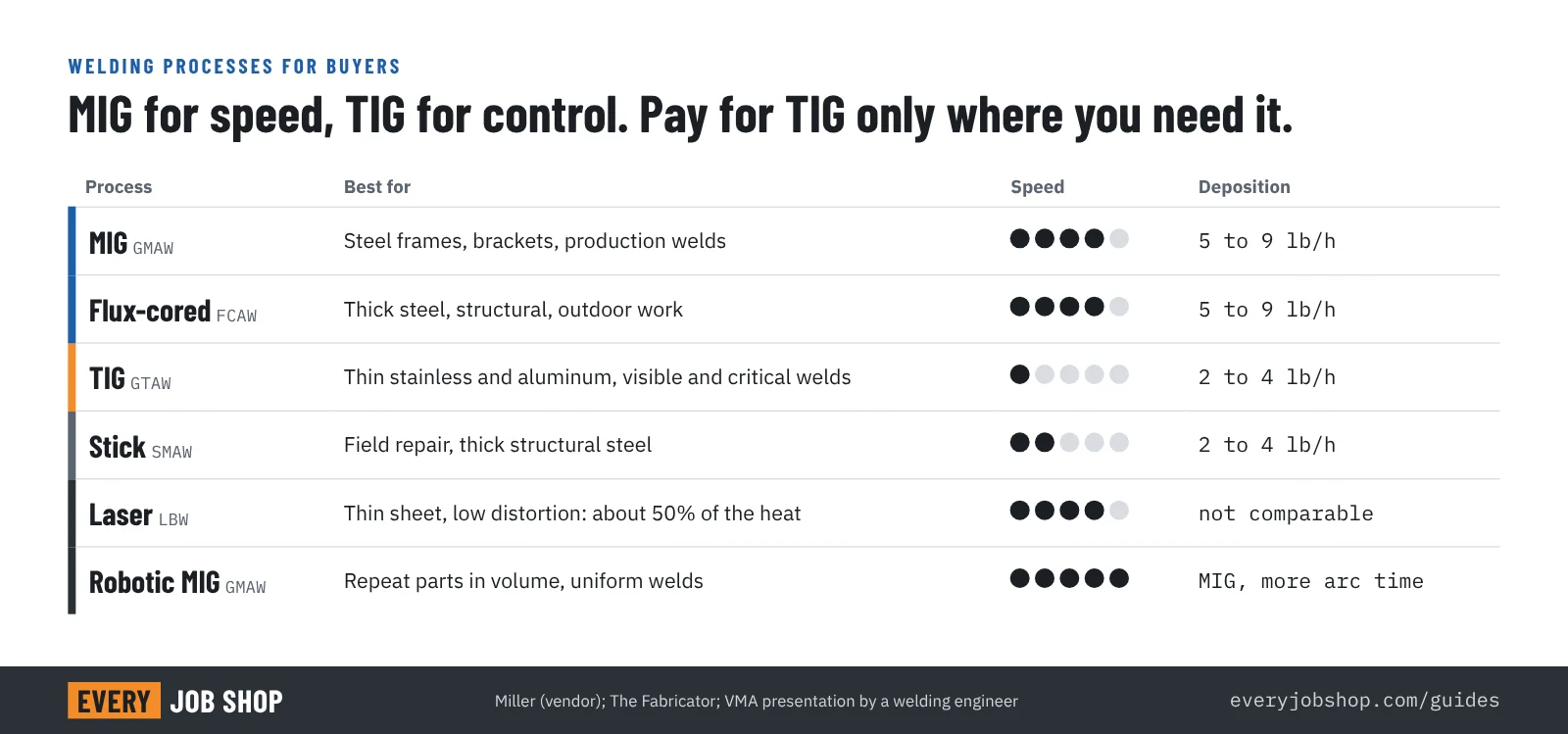
The welding processes, in plain words
| Process | Also called | Best for | Speed | Look and cleanup |
|---|---|---|---|---|
| MIG | GMAW | Steel frames, brackets, production welds in steel, stainless and aluminum | Fast | Some spatter, grinding where it shows |
| Flux-cored | FCAW | Thick steel, outdoor and structural work | Fast | Slag to remove |
| TIG | GTAW | Thin stainless and aluminum, visible welds, critical joints | Slowest | Clean, precise, heat tint to remove for a bright finish |
| Stick | SMAW | Field repair, thick structural steel | Slow | Slag to remove |
| Laser | LBW | Thin sheet, low distortion, high volume | Fast | Narrow seam, little heat tint |
| Robotic MIG | Repeat parts in volume | Fast and consistent | Like MIG, more uniform |
What the processes mean for your part:
- MIG is faster than TIG. Miller, a welding equipment maker, writes that MIG moves faster than TIG and introduces less total heat overall, while TIG demands higher coordination and experience (vendor source).
- TIG is the slowest arc process. The Fabricator calls it the slowest welding process with the lowest deposition rate. Typical figures from a welding engineer's industry presentation: manual stick and TIG deposit about 2 to 4 lb of weld metal an hour, semi-automatic MIG and flux-cored about 5 to 9, counting the time the welder is not welding.
- Laser welding puts in less heat. In Miller's comparison, laser welding introduces roughly 50% of the total heat that TIG or MIG would put into the same part, which means less distortion on thin sheet.
The practical rule: specify TIG only where the joint or the appearance needs it, and let the shop choose MIG or a robot everywhere else.
Where the money in a weld goes
Filler wire and gas are a small share of a welded part. A Praxair specialist quoted in Trailer/Body Builders put 85% of welding costs in overhead and labor, with wire at 6%, equipment 4%, gas 3% and power 2% (2003, but the split follows from the arithmetic: the welder's time dominates).
So the price of a weldment follows the time it takes:
- Weld length and size. The weld metal in a fillet weld grows with the square of its size.
- Fit-up. Parts that are laser cut and tabbed into each other need little fixturing; parts cut on a saw and held with clamps take longer.
- Position. Flat welds are fastest. Vertical and overhead welds are slower.
- Distortion. Long welds on thin sheet pull the part out of shape, and straightening is extra work.
- Cleanup and finish. Grinding welds flush, removing heat tint from stainless, and blending for paint can take longer than the welding.
- Inspection. Visual inspection is part of every job; dye penetrant, magnetic particle, ultrasonic and radiographic testing are separate steps with their own cost.
Weld size: the line on the drawing that costs the most
A fillet weld one size larger than needed is the most common way to overpay. The cross-section of a fillet weld is half the leg squared, so a 3/8 in fillet holds 2.25 times the metal of a 1/4 in fillet, and a 1/2 in fillet four times.
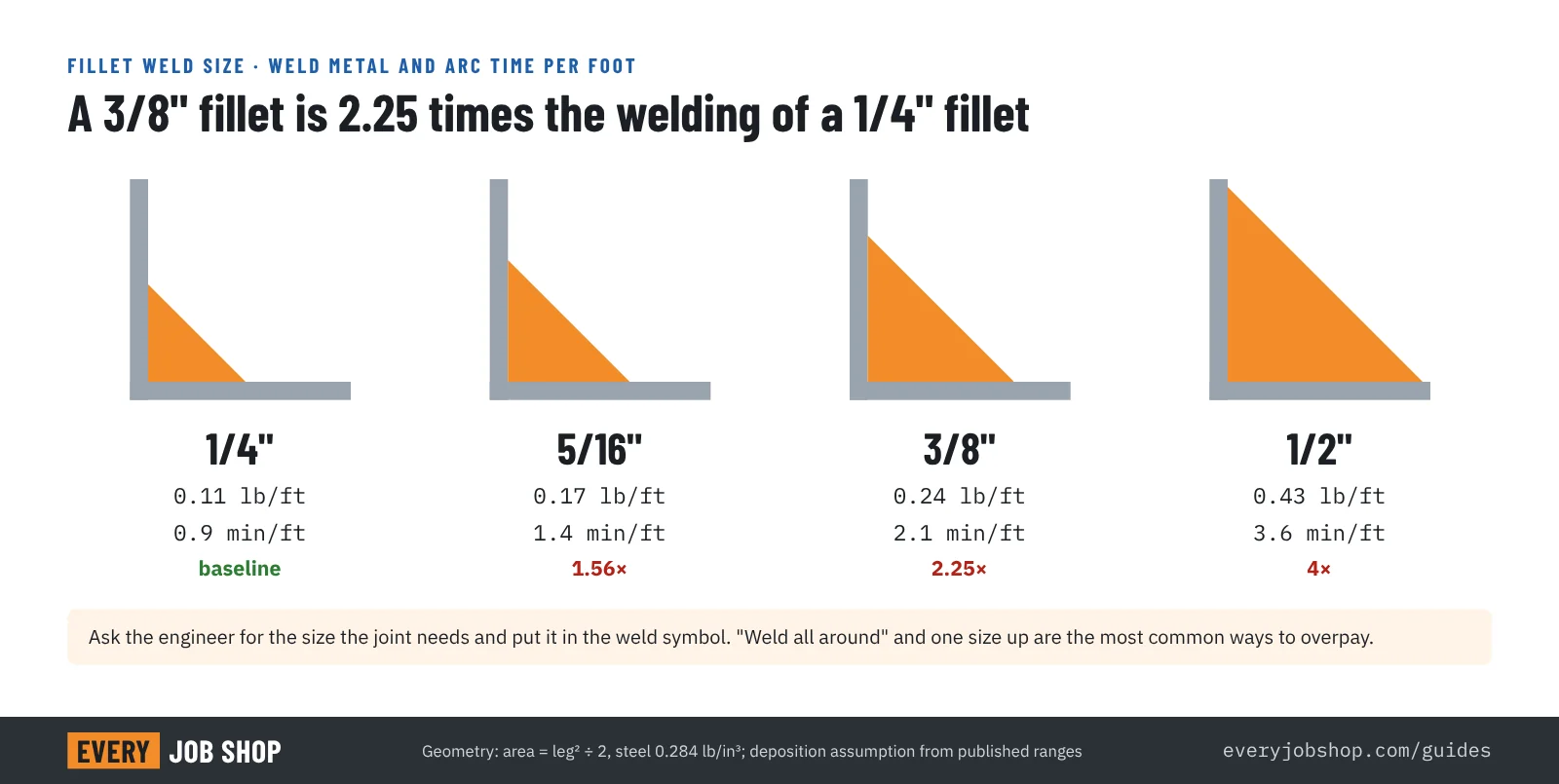
| Fillet size | Weld metal per foot (steel) | Relative | Arc time per foot at 7 lb/h |
|---|---|---|---|
| 1/4 in | 0.11 lb | 1.0 | 0.9 min |
| 5/16 in | 0.17 lb | 1.6 | 1.4 min |
| 3/8 in | 0.24 lb | 2.25 | 2.1 min |
| 1/2 in | 0.43 lb | 4.0 | 3.6 min |
Weld metal is the cross-section times 12 inches times the density of steel (0.284 lb per cubic inch). The arc times assume a semi-automatic MIG deposition of 7 lb an hour, in the middle of the range above; larger welds often need several passes and take longer. Ask your engineer for the size the joint needs, and write it on the drawing.
Which welding code applies
A welding code sets how procedures and welders are qualified, what is acceptable and how the work is inspected. The design or contract decides which one applies; if nothing does, say which code or shop standard you expect.
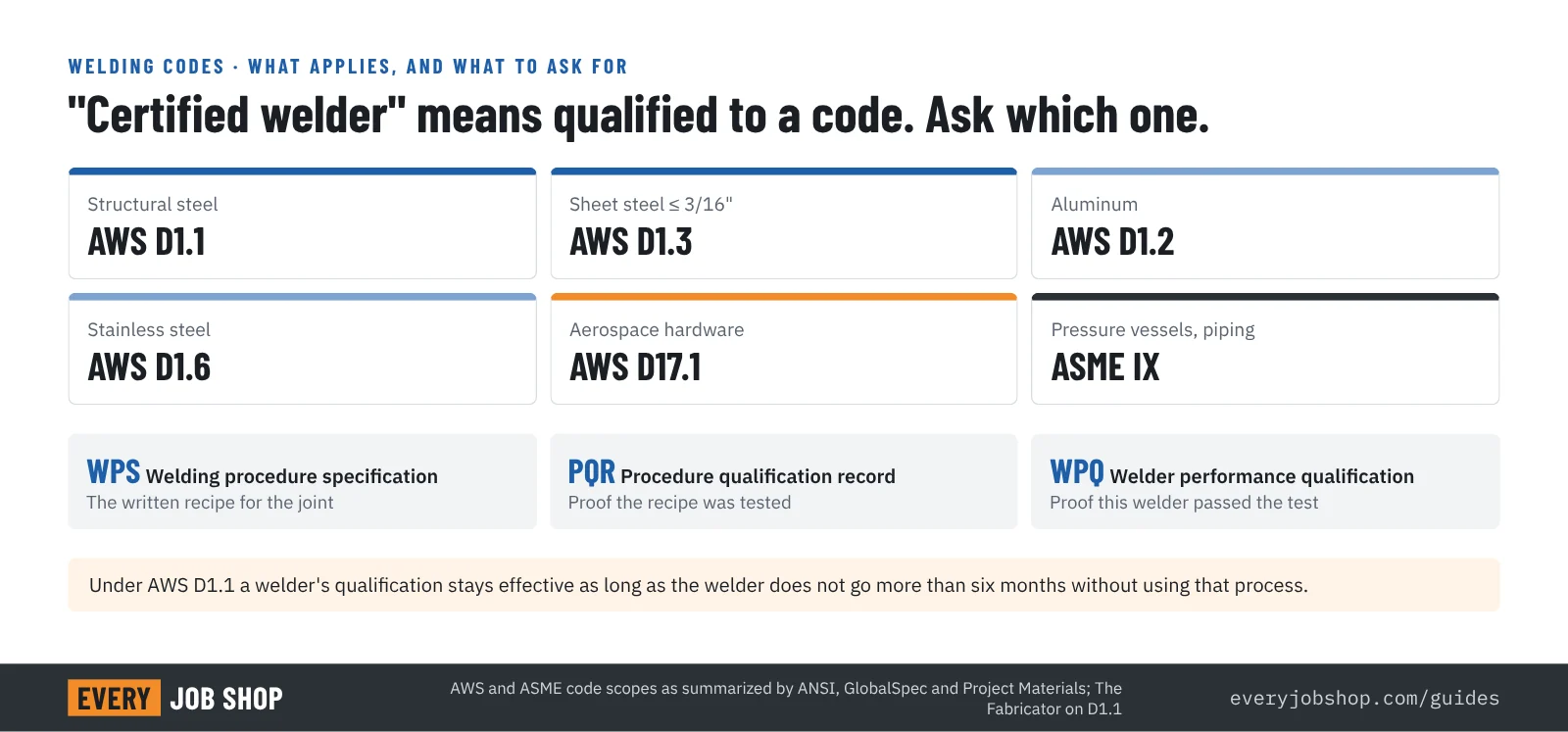
| Code | Covers | Typical parts |
|---|---|---|
| AWS D1.1 | Structural welding of steel | Frames, platforms, brackets, structural members |
| AWS D1.3 | Structural sheet and strip steel up to 3/16 in nominal thickness | Cold-formed and sheet steel structures |
| AWS D1.2 | Structural welding of aluminum | Aluminum frames and structures |
| AWS D1.6 | Structural welding of stainless steel | Stainless structures and supports |
| AWS D17.1 | Fusion welding for aerospace applications | Aircraft and space hardware |
| ASME Section IX | Qualification of welding for pressure equipment, used with construction codes for boilers, vessels and piping | Pressure vessels, process piping |
Qualifications do not transfer automatically from one code to another: a welder qualified to ASME Section IX is not automatically qualified to AWS D1.1, and the reverse. If your part falls under a code, ask the shop whether its procedures and welders are qualified to that code, not just "certified".
What "certified welder" means, and what to ask for
Three documents sit behind a coded weld:
- WPS, the welding procedure specification: the written recipe for a joint, with process, filler metal, gas, current, positions and thickness range.
- PQR, the procedure qualification record: proof that the recipe was tested and the test welds passed.
- WPQ, the welder performance qualification: proof that a named welder passed a test weld to that procedure.
Under AWS D1.1, a welder's qualification stays effective as long as the welder does not go more than six months without using that process. That is why shops keep continuity logs. When a buyer asks for "certified welders", the useful request is: the WPS for your joints and the current WPQs of the welders who will weld them.
A CWI, an AWS Certified Welding Inspector, is the person who checks the work. Candidates pass three exams (fundamentals, practical and code book) with at least 72% on each; the certification is valid for nine years with renewals at years three and six. Ask whether the shop has a CWI on staff or uses an outside inspector, and who signs the inspection report.
What to put on the drawing
- Weld symbols to the AWS A2.4 standard, with the type, size, length and pitch of each weld. "Weld all around" on every joint is an invitation to overpay.
- The process only where it matters, for example TIG on a visible stainless seam.
- The code and the acceptance criteria, if the part falls under one.
- Inspection: visual only, or which welds need dye penetrant, magnetic particle, ultrasonic or radiographic testing, and how many.
- Finish: as welded, ground flush, blended for paint, heat tint removed or passivated.
- Critical dimensions after welding, so the shop knows what must stay flat or square.
Our DFM guide covers the design side: tab-and-slot parts, access for the torch and welds that pull parts out of tolerance.
Six ways to cut the cost of welded parts
- Specify the weld size the joint needs, not one size up.
- Use intermittent welds where a continuous weld is not structural.
- Let the shop choose MIG where the appearance does not matter.
- Design laser cut parts that locate themselves with tabs and slots, so fixturing takes minutes.
- Ask for grinding only on visible or mating surfaces.
- Combine cutting, bending, welding and finishing at one shop. Our laser cutting cost guide shows how fixed costs per order add up across separate suppliers.
Find welding shops
EveryJobShop lists 2,111 US shops that offer welding: 1,038 list aluminum, 918 stainless steel and 331 hold AS9100. The most are in California (274), Texas (134), Ohio (127), Pennsylvania (123) and Michigan (116). Filter by material and certification in the full list, use our 12 questions for a new shop, and send one RFQ to up to 30 shops at once.
Questions people ask
- Is MIG or TIG welding better?
- Neither is better in general. MIG (GMAW) is faster and puts less total heat into the part, so it is the usual choice for steel fabrications and production work. TIG (GTAW) is slower and needs a more skilled welder, but gives precise control and a clean look on thin stainless, aluminum and visible welds. Specify TIG only where the joint or the appearance needs it.
- What does a welded part cost?
- Mostly time. A Praxair specialist put 85% of welding cost in labor and overhead, with wire at 6%, equipment 4%, gas 3% and power 2%. The price follows the length and size of the welds, the process, the position, the fit-up and the cleanup and inspection the drawing asks for.
- What does a certified welder mean?
- Under codes such as AWS D1.1, a welder is qualified by passing a test weld to a written procedure, and the qualification covers a process, position and range of thicknesses. Under D1.1 it stays valid as long as the welder does not go more than six months without using that process. Ask the shop for the welder qualification records and the welding procedure that apply to your part.
- Which welding code applies to my part?
- The design or contract decides. Structural steel is usually AWS D1.1, structural sheet steel up to 3/16 inch AWS D1.3, aluminum AWS D1.2, stainless AWS D1.6, aerospace hardware AWS D17.1, and pressure vessels and piping ASME Section IX with the construction code. If none applies, say which code the shop should work to, or which shop standard is acceptable.
- What is a CWI?
- An AWS Certified Welding Inspector. Candidates must pass three exams (fundamentals, a practical exam and a code book exam) with at least 72% on each. The certification is valid for nine years, with renewal applications at years three and six.