A buyer sends a flat steel bracket to three shops and gets three answers: $118 for one, $17.71 each for ten, $7.66 each for a hundred. Then a fourth shop quotes "35 cents an inch". None of these numbers is wrong. They are the same arithmetic, seen at different quantities.
So what does laser cutting actually cost?
For most small parts the laser itself is the cheapest line on the quote. The money goes into the sheet, the press brake, and the setup and programming that every order pays once. This guide shows how a shop turns a DXF into a price, works through a full example at four quantities, and lists the design choices that move the number.
How a shop prices a laser cut part
Every laser quote, whether it comes from an estimator or an instant-quote website, is built from the same five pieces:
- Machine time. Cut length divided by the cutting speed for that material and thickness, plus a fixed time for every pierce (each hole or slot starts with one), plus the rapid moves between features. Real speed is lower than the book speed, because the head slows down in corners and small features.
- Material. The share of the sheet the part uses, including the skeleton left around it after nesting, priced per pound or per sheet.
- Secondary operations. Bending, deburring, tapping, hardware insertion, welding and finishing, each with its own rate.
- Fixed cost per order. Programming and nesting, machine setup, the first part check, paperwork. Paid once, whatever the quantity.
- Margin. Price = cost ÷ (1 − margin). A 25% margin means dividing by 0.75, not adding 25% (our guide on quote calculators shows why the two are not the same).
Online services such as SendCutSend work the same way but replace the per-order setup with an order minimum. Its laser cutting page states that pricing starts at $29 per order, and bending carries its own minimum charge (vendor sources).
What a laser hour costs
There is no national survey of laser cutting rates, and published figures from equipment sellers vary by a factor of three. The honest way to read a rate is to know what is in it:
- The machine. A US-built 6 kW fiber laser with a 4 x 8 ft bed is listed from $101,995 (ShopSabre FiberSabre) (vendor list price). Higher-power machines with automatic sheet loading and part sorting cost several times as much. They charge more per hour, but they also cut faster and run unattended.
- Assist gas and power. Oxygen for thick carbon steel, nitrogen for stainless, aluminum and clean edges on thin steel. Nitrogen at high pressure is a real cost on every cutting minute.
- Operator, overhead and how many hours the laser actually cuts. A laser that cuts 2,000 hours a year needs a higher rate than the same laser cutting 4,000. Our guide on how to calculate a shop rate builds one line by line.
In the example below we use $120 an hour for a 6 kW fiber laser, $12 an hour for gas and $95 an hour for the press brake. These are the default rates in our free quote calculator, not a market price.
Thickness decides the cutting time
Cutting speed falls steeply with thickness. On the same 6 kW fiber laser, a foot of cut in 16 gauge steel takes about one second; in 1/4 inch steel about seven; in 1/2 inch about sixteen. Pierce time grows too, from a quarter of a second to two.
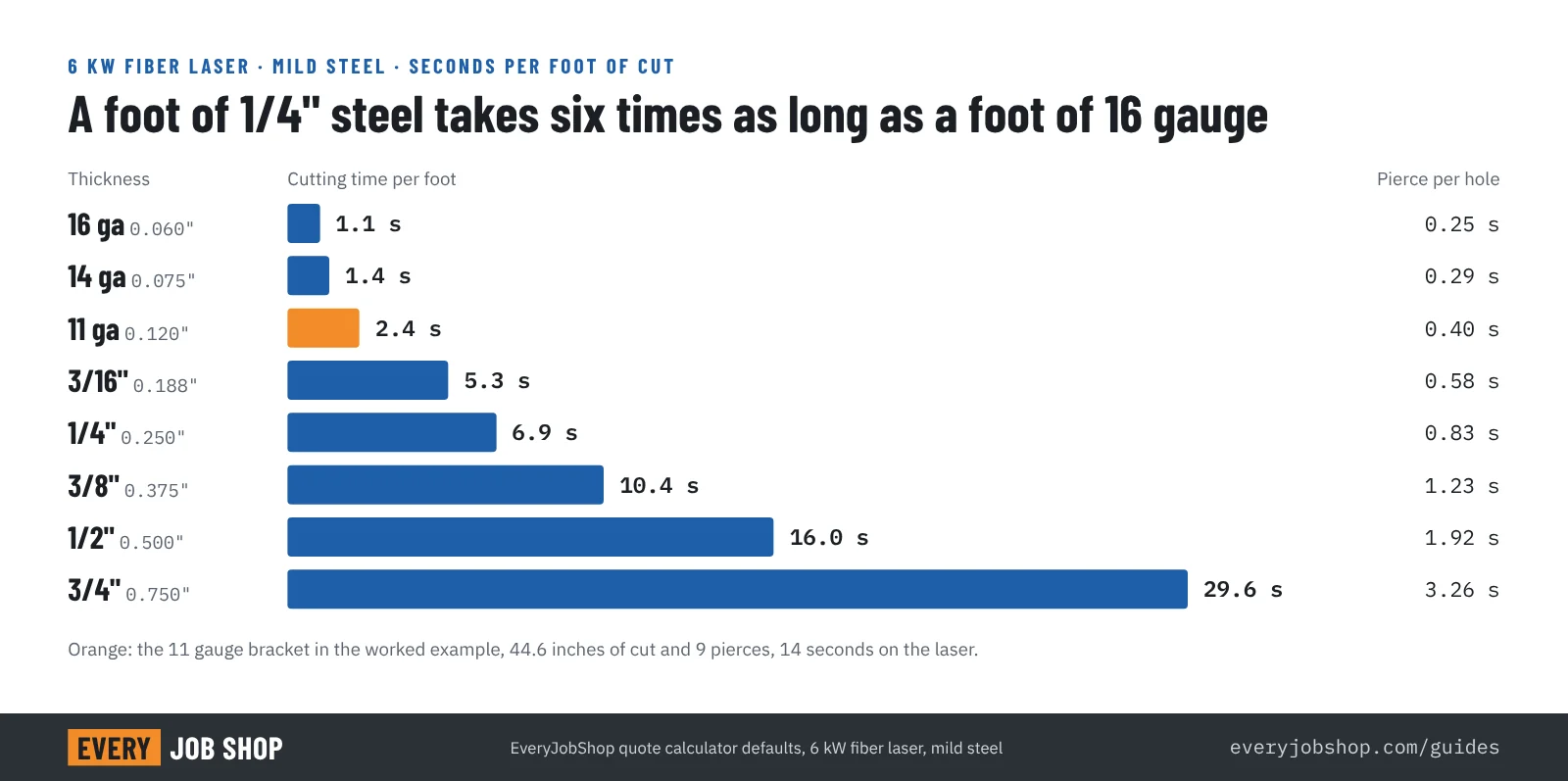
The speeds come from the default table in our quote calculator, typical of a 6 kW fiber laser on mild steel with a 15% allowance for acceleration and corners. Your shop's machine will differ, which is exactly why shops quote from their own measured speeds. Two things follow for buyers:
- Do not specify thicker than the part needs. Going from 11 gauge (0.120 in) to 3/16 in more than doubles the cutting time per foot, and the sheet weighs 57% more.
- Thick parts with many holes are pierce-heavy. At 1/2 inch, twenty holes add about 40 seconds of piercing before a single inch is cut.
A worked example: an 11 gauge bracket at 1, 10, 100 and 1,000 pieces
This is our own example to show how a price is built, not a quote from any shop. Every assumption is stated so you can swap in your own.
The part: a mounting bracket in 11 gauge (0.120 in) mild steel, 6 x 9 in flat, with six 13/32 in holes, two slots and two bends. Total cut length 44.6 in, nine pierces. It weighs 1.83 lb.
Assumptions:
- 6 kW fiber laser at $120/h, gas $12/h. Cutting speed at 0.120 in: 348 in/min, plus 15% for corners and acceleration. Pierce time 0.4 s.
- Laser time per part: 0.15 min cutting + 0.06 min piercing + 0.02 min of rapid moves = 0.23 min.
- Material: steel sheet at $0.90/lb, with 80% of the sheet used by parts. For comparison, mill hot-rolled coil was $1,255 per short ton (63 cents a pound) in mid-October 2026; service centers add processing, freight and margin.
- Press brake at $95/h: two bends at 23 s each plus 20 s to turn the part = 66 s.
- Deburring: $0.60 a part.
- Fixed cost per order: laser setup 10 min ($20.00), press brake setup 15 min ($23.75), programming, nesting and paperwork $40.00. Total $83.75.
- Margin: 25% (price = cost ÷ 0.75).
| Cost item | Qty 1 | Qty 10 (per part) | Qty 100 (per part) | Qty 1,000 (per part) |
|---|---|---|---|---|
| Fixed cost per order ($83.75) | $83.75 | $8.38 | $0.84 | $0.08 |
| Laser time (0.23 min at $120/h) | $0.46 | $0.46 | $0.46 | $0.46 |
| Assist gas | $0.05 | $0.05 | $0.05 | $0.05 |
| Material (1.83 lb ÷ 0.80 × $0.90) | $2.06 | $2.06 | $2.06 | $2.06 |
| Bending (66 s at $95/h) | $1.74 | $1.74 | $1.74 | $1.74 |
| Deburring | $0.60 | $0.60 | $0.60 | $0.60 |
| Cost | $88.66 | $13.29 | $5.75 | $4.99 |
| Price at 25% margin | $118.21 | $17.71 | $7.66 | $6.66 |
What the table shows:
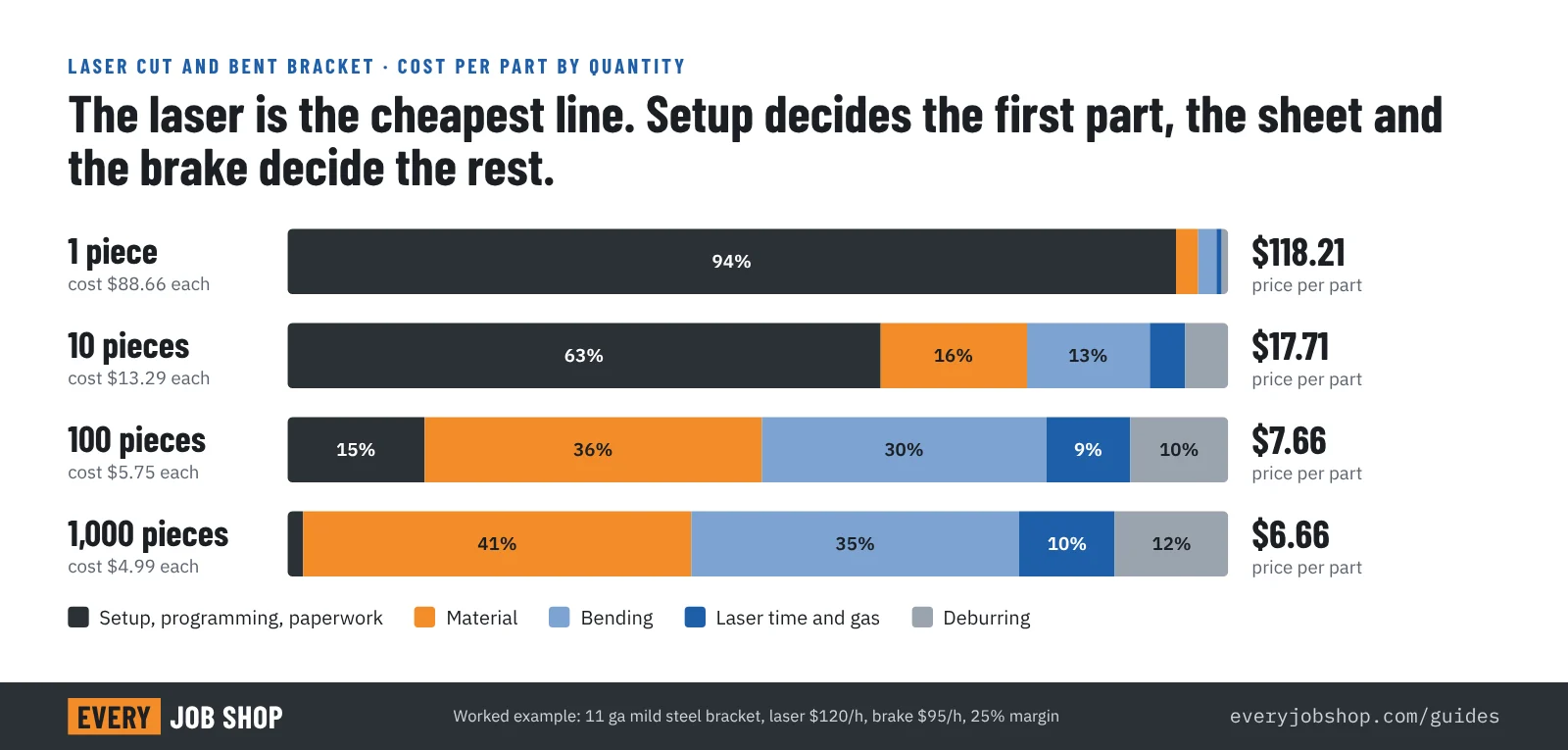
- At one piece, 94% of the cost is fixed. The laser runs for 14 seconds; the setups and programming around it cost $83.75.
- At 100 pieces, laser time and gas are 9% of the cost. Material is 36% and bending 30%. Shaving seconds off the cutting path matters far less than the sheet price, the gauge and the number of bends.
- Quantity breaks flatten fast. The price drops 85% from 1 to 10 pieces, 57% from 10 to 100, and only 13% from 100 to 1,000. Asking for prices at a few quantities shows you where the curve flattens.
Bending: seconds per bend, minutes per setup
A press brake prices like a laser: a few seconds per bend at the machine rate, and a setup that is paid once per batch. The setup is where bending gets expensive: The Fabricator notes that setup is the most expensive part of any press brake operation, because time spent changing tools is time not spent bending.
What raises the cost of bent parts:
- Different bend radii or tool profiles in one part. Each one may be another tool change.
- Short flanges, bends close to holes, and tight tolerances across bends. Our DFM guide lists the rules of thumb.
- Large or heavy parts that need two people at the brake.
- Tolerances tighter than the process holds. Protolabs gives ±1 degree on every bend angle, ±0.005 in between features on one flat surface and ±0.015 to ±0.030 in across bends (vendor tolerance sheet). Asking for less means slower bending, more measuring and more scrap.
Material: grade, thickness and how well the parts nest
Material is often the biggest line once the quantity grows. Three things set it:
- Grade. Mild steel is cheapest per pound and cuts fast with oxygen. Stainless and aluminum cost more per pound and are cut with nitrogen. SendCutSend's own example prices the same sprocket at $19.60 in 0.063 in Grade 5 titanium and $6.76 in 0.060 in 304 stainless (vendor source). Our guide to metal prices and tariffs shows how much US steel and aluminum have moved since 2025.
- Thickness. Weight grows with thickness, and so does cutting time.
- Nesting. Parts are fitted onto a standard sheet (48 x 96 in or 60 x 120 in in the US). Odd shapes and large parts leave more skeleton, and the buyer pays for it. SendCutSend suggests keeping parts under 28 in to keep costs low, because larger parts use more material and machine time.
Eight ways to cut the cost of a laser cut part
- Order the quantity you will use in a year, or ask for quantity breaks. Fixed cost is almost the whole price of a single part.
- Use the thinnest gauge that does the job. It is lighter and cuts faster.
- Choose standard materials. Mild steel, 5052 aluminum and 304 stainless are stocked everywhere; exotic grades come with minimums and lead times.
- Fewer, larger holes. Every pierce costs time, and in thick plate a lot of it. SendCutSend's design advice says the same: a cost-effective design has few pierce points.
- Keep bends consistent. Same inside radius, same direction where possible, enough flange length for the tooling.
- Do not over-tolerance. Put tight numbers only on features that mate with something.
- Send clean files. One part per file, closed contours, no duplicate lines, units stated. A messy DXF costs an estimator's time, and online services charge more for pre-nested files.
- Combine operations at one shop. A part that is cut, bent, welded and powder coated under one roof avoids four sets of setup, freight and handling.
Local shop or online service?
Online services are hard to beat for flat and simply bent parts in stocked materials: an instant price, no minimum quantity and next-day shipping in many cases. A local job shop earns its place when the part needs more than cutting: welding, machining, hardware, finishing, assembly, inspection reports, or a material and thickness the online menus do not offer. It also gives you someone who will call about a problem in the drawing instead of cutting it as drawn.
The way to know is to ask both, with the same files and quantities. Our guide on what to send with an RFQ has the checklist.
Find laser cutting and bending shops
EveryJobShop lists 711 US shops that offer laser cutting and 956 that offer press brake bending. 423 shops list laser cutting, bending and welding, so a part can be cut, bent and welded in one place. Search by state, material and certification in the full list, and when the drawing is ready, send one RFQ to up to 30 shops and compare the answers side by side.
Questions people ask
- How much does laser cutting cost per hour?
- There is no official survey of laser cutting rates. Shops build their own machine rate from the laser's price, running costs, operator, overhead and how many hours it cuts. In our worked example we use $120 an hour for a 6 kW fiber laser plus $12 an hour for assist gas. A small US-built 6 kW machine lists from about $102,000; large machines with automatic loading cost several times as much, so their hourly rate is higher but they cut faster.
- Do shops charge per inch of cut?
- Not directly. The quote is built from machine time, and machine time is cut length divided by the cutting speed, plus a fixed time for every pierce. Cut length is a good proxy at one thickness, but one foot of cut in 1/4 inch steel takes about six times as long as in 16 gauge, and a part with many small holes pays for every pierce.
- Why is one laser cut part so expensive?
- Because setup, programming and order handling are paid once per order, whatever the quantity. In our example those fixed costs are $83.75, about 94% of the cost of a single bracket. At 100 pieces they add 84 cents to each part. Online services handle this with an order minimum instead, for example $29 per order at SendCutSend.
- What is the cheapest material for laser cut parts?
- Mild steel is usually the cheapest per part: the sheet is inexpensive and it cuts fast. Stainless steel and aluminum cost more per pound and are cut with nitrogen. SendCutSend's own example shows the same sprocket at $19.60 in 0.063 inch Grade 5 titanium and $6.76 in 0.060 inch 304 stainless.
- How much does a press brake bend cost?
- Each bend is a few seconds of machine time plus handling, priced at the press brake's hourly rate, and every new setup of tooling is paid once per batch. In our example two bends and one turn of the part take about 66 seconds, $1.74 at $95 an hour. Parts that need special tooling, tight flange tolerances or many tool changes cost more.