Stamping is the cheapest way there is to make a sheet metal part, once you have paid for the die. Before that it is the most expensive: the first part out of a progressive die can cost tens of thousands of dollars. Whether stamping is right for your part is a question about quantity, and you can work it out before you ask for a quote.
So what does a stamping shop actually do, at what quantity does a die pay for itself, and how do you find a shop that fits?
This guide answers that with published figures (labelled as vendor figures where they come from a vendor), a worked break-even example with its assumptions stated, and our data on the 390 shops in the EveryJobShop index that list stamping as of November 17, 2026.
Key numbers
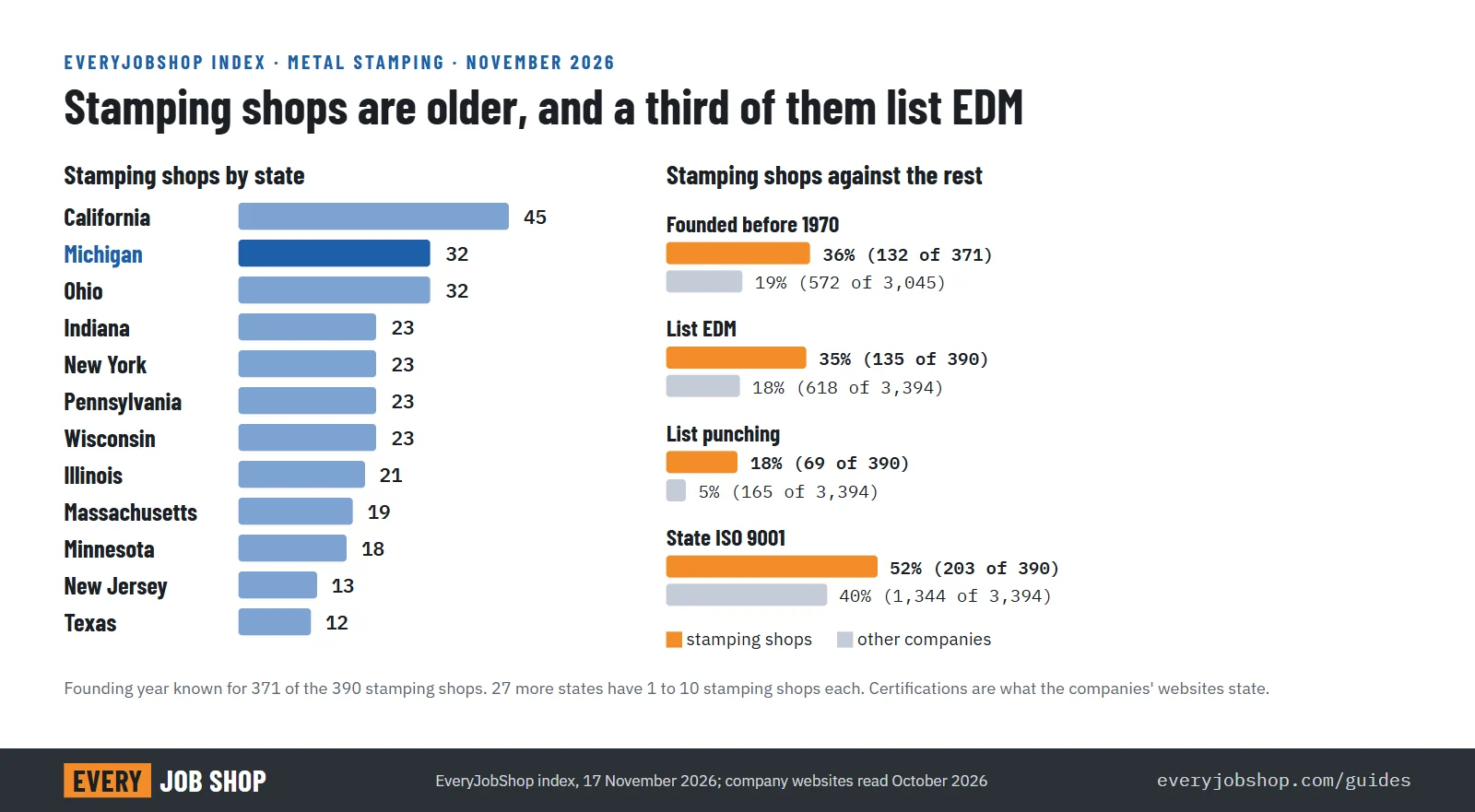
- 390 of 3,784 US job shops (10%) list stamping, in 39 states. California has 45, then Michigan and Ohio (32 each), and Indiana, New York, Pennsylvania and Wisconsin (23 each).
- Highest share: in New Jersey 13 of 63 companies list stamping (21%), in Minnesota 18 of 94 (19%) and in New York 23 of 129 (18%).
- They are old shops. Median founding year 1980, against 1994 for the rest of the index; 36% were founded before 1970 (19% of the others). Stamping is a business built on dies that run for decades.
- They make tooling. 35% also list EDM (18% of the others), the process that cuts punches and die openings in hardened steel, and 31% list grinding. 24 describe themselves as tool and die makers on their home page.
- Sheet metal around the press: 41% also bend (24%), 37% laser cut (17%) and 18% punch on a turret (5%), so many can make your first parts without a die and switch later.
- Certifications: 203 state ISO 9001 (52%, against 40% of the others), 76 AS9100 (19%), 81 ITAR (21%) and 13 IATF 16949, the automotive standard (3%, against 1%).
Processes come from our index; founding years, equipment and certifications are what the companies' own websites state, read by our crawler in October 2026. We have not checked them.
What a stamping shop does
A stamping die is a pair of hardened steel tools, a punch side and a die side, mounted in a press. Each press stroke closes the die on the sheet or strip and does some combination of:
- Blanking and piercing: cutting the outline and the holes.
- Forming and bending: flanges, tabs, offsets, embossed ribs.
- Drawing: pulling the metal into a cup or box shape (deep drawing for deep ones).
- Coining: squeezing the metal to a precise thickness or sharp detail.
The kinds of dies you will hear about:
| Die | How it works | Typical use |
|---|---|---|
| Progressive | A coil strip advances through a row of stations, one or more operations per station, and a finished part drops off at the end with each stroke (Wikipedia) | Small and medium parts in high volume: brackets, clips, terminals, contacts |
| Transfer | The blank is cut free early and fingers move it between stations; slower, but handles deeper drawn parts a progressive die cannot (Wikipedia) | Large or deep parts; Kenmode, a stamper, calls it best for large parts |
| Compound | Blanks and pierces in one stroke at one station | Flat parts: washers, shims, gaskets, flat brackets |
| Line or short-run dies | One simple die per operation, parts moved by hand or robot between presses | Lower volumes, larger parts, parts still changing |
| Fourslide (multislide) | A horizontal machine with tools coming from several sides, bending strip or wire in several planes (Wikipedia) | Clips, springs, wire forms, small complex bends |
The stamping shops in our index often keep a tool room next to the presses (a third list EDM, a third grinding) and laser cut and bend as well, a mix that suits short and medium runs and parts that start without a die.
When stamping beats laser cutting and bending
A laser cut and bent part has almost no tooling cost: the program is the tool. Each part, though, takes minutes of laser and press brake time. A stamped part takes a fraction of a second on the press, but only after the die is built. So the choice is a break-even calculation:
break-even quantity = die cost ÷ (price per part without the die − price per part with the die)
Worked example
Assumptions, made up for illustration and not a quote: a 16 gauge steel bracket with four holes and two bends. By laser cutting and press brake it costs $4.50 a part (our laser cutting guide shows how such a price is built). A short-run die that blanks, pierces and forms costs $6,000 and gives a piece price of $0.90. A progressive die costs $45,000 and gives a piece price of $0.15. Material is the same in all three and left out, and so are die maintenance, finishing and freight.
| Parts ordered | Laser + press brake | Short-run die ($6,000) | Progressive die ($45,000) |
|---|---|---|---|
| 1,000 | $4.50 a part | $6.90 | $45.15 |
| 5,000 | $4.50 | $2.10 | $9.15 |
| 25,000 | $4.50 | $1.14 | $1.95 |
| 100,000 | $4.50 | $0.96 | $0.60 |
| 500,000 | $4.50 | $0.91 | $0.24 |
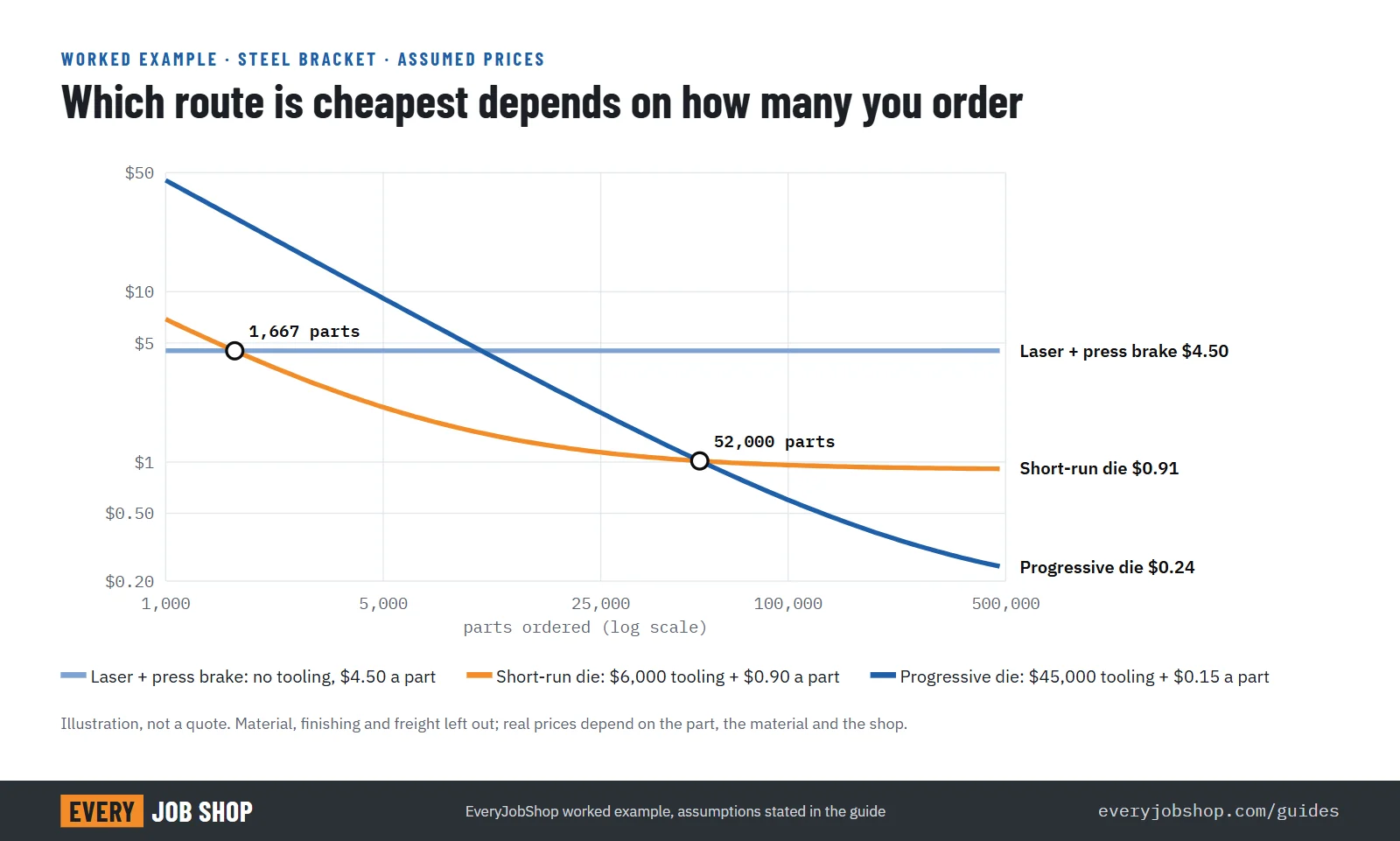
- The short-run die beats the laser at 6,000 ÷ (4.50 − 0.90) = about 1,667 parts.
- The progressive die beats the short-run die at (45,000 − 6,000) ÷ (0.90 − 0.15) = about 52,000 parts.
That second number lands where the published rules of thumb do. Fictiv, a manufacturing marketplace, says a progressive die typically becomes viable at 50,000 to 100,000 parts a year and shows the same arithmetic: a $50,000 die adds about $0.10 to each of 500,000 parts and $10.00 to each of 5,000 (vendor article).
Three practical points the arithmetic leaves out:
- The die takes time. Fictiv gives 12 to 20 weeks to build and commission a high-quality progressive die, and as little as 8 weeks for a simple one. Laser parts can ship in days, so many products launch on laser parts and move to a die once the design is frozen. Our prototype to production guide covers that switch.
- Design changes cost money after the die is built. Moving a hole on a laser part is a new program; on a progressive die it is a die change. Freeze the design first.
- Who owns the die. Often the buyer pays for the die and owns it while the shop stores and maintains it, but terms vary. Put ownership, storage and the number of hits the die is guaranteed for in writing.
What drives stamping cost
The die:
- Number of operations and stations. Every hole pattern, bend and draw is another station or another die.
- Part size and material thickness. Bigger and thicker parts need bigger dies and a bigger press.
- Tolerances. Fictiv gives plus or minus 0.05 to 0.10 mm as standard for progressive stamping and says tighter than 0.05 mm is achievable but needs frequent die sharpening (vendor figures).
- Die steel and life. A die for a million hits is built from better steel, with more inserts, than one for 20,000.
Each part:
- Press speed. Progressive presses run hundreds of strokes a minute, 200 to 600 or more in Fictiv's table; transfer and line dies run slower.
- Material utilization. How much of the strip ends up as scrap between parts. Nesting the part on the strip is part of the die design.
- Secondary operations: tapping, inserting hardware, welding, deburring, plating, painting.
- Run size. Every setup of the die in the press costs time, so frequent small releases cost more per part than a few large ones.
Design rules that keep the die simple, also from Fictiv: holes at least one material thickness in diameter (1.2 to 1.5 times for better tool life), bend radii at least one thickness, and holes at least two thicknesses from a bend. Our DFM guide lists more.
What to send for a stamping quote
- A 3D model and a 2D drawing with tolerances, and a flat pattern if you have one.
- Material, grade, thickness and temper, and any coating or plating.
- Annual volume and release size: how many a year and how many per delivery. This decides the die type more than anything else.
- How long the part will run, in years, so the shop can size the die life.
- Which features are critical and which tolerances can open up; a looser hole position can remove a station.
- Whether you want a quote for the die, the parts, or both, and whether you already own a die the shop could run.
- Bridge parts: ask whether the shop can laser cut and bend the first parts while the die is built. 37% of the stamping shops in our index also laser cut.
Our RFQ guide covers the rest of a complete request.
Where the stamping shops are
| State | Stamping shops | Share of the state's shops | Also list EDM | Also bend | ISO 9001 | IATF 16949 |
|---|---|---|---|---|---|---|
| California | 45 | 8% | 21 | 16 | 25 | 3 |
| Michigan | 32 | 15% | 8 | 12 | 22 | 3 |
| Ohio | 32 | 15% | 6 | 14 | 14 | 2 |
| Indiana | 23 | 17% | 6 | 11 | 9 | 1 |
| New York | 23 | 18% | 7 | 12 | 13 | 0 |
| Pennsylvania | 23 | 11% | 11 | 8 | 12 | 0 |
| Wisconsin | 23 | 16% | 8 | 10 | 12 | 2 |
| Illinois | 21 | 14% | 7 | 7 | 9 | 0 |
| Massachusetts | 19 | 15% | 9 | 6 | 12 | 1 |
| Minnesota | 18 | 19% | 9 | 8 | 14 | 0 |
| New Jersey | 13 | 21% | 4 | 5 | 6 | 0 |
| Texas | 12 | 5% | 5 | 5 | 5 | 0 |
| Missouri | 10 | 14% | 4 | 4 | 4 | 0 |
The pattern follows the old industrial belt: Michigan, Ohio, Indiana, Wisconsin, Illinois and Minnesota hold 149 of the 390, close to two in five. Texas, with 235 companies in our index, has only 12 that list stamping (5%), and Florida 9 of 148 (6%).
By city, the most stamping shops are in Chicago, Illinois (5), then Dayton, Ohio, Sterling Heights, Michigan and Saint Paul, Minnesota (4 each).
None of the stamping shops in our index has confirmed its listing with us yet; all 390 are indexed from public sources. If you run one, claim your listing.
How to vet a stamping shop
- Ask whether it builds its own dies. A shop with an in-house tool room (wire EDM, grinding, CNC milling) can fix and change a die in days, not weeks. A third of the stamping shops in our index list EDM.
- Ask about its presses: tonnage, bed size, and whether they are fed from coil. The press decides the largest part and the thickest material.
- Ask what it does after the press: tapping, hardware insertion, welding, finishing, assembly. 23% of the stamping shops in our index list assembly.
- Ask how it controls quality over a long run: first article inspection, in-die sensors, sampling plans, and a CMM (24% of the stamping shops name one). For automotive work ask for IATF 16949 and PPAP; for aerospace check the AS9100 certificate in OASIS, as our certifications guide explains.
- Get die ownership, maintenance and storage in writing, including what happens to the die if you move the work.
- Start with bridge parts or a short-run die if the design may still change. The vetting guide has the full question list.
Find metal stamping shops
Browse all 390 stamping shops on a map, or narrow the list: stamping shops with IATF 16949, with AS9100, and compare with the laser cutting and punching shops for lower volumes. With a drawing ready, send one RFQ to up to 30 shops and give the annual volume, so each shop can tell you whether a die pays off.
Questions people ask
- What is metal stamping?
- Metal stamping makes sheet metal parts in a press with a die made for that part. The die cuts (blanks and pierces) and forms (bends, draws, coins) the metal in one or more press strokes. Once the die exists, each part takes seconds or less, which is why stamping is the cheapest way to make sheet metal parts in volume. The cost is the die itself, which has to be designed and built before the first part.
- How much does a stamping die cost?
- It depends on the part. Fictiv, a manufacturing marketplace, gives a range of about $30,000 to over $250,000 for a progressive die, and about $10,000 to $350,000 or more in its FAQ, with 12 to 20 weeks to build and commission a high-quality die. Simple short-run and single-operation dies cost a fraction of that. These are vendor figures; get a tooling quote for your part.
- At what quantity does stamping become cheaper than laser cutting?
- When the money saved on each part pays back the die. In our worked example a bracket costs $4.50 by laser cutting and bending, $0.90 plus a $6,000 short-run die by stamping, and $0.15 plus a $45,000 progressive die. The short-run die beats the laser from about 1,667 parts, and the progressive die beats the short-run die from about 52,000 parts. Fictiv puts the point where a progressive die typically pays off at 50,000 to 100,000 parts a year. Your break-even depends on your part's prices.
- What is the difference between progressive and transfer die stamping?
- In a progressive die the part stays attached to the metal strip and moves through a row of stations, one operation per station, and a finished part drops off at the end with every press stroke. In a transfer die the part is cut free early and fingers or rails move it from station to station, which allows larger and deeper drawn parts that cannot stay on a strip, at a slower rate.
- How many metal stamping companies are there in the US?
- In the EveryJobShop index, 390 of the 3,784 US job shops (10%) list stamping as of November 2026, in 39 states. California has 45, then Michigan and Ohio (32 each), and Indiana, New York, Pennsylvania and Wisconsin (23 each). Their median founding year is 1980, against 1994 for the other companies in the index, and 35% of them also list EDM.