Search "machine shop near me" and you get a page of map pins, a few directories and some shops with good advertising. Ask an AI assistant and you get five names. Neither tells you whether a shop can hold your tolerance, has run your material before, or will call you when the drawing does not make sense.
So how do you find a machine shop you can trust?
Start from the part, search where you can filter by equipment and certification, ask a short list of shops the same twelve questions, and verify the answers you can verify. Then give the best one a first order before you give it a production order. This guide walks through each step.
There are more shops than you think, and most are small
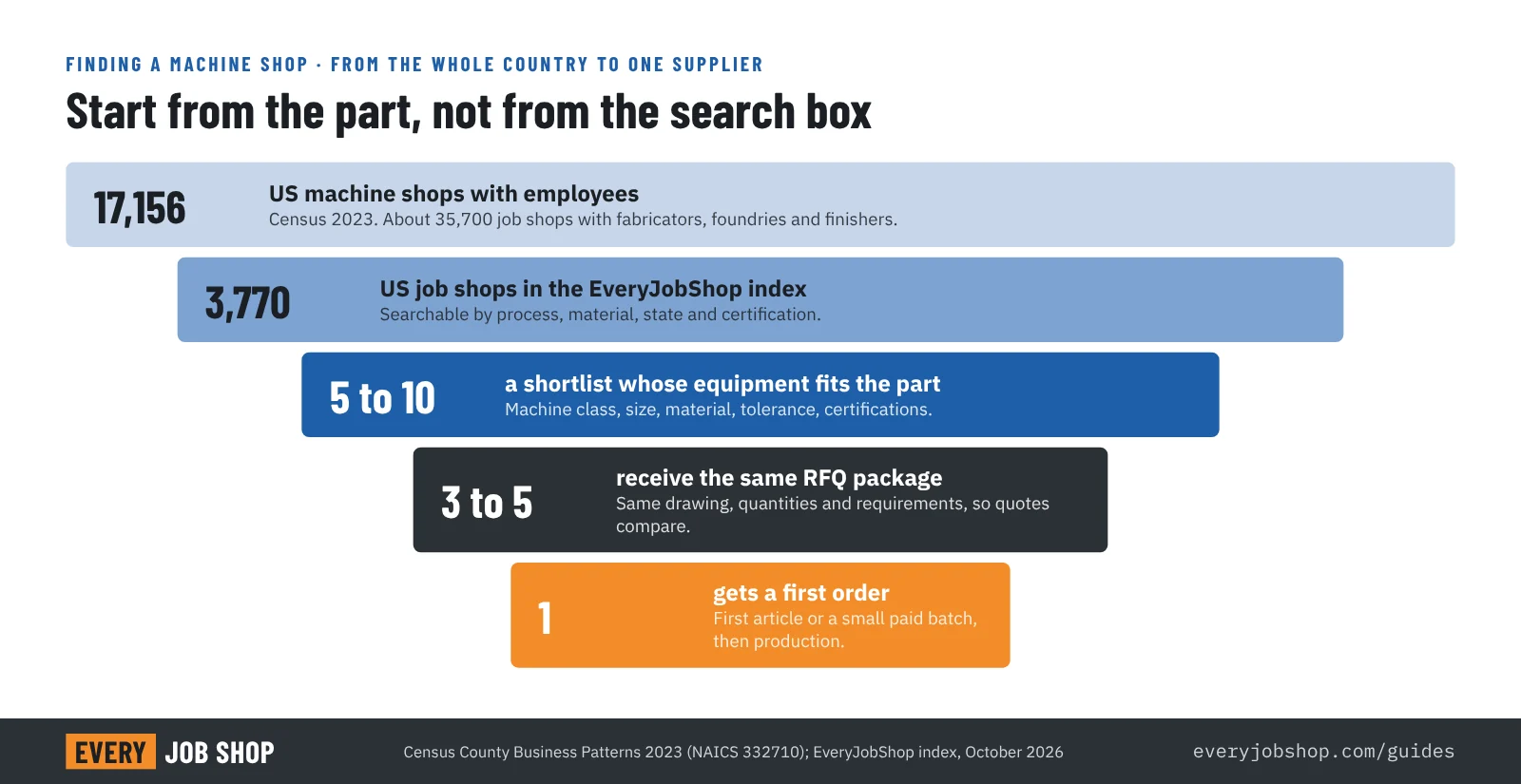
The Census Bureau counts 17,156 machine shops with paid employees in the US, and about 35,700 job shops once fabricators, stampers, foundries and finishers are added. 83% of machine shops have fewer than 20 employees; the average is 13.
That shapes how you should search and vet:
- Most good shops do little marketing. In our October 2026 test, only 1 in 4 shop websites told an AI assistant what the shop makes, and four assistants mostly named different shops. The first page of results is a small and random sample.
- Many are old and stable. Of the 3,411 shops in our index whose website states a founding year, 1,109 were founded before 1980, and the median shop is 34 years old.
- Small means personal. You will often talk to the owner. It also means limited capacity and key people who go on vacation. Ask about both.
Step 1: write down what the part needs
Before you search, write one paragraph about the part. It becomes your filter, and later the first page of the RFQ:
- Process: milling, turning, Swiss, laser cutting and bending, welding, grinding, EDM, casting.
- Material and size: alloy, stock form, the largest dimension.
- Tolerances and finish: the tightest tolerance and where it is, surface finish, coatings.
- Quantity: prototype, a batch, or a yearly volume with releases.
- Requirements: certifications (ISO 9001, AS9100, ISO 13485), ITAR, material certs, inspection reports, first article.
A shop that runs 6061 aluminum brackets every day is a poor fit for a 17-4 stainless shaft at ±0.0005 in, however good it is. Our guide on tolerances and what they cost explains which processes hold which numbers.
Step 2: search where you can filter
- Directories you can filter by process, material, state and certification. EveryJobShop lists 3,770 US shops in 50 states, with equipment read from 2,443 shop websites and filters for state, process and certification. It is free and needs no account.
- Your state's Manufacturing Extension Partnership (MEP) center. The NIST MEP network runs a supplier scouting service that typically returns results in 30 to 45 days; companies are asked to contact their local MEP center.
- The SBA small business database and SAM.gov if you buy for government contracts and need small business or socio-economic status. The SBA's Dynamic Small Business Search lists small firms by industry code and state, and shops registered for federal work appear in SAM.gov with their registration status.
- People. Engineers, other buyers, the shop that does your anodizing or heat treating. Finishers and heat treaters see the work of every machine shop in town.
- Trade shows and associations, where you can see the parts a shop is proud of.
Step 3: shortlist by equipment
A shop's machine list says more than its homepage. Look for:
- The right machine class: 5-axis mills for complex parts in one setup, Swiss lathes for small turned parts in volume, a fiber laser and press brake for sheet metal.
- Enough size: travels, swing, sheet size and press brake tonnage that fit your largest part with room to spare.
- Inspection equipment: a CMM, height gauges, thread and bore gauges, a surface plate in a temperature-controlled room for tight work.
- Secondary operations in house if you want one supplier for the whole part: welding, finishing, assembly.
Shortlist 5 to 10 shops whose equipment fits, then send the same RFQ package to 3 to 5 of them. Our guide on what to send with an RFQ has a checklist and a template.
Step 4: ask the same 12 questions
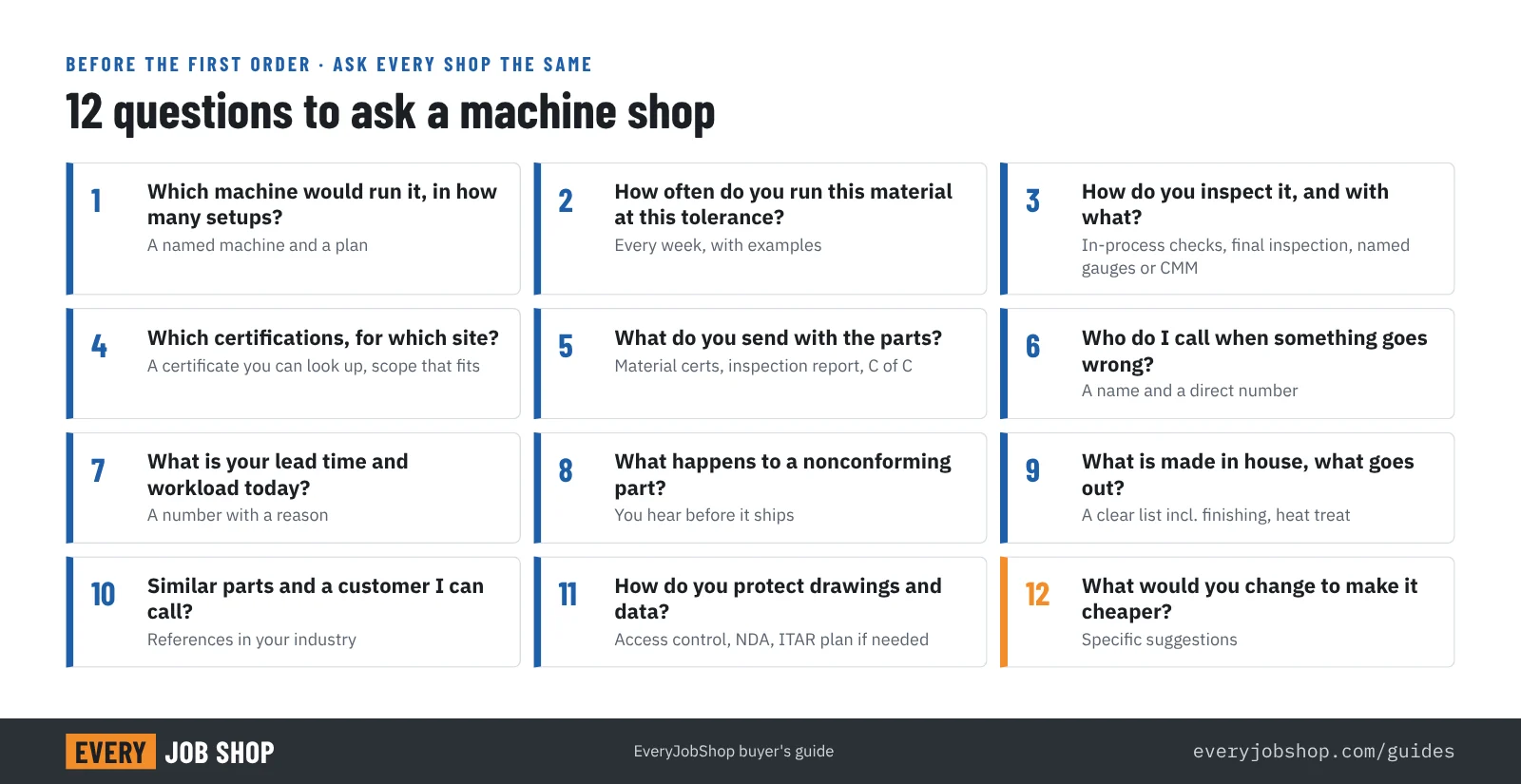
| # | Question | What a good answer sounds like |
|---|---|---|
| 1 | Which machine would run this part, and how many setups? | A specific machine and a plan, not "we can do anything" |
| 2 | How often do you run this material at this tolerance? | Every week, with examples |
| 3 | How do you inspect it, and with what? | In-process checks plus a final inspection, with named equipment |
| 4 | Which certifications do you hold, for which site? | A certificate you can look up, with a scope that covers the work |
| 5 | What do you send with the parts? | Material certs, an inspection report, a certificate of conformance when asked |
| 6 | Who do I call when something goes wrong? | A name and a direct number |
| 7 | What is your lead time today, and what is your workload? | A number with a reason, not a guess |
| 8 | What do you do with a nonconforming part? | They tell you before they ship, with a corrective action |
| 9 | What do you make in house, and what goes out? | A clear list, including who does finishing and heat treat |
| 10 | Have you made similar parts, and can I talk to that customer? | References in your industry |
| 11 | How do you protect my drawings and data? | Access control, an NDA, and for ITAR work, registration and a plan |
| 12 | What would you change in this design to make it cheaper? | Specific suggestions. A shop that asks good questions understood the part |
The last question is the most revealing. Shops that suggest a looser tolerance on a non-critical feature or a standard radius are thinking about your part, not just pricing it.
Step 5: verify what you can
- Certifications. Look the certificate up in IAF CertSearch for ISO 9001 or OASIS for AS9100, and read the scope and the site address. Our certification guide explains what each one proves and what it does not.
- ITAR. Defense articles need a shop registered with the State Department's Directorate of Defense Trade Controls; ask for the registration letter. Exports of defense articles to China are under a policy of denial (22 CFR 126.1), so ITAR work must stay with registered US shops.
- Registration and insurance. Check the business registration with the state's secretary of state, SAM.gov for government work, and ask for a certificate of insurance.
- The address. Street View, the website's photos and the shop's own machine list should describe the same place. A broker who subcontracts everything is a legitimate business, but you should know you are buying from one.
Step 6: visit, or ask for a video call from the floor
What to look at on a shop visit:
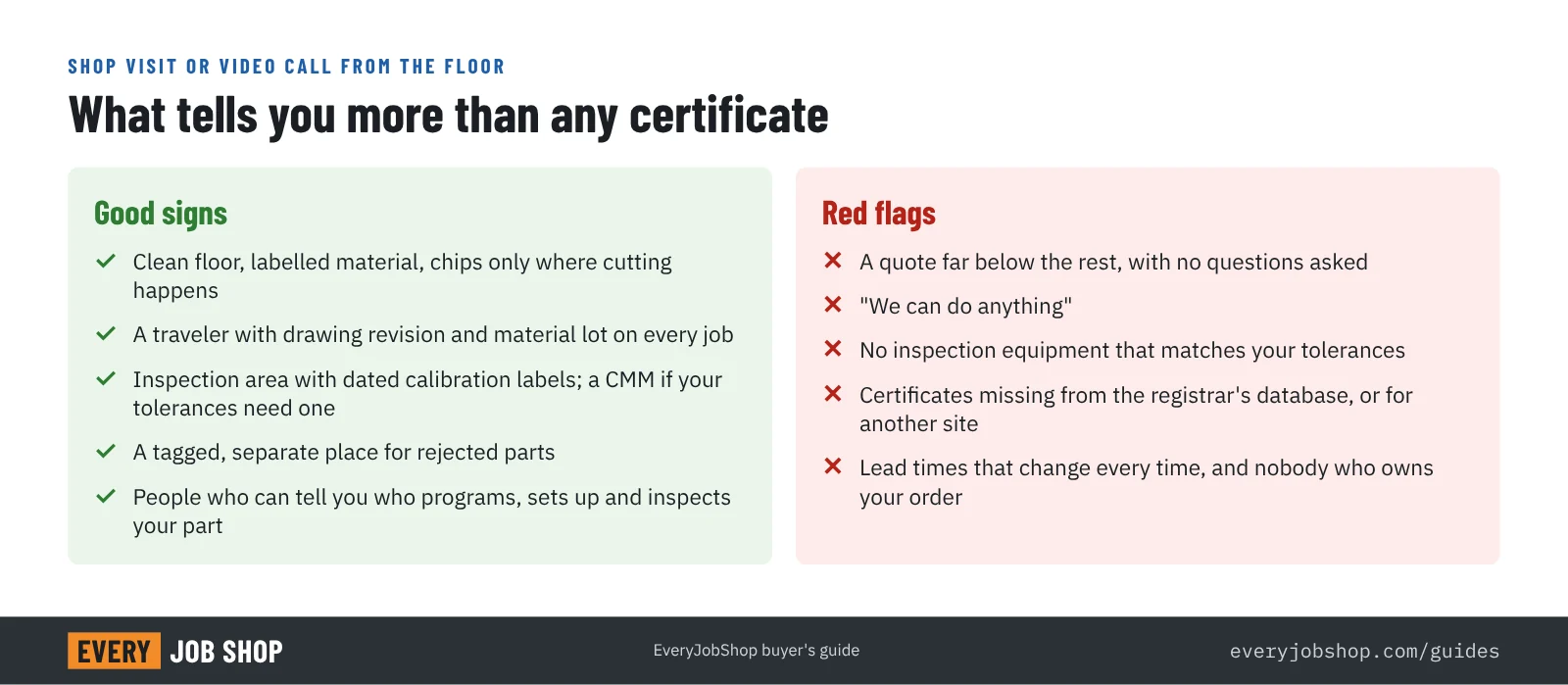
- Housekeeping. Clean floors, labelled material, chips where cutting happens. Disorder on the floor usually shows up in the parts.
- Travelers and identification. Every job on the floor should carry its paperwork, drawing revision and material lot.
- Inspection. A dedicated area, calibration labels with dates, a CMM if your tolerances need one.
- Nonconforming parts. A tagged, separate place for rejected parts. If nobody can show you one, ask how they handle them.
- People. Who would program, set up and inspect your part, and how long they have been there.
Red flags
- A quote far below the others with no questions asked. It may have missed a requirement. Ask it to confirm the drawing revision, tolerances and finish.
- "We can do anything." Good shops say what they are best at and what they send out.
- No inspection equipment that matches your tolerances.
- Certificates that cannot be found in the registrar's database, or that cover another site.
- Lead times that change every time you ask, and no one who owns your order.
Step 7: start with a first order
Give a new shop a first article or a small paid batch before a production order. For aerospace work, a first article inspection report to SAE AS9102 is the norm; for other work, ask for a dimensional report on the first parts. Compare the report with your drawing, measure a few parts yourself, and note how the shop communicated along the way. A shop that called you with a question before cutting is usually the one you keep.
Buying volume parts that are made overseas today? Our guide on reshoring parts from China in 2026 shows how to compare a US quote with the landed cost.
Start your shortlist
Search 3,770 US machine shops, fabricators and foundries by process, state, material and certification, or browse by state, starting with California, Texas or Ohio. Pick the shops whose equipment fits and send one RFQ to up to 30 of them at once.
Questions people ask
- How do I find a good machine shop near me?
- Start from the part, not from the search box: write down the process, material, size, tolerance, quantity and certifications it needs. Then search a directory you can filter by those, such as EveryJobShop (3,770 US shops in 50 states), ask your local Manufacturing Extension Partnership center, and ask other buyers and engineers. Shortlist 5 to 10 shops whose equipment fits the part and send the same RFQ package to 3 to 5 of them.
- What questions should I ask a machine shop before ordering?
- Ask which machines would run the part, which materials and tolerances they work in every week, how they inspect and with what equipment, which certifications they hold and for which site, who you talk to about problems, what their typical lead time and current workload are, how they handle nonconforming parts, whether they make it all in house, and for references from similar work.
- How can I check if a machine shop is legitimate?
- Check the certificate in the registrar's database (IAF CertSearch for ISO 9001, OASIS for AS9100), the company's registration in SAM.gov if it does government work, its business registration with the state, a certificate of insurance, and its website and address. A shop visit or a video call from the shop floor tells you more than any document.
- How many machine shops are there in the US?
- The Census Bureau counted 17,156 machine shops with paid employees in 2023. 83% have fewer than 20 employees and the average is 13. Including fabricators, stampers, foundries, forges and finishers, there are about 35,700 job shop establishments.
- Should I start with a small order?
- For a new supplier and a part that matters, yes. A first article or a small paid batch shows how the shop reads your drawing, how it communicates and what its inspection report looks like, before you depend on it for production quantities.