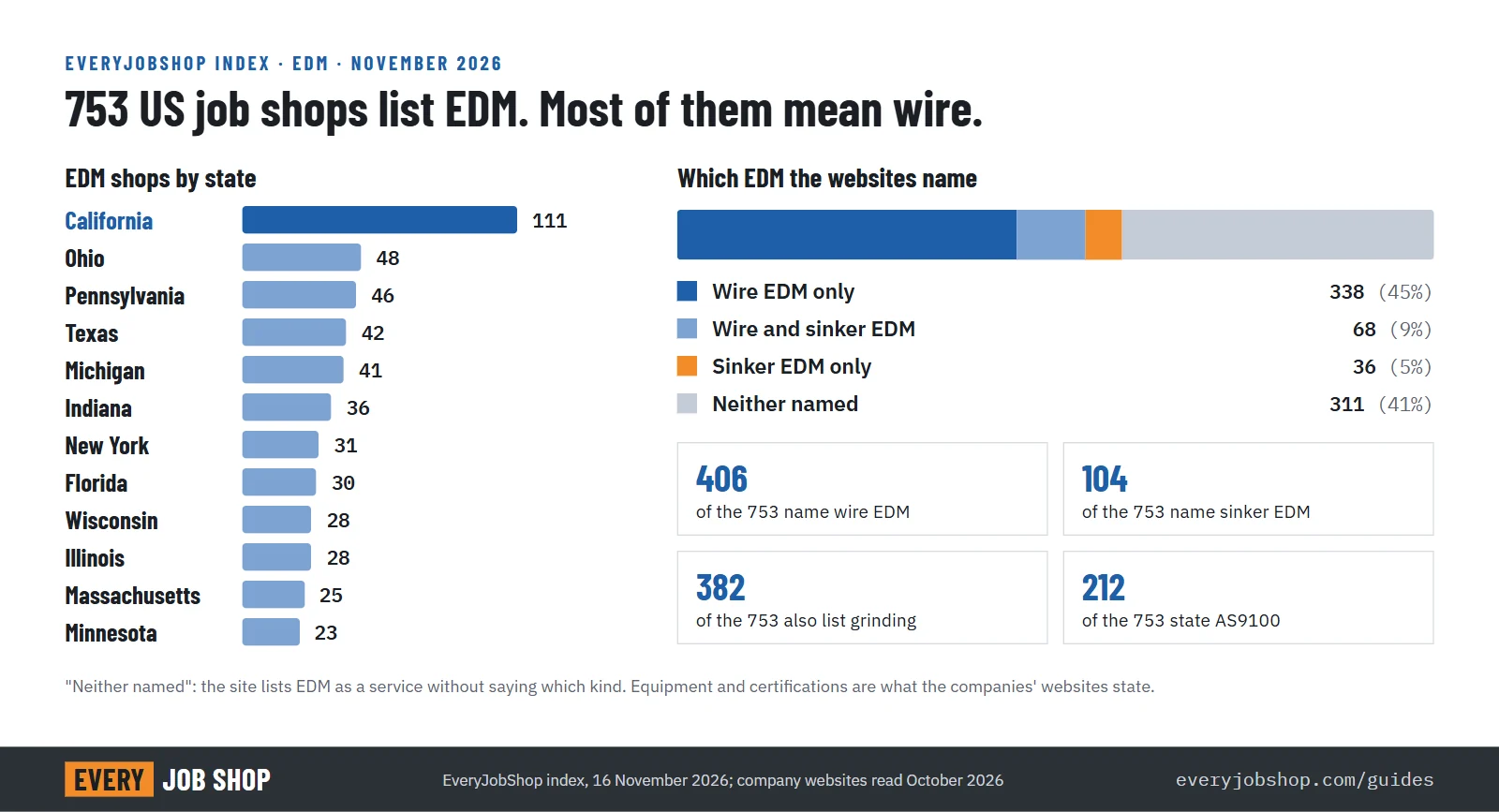
753 US job shops in our index list EDM, and the word covers two different machines. 406 of them name wire EDM on their website, 104 name sinker EDM, 68 name both, and 311 list "EDM" without saying which. If your part is a punch profile you need the first; if it is a blind cavity in a mold you need the second. A quote request that just says "EDM" can land on the wrong machine.
So what does each kind of EDM do, when is it worth paying for instead of milling, and what decides the price?
This guide answers that with the machine builders' own figures (labelled as vendor figures), a worked cost example with its assumptions stated, and our data on the 753 shops in the EveryJobShop index as of November 16, 2026.
Key numbers
- 753 of 3,783 US job shops (20%) list EDM, in 48 states. California has 111, then Ohio (48), Pennsylvania (46), Texas (42) and Michigan (41).
- Which EDM: 406 name wire EDM (54%), 104 sinker EDM (14%), 68 both. 311 (41%) list EDM without naming the kind.
- EDM builders named: Mitsubishi by 81 shops, GF AgieCharmilles (Agie or Charmilles) by 54, Makino by 40 and Sodick by 29. Mitsubishi and Makino also build lasers or mills, so not every mention is an EDM.
- Certifications: 212 state AS9100 (28%, against 18% of the other companies), 195 ITAR (26% against 17%), 47 ISO 13485 (6% against 2%) and 385 ISO 9001 (51% against 38%).
- What else they do: 382 also list grinding (51%, against 19% of the others) and 18% list stamping (8%), the tool and die side of the trade. 44% name a 5-axis machine (23%) and 38% a CMM (20%).
- Highest share: in Idaho 8 of 30 companies list EDM (27%), in Alabama 13 of 49 (27%) and in Indiana 36 of 139 (26%).
Certifications, equipment and the kind of EDM are what the companies' own websites state, read by our crawler in October 2026. We have not checked them.
What wire EDM does
Electrical discharge machining removes metal with sparks. The part and the tool sit in a dielectric fluid, the machine pulses current across a small gap, and each spark melts and flushes away a tiny crater of metal. The tool never touches the part. In Sodick's words, wire EDM "cuts any electrically conductive material", and since there is no contact there is no cutting force (vendor page).
Wire EDM uses a thin wire fed continuously from a spool between two guides above and below the part, like a band saw that never dulls. It cuts profiles through the whole thickness of the part:
- Punches, die openings and strippers for stamping tools, in hardened tool steel.
- Sharp inside corners and narrow slots. The smallest inside radius is half the wire diameter plus the spark gap. GF AgieCharmilles' CUT P series runs wire from 0.05 to 0.33 mm (vendor figure), so with 0.25 mm wire an inside corner comes out a little over 0.125 mm (0.005 inch) in radius. Outside corners can be dead sharp.
- Thin walls and delicate features that would deflect under an end mill.
- Gears, splines, keyways and extrusion dies, and tapers: the guides can tilt (the CUT P lists up to plus or minus 30 degrees).
- Thick parts. Maximum part heights run to hundreds of millimeters: 250 mm on the CUT P 350 and 750 mm on the CUT P 1250, and 215 to 505 mm across Mitsubishi Electric's MV-S series (vendor figures).
The limit: the cut has to go through. Wire EDM cannot make a blind pocket, and an internal profile needs a start hole for the wire to thread through.
What sinker EDM does
Sinker EDM (also ram EDM or die-sink EDM) uses an electrode machined to the shape of the feature, usually graphite or copper, and lowers it into the part. The sparks erode the negative of the electrode into the steel. It makes what wire cannot:
- Blind cavities and pockets, especially in injection molds and die-casting dies. GF AgieCharmilles shows its FORM X die-sinking machines on multi-cavity molds and lists a best surface finish of Ra 0.05 micron (vendor figure).
- Deep narrow ribs and sharp internal corners at the bottom of a pocket, where no end mill fits.
- Textures and fine finishes on mold surfaces.
- Features in hardened steel or carbide that are not open on both sides.
Sinker EDM costs the electrodes on top of machine time. A cavity with a fine finish may need a roughing electrode and one or more finishing electrodes, each one machined first.
When EDM beats milling
- The material is already hard. Hardened tool steel (D2, A2 and others), carbide, and heat-treated alloys. Machining before heat treat and then EDMing the critical features after avoids the distortion that heat treat causes.
- The drawing has sharp inside corners. An end mill leaves its own radius in every inside corner. Our DFM guide explains the radius rule; when the corner really has to be sharp, EDM is the way.
- Walls are thin or features are tiny. No cutting force means no deflection and no burrs.
- Tight tolerance on a profile. Each skim pass recuts the profile at low power and corrects the pass before it.
- The shape is tooling. Punches and dies, which is why EDM shops list stamping and grinding so much more often than other shops.
Milling wins on soft material and open shapes: it removes metal many times faster. The economical route for many parts is to mill most of the part, heat treat, then EDM and grind only the features that need it. Ask the shop whether it does all three in house; 382 of the EDM shops in our index also list grinding.
Tolerances and surface finish: the vendor figures
Builders publish the best their machines do under controlled conditions. All of these are vendor figures:
| Builder and machine | Stated accuracy | Stated surface finish | Conditions | Source |
|---|---|---|---|---|
| Sodick ALC600G iGE+ | plus or minus 3 microns (0.00012 inch) | 0.20 micron Ra (8 RMS) | sample cut, 100 mm SKD11 tool steel, 0.2 mm wire | Sodick |
| Sodick wire EDM range | down to plus or minus 3 microns | as fine as 0.36 micron Ra | company-wide statement | Sodick |
| Mitsubishi Electric MV-S series | 3 microns or better | down to 0.3 micron Ra | general statement | Mitsubishi Electric |
| GF AgieCharmilles CUT P | no number published | 0.10 micron Ra minimum | CUT P 350 and 600 | AgieCharmilles |
Three things to take from the table:
- The finish comes from the skim passes. The fine finishes in the table come from skim passes after the rough cut. Every skim pass is another trip around the whole profile, and it is on the bill.
- A sample cut is not a production tolerance. The machine holds microns in a temperature-controlled room on a proven program. A shop quotes what it can hold on your part, first time, with its own process, and that is a looser number.
For where EDM sits against milling, turning and grinding on a tolerance scale and what each step costs, see the tolerance guide.
What drives the cost of wire EDM
Wire EDM is quoted on machine time, and machine time follows a few things you can see on the drawing:
- Cut length times thickness. The roughing pass removes a slot the width of the wire through the full thickness, so time grows with the area of the cut: perimeter multiplied by height.
- Skim passes. Each one is another lap of the profile at a faster feed. More accuracy and a finer finish mean more skims.
- Start holes. Every internal profile needs a hole for the wire, drilled before hardening or burned with an EDM hole driller after.
- Setup and stacking. Indicating the part, threading the wire, proving the program. Several thin parts stacked and cut together share one cut.
- Material. Thick high-alloy steel, carbide and parts with interrupted cuts slow the wire down.
Worked example
Assumptions, made up for illustration and not a quote: a die opening in hardened D2 tool steel with a 200 mm perimeter; a roughing rate of 100 square millimeters of cut area per minute; skim passes at 20 mm per minute of profile on a 25 mm part and 10 mm per minute on a 50 mm part; 5 minutes for the start hole; 30 minutes of setup; a machine rate of $90 an hour ($1.50 a minute). Wire, the hardened blank and inspection are left out. Use your own shop's rate; our hourly rate guide shows how one is built.
| Case | Rough cut | Skim passes | Start hole and setup | Total time | Price at $90/h |
|---|---|---|---|---|---|
| 25 mm thick, rough cut only | 50 min | none | 35 min | 85 min | $127.50 |
| 25 mm thick, rough + 2 skims | 50 min | 20 min | 35 min | 105 min | $157.50 |
| 25 mm thick, rough + 3 skims | 50 min | 30 min | 35 min | 115 min | $172.50 |
| 50 mm thick, rough + 2 skims | 100 min | 40 min | 35 min | 175 min | $262.50 |
Doubling the thickness raises the price by two thirds; adding a third skim pass adds about 6%. A tolerance only where the function needs it, on the features that need it, keeps skim passes off the rest of the profile. Stacking ten 2.5 mm plates gives the same 25 mm cut as one thick part, which is why thin parts are often cheap to wire in batches.
What to send for an EDM quote
- A 3D model and a 2D drawing, with the profile clean (closed contours, no duplicate lines). A DXF of the profile helps for wire work.
- Material and condition: grade, and whether you supply it hardened, or the shop buys it and sends it for heat treat. Give the hardness.
- Which features need EDM, if the rest can be milled or ground, and which surfaces are critical.
- Tolerances and finish on those features.
- Quantity, per batch and per year, so the shop can plan stacking.
- Wire or sinker, if you know. If you do not, describe the feature (through profile or blind cavity) and let the shop choose.
Our RFQ guide covers the rest of a complete request.
Where the EDM shops are
| State | EDM shops | Share of the state's shops | Name wire EDM | Name sinker EDM | State AS9100 |
|---|---|---|---|---|---|
| California | 111 | 19% | 52 | 19 | 40 |
| Ohio | 48 | 23% | 27 | 5 | 12 |
| Pennsylvania | 46 | 23% | 23 | 7 | 11 |
| Texas | 42 | 18% | 14 | 1 | 6 |
| Michigan | 41 | 19% | 21 | 4 | 5 |
| Indiana | 36 | 26% | 25 | 7 | 8 |
| New York | 31 | 24% | 17 | 6 | 12 |
| Florida | 30 | 20% | 18 | 1 | 8 |
| Wisconsin | 28 | 20% | 13 | 6 | 7 |
| Illinois | 28 | 19% | 20 | 3 | 6 |
| Massachusetts | 25 | 20% | 17 | 4 | 4 |
| Minnesota | 23 | 24% | 14 | 3 | 8 |
Eleven more states have 10 or more EDM shops each, with their own page: Arizona (22), Connecticut (18), North Carolina and Virginia (14 each), Alabama, Colorado, New Jersey and Missouri (13 each), Oregon, Tennessee and Utah (11 each).
Sinker EDM is scarcer than wire everywhere: only California, Indiana, Pennsylvania, New York and Wisconsin have six or more shops that name it. For a mold cavity, start with those states or ask a wire shop which sinker shop it works with. Texas has 42 EDM shops but only one that names sinker EDM.
By city, the most EDM shops are in San Jose, California and Houston, Texas (14 each), then Phoenix, Arizona (9), Albuquerque, New Mexico and Dayton, Ohio (8 each).
Two shops that list EDM have confirmed their listing with us ("Verified with the shop"): Sierra Machinery and Engineering in Sparks, Nevada, which names wire EDM and grinding in house, and Prototek Digital Manufacturing in Menomonie, Wisconsin. Verified means the shop confirmed its details, not that we audited its work.
How to vet an EDM shop
- Ask which machine and which wire. Builder, age, maximum part height and taper, and whether it runs the fine wire a tight inside corner needs.
- Ask what it holds on your thickness and material, not the brochure number, and how many skims that takes.
- Ask how it measures. A CMM or optical measurement for the profile, a profilometer for finish. 38% of the EDM shops in our index name a CMM on their site.
- For sinker work, ask who makes the electrodes and from what. A shop that mills its own graphite electrodes controls the lead time.
- Ask about heat treat and grinding. In house or outside, and in which order. For aerospace work check the AS9100 certificate in OASIS and whether the heat treater is Nadcap accredited; our AS9100 and ITAR guide explains both.
- Start with one part or a short batch and compare the inspection report with your drawing. The vetting guide has the full question list.
Find EDM shops
Browse all 753 EDM shops on a map, or narrow the list: EDM shops with AS9100, with ISO 13485, and compare with the grinding shops. With a drawing ready, send one RFQ to up to 30 shops and say whether the feature is a through profile (wire) or a blind cavity (sinker).
Questions people ask
- What is the difference between wire EDM and sinker EDM?
- Both remove metal with electrical sparks in a dielectric fluid, without the tool touching the part. Wire EDM uses a thin wire, typically 0.05 to 0.33 mm on a current GF AgieCharmilles machine, that runs through the part like a band saw and cuts profiles through its full thickness: punches, die openings, slots, gears. Sinker EDM, also called ram or die-sink EDM, presses a shaped electrode, usually graphite or copper, into the part and leaves its negative: mold cavities, ribs, blind pockets and shapes that do not go through.
- How accurate is wire EDM?
- The builders publish figures for their best results: Sodick lists a sample cut in 100 mm thick SKD11 tool steel held to plus or minus 3 microns (0.00012 inch) with a 0.20 micron Ra finish, and Mitsubishi Electric describes its MV-S series as accurate to 3 microns or better with finishes down to Ra 0.3 micron. These are vendor figures from sample cuts under controlled conditions. A job shop quotes what it can hold on your part, in your material and thickness, which is a looser number; ask for it before you order.
- When should I use EDM instead of milling?
- When the material is already hardened, when the drawing has sharp inside corners or narrow slots an end mill cannot reach, when walls are too thin to take cutting forces, and for punches, dies and other tooling profiles. Milling is faster and cheaper on soft material with open shapes, so a common route is to mill most of the part and EDM only the features that need it.
- What drives the cost of wire EDM?
- Mostly machine time, which grows with the cut length multiplied by the part thickness, and with each skim pass added for accuracy and finish. Start holes for internal profiles, setup, the number of parts stacked in one cut, and the wire itself add to it. In our worked example, doubling the thickness of a 200 mm profile from 25 to 50 mm raises the price from about $158 to about $263.
- How many wire EDM shops are there in the US?
- In the EveryJobShop index, 753 of the 3,783 US job shops (20%) list EDM as of November 2026, in 48 states. 406 of them name wire EDM on their website and 104 name sinker EDM; 311 list EDM without saying which kind. California has 111 EDM shops, then Ohio (48), Pennsylvania (46), Texas (42) and Michigan (41).