Many buyers assume a CNC part has a price, the way a bolt does: send the drawing, get the number, and if one shop is much higher it must be overcharging. Then the same aluminum bracket comes back at $560 for one piece and $51 each for a hundred, and two shops quoting the same hundred pieces are a factor of two apart.
So what does CNC machining actually cost?
It costs machine time plus everything that has to happen before the first chip: programming, setup, inspection. Those fixed costs, the machine the shop chooses, and how much risk it sees in your tolerances explain almost every gap between quotes. This guide shows the rates, the cost drivers, a full worked example and the design changes that cut the price.
The four parts of every CNC price
Every quote, whether it comes from an estimator's spreadsheet or an instant-quote engine, is built from the same pieces:
- Fixed cost per job. CAM programming, fixture design, and the quoting and paperwork itself. Protolabs Network (Hubs), a manufacturing marketplace, describes design-for-manufacturing and administrative costs as "generally fixed costs".
- Fixed cost per batch. Setting up the machine: loading tools, mounting vises or fixtures, touching off, proving out the first part, first article inspection.
- Variable cost per part. Machine time (cycle time times the machine rate), material, deburring, inspection of each part.
- Outside processes. Anodizing, plating, heat treating and powder coating are usually sent to specialist vendors, who charge per lot with a minimum.
Machine hourly rates by type
There is no official national survey of CNC shop rates. Most published figures come from manufacturing marketplaces and shops themselves, so treat them as benchmarks, not prices. The clearest comparison is the Protolabs Network (Hubs) CNC machining guide (vendor source, page current in 2026), which sets 3-axis milling as the baseline and calls the figures rough estimates:
| Machine type | Hubs estimate | Relative to 3-axis | Typical work |
|---|---|---|---|
| CNC turning (lathe) | $65/h | about 15% less | Shafts, bushings, round parts |
| 3-axis milling | $75/h | baseline | Plates, brackets, housings with features on few faces |
| Mill-turn center | $95/h | about 25% more | Round parts with milled flats, cross holes |
| Indexed 5-axis milling | $120/h | about 60% more | Parts with features on many faces, fewer setups |
| Continuous 5-axis milling | $150/h | about 100% more | Impellers, organic surfaces, complex aerospace parts |
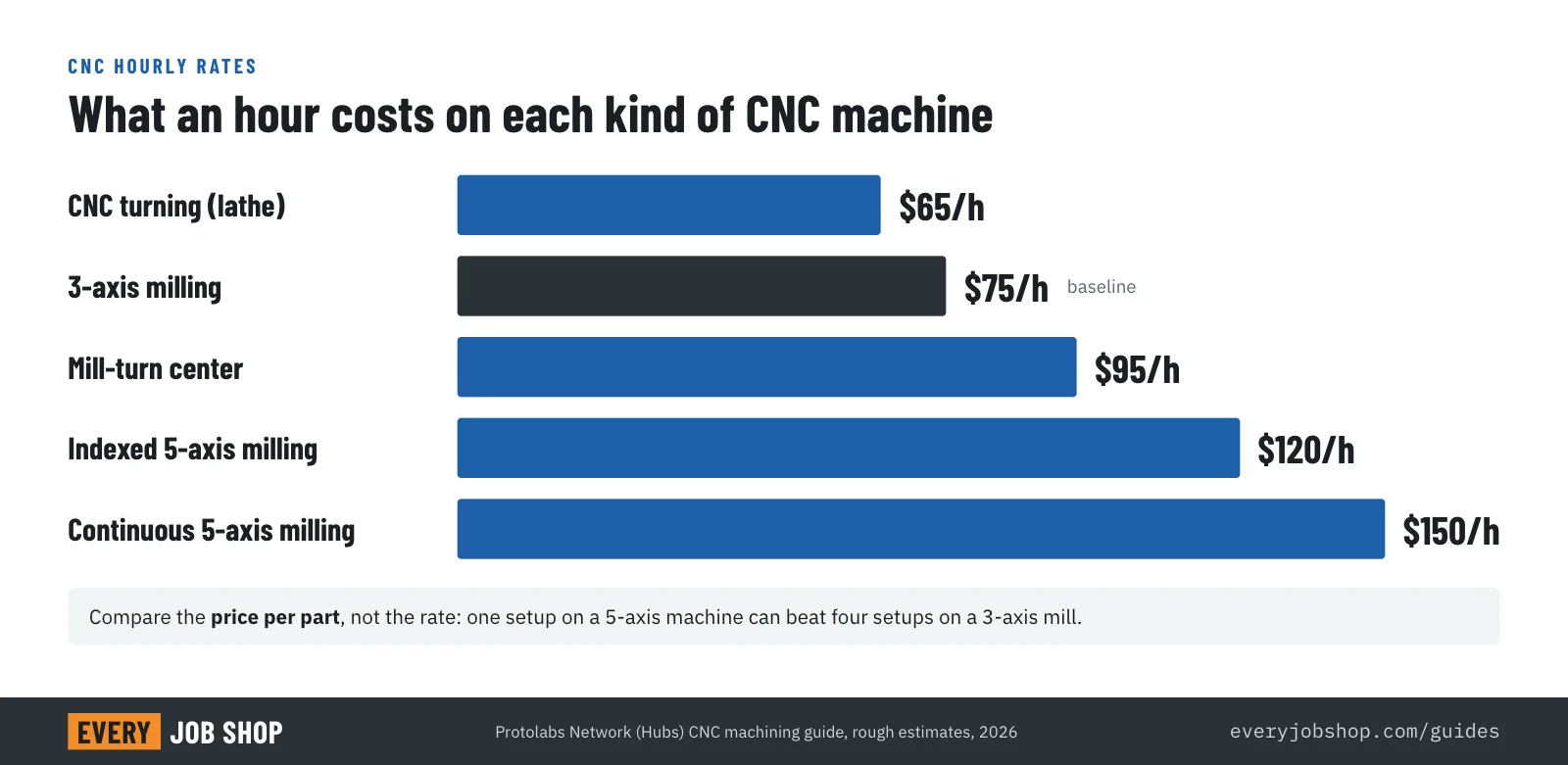
Two things the table does not show:
- Swiss-type lathes are not listed in the Hubs guide. They are built for small, long, precise turned parts in high quantity, bar-fed and often running unattended, so shops usually quote them on cycle time across a large run rather than on an hourly rate you can compare directly.
- A higher rate can mean a lower price. A 5-axis machine costs more per hour, but if it finishes a part in one setup instead of four on a 3-axis mill, the total can be lower. Compare the price per part, not the rate.
Setup and programming
For low quantities, setup and programming usually cost more than the machining itself. A simple bracket may need an hour or two of CAM work and roughly an hour of setup per operation. These numbers depend entirely on the part and the shop, which is why our example below states its assumptions.
The effect of spreading those costs is large. In a Hubs design tips article (vendor source), going from one to five parts can cut the unit price by about half, and volumes above 1,000 parts can reduce unit cost five to ten times, in their example for 304 stainless steel parts.
Material
Material cost is two things: the price of the stock and how hard the material is to cut. The Hubs design tips article lists retail prices for a 6 x 6 x 1 in block from McMaster-Carr (prices as listed in the article; check current prices):
| Material | 6 x 6 x 1 in block (retail, as listed) |
|---|---|
| ABS | $17 |
| Aluminum 6061 | $25 |
| POM (Delrin) | $27 |
| Nylon 6 | $30 |
| Aluminum 7075 | $80 |
| Stainless steel 304 | $90 |
| Brass C360 | $148 |
| Stainless steel 303 | $150 |
| PEEK | $300 |
Machinability matters as much as the stock price. The same article gives a machinability index of about 45% for 304 stainless and about 78% for 303, which is why 303 can be cheaper to machine overall despite the higher stock price, if the part allows it. The Hubs guide also notes that hard-to-machine materials such as Inconel raise machining time, tool wear and the risk of having to remake a part.
Shops also need a blank larger than the part. Hubs suggests about 0.125 in (3 mm) extra in each dimension, so a part that is 4 in long is cut from at least 4.125 in of stock.
Tolerances and finish
Tolerances change how a part is made. A general tolerance of ±0.005 in can usually be held with standard roughing and finishing passes. A ±0.0005 in bore needs a slower finishing pass or reaming, careful temperature control, a more capable machine and an inspection step with a bore gauge or CMM. Hubs gives its standard tolerance as ±0.125 mm (about ±0.005 in), with ±0.025 mm (about ±0.001 in) feasible, and its advice is short: define tolerances on critical features, but "do not over-tolerance".
Finishes follow the same logic. In the same guide, Hubs ranks finishes by relative cost: as-machined adds nothing, bead blasting and silk screening add a little, anodizing and powder coating more, and hardcoat anodizing most. Each additional finish also means masking, handling and a lot charge from the finishing vendor.
A worked example: a 6061 aluminum bracket at 1, 10 and 100 pieces
This is our own example to show how a price is built, not a quote from any shop. The assumptions are stated so you can swap in your own.
The part: a 6061-T6 aluminum bracket, 4 x 3 x 1 in, milled on a 3-axis machine in two operations, with tapped holes, one bore at ±0.001 in, everything else ±0.005 in, clear anodized.
Assumptions:
- Machine rate $75/h (the Hubs 3-axis baseline above).
- CAM programming: 1.5 h at $75/h = $112.50, once per job.
- Setup: two operations at 0.75 h each = 1.5 h at $75/h = $112.50 per batch.
- First article inspection: 0.5 h at $75/h = $37.50 per batch.
- Cycle time: 18 min per part for both operations = $22.50.
- Deburr and inspection of each part: 5 min at $60/h = $5.00.
- Material: a 4.25 x 3.25 x 1.25 in blank (about 17 cubic inches). At the retail price listed above (about $0.70 per cubic inch) that is about $12; we assume $8, since shops buy bar and plate below retail.
- Anodizing by an outside vendor: $150 lot minimum, or $2.50 a part at 100 pieces.
- Margin: 20% (price = cost ÷ 0.80).
| Cost item | Qty 1 | Qty 10 (per part) | Qty 100 (per part) |
|---|---|---|---|
| Programming ($112.50 per job) | $112.50 | $11.25 | $1.13 |
| Setup ($112.50 per batch) | $112.50 | $11.25 | $1.13 |
| First article inspection ($37.50) | $37.50 | $3.75 | $0.38 |
| Machining (18 min at $75/h) | $22.50 | $22.50 | $22.50 |
| Deburr and inspection | $5.00 | $5.00 | $5.00 |
| Material | $8.00 | $8.00 | $8.00 |
| Anodizing | $150.00 | $15.00 | $2.50 |
| Cost | $448.00 | $76.75 | $40.63 |
| Price at 20% margin | $560.00 | $95.94 | $50.78 |
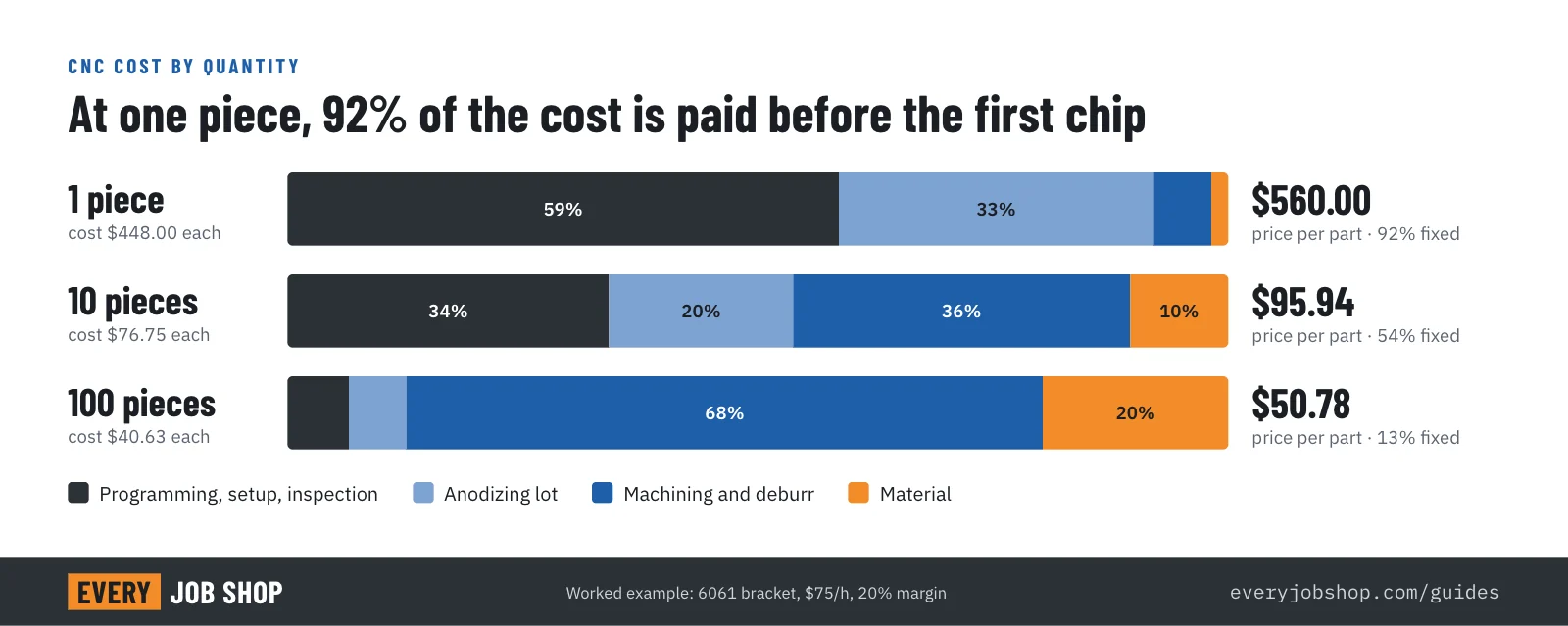
What the table shows:
- At one piece, more than 90% of the cost is fixed: programming, setup, inspection and the anodizing lot minimum. Machining is only $22.50 of $448.
- At 100 pieces, machine time is the biggest line. That is when cycle time reductions pay off, and real shops often find them: a better fixture holding several parts, a faster tool path, a second operation eliminated. Our example keeps the cycle time fixed, so the real price at 100 could be lower.
- The ±0.001 in bore is hidden in the 18 minutes and in the inspection time. If the bore could be ±0.005 in, the finishing pass and gauge check get shorter, and a shop with less precise machines could also quote it.
How to cut the cost of a CNC part
Most of these come from the Hubs design tips; the reasons are the same at any shop.
- Order more at once, or ask for quantity breaks. Fixed costs are the largest part of small orders. Asking for prices at 10, 50 and 100 shows you where the curve flattens.
- Tolerance only what matters. Put a general tolerance in the title block and tight tolerances only on fits, bores and datums.
- Add internal corner radii. End mills are round. Hubs recommends a radius of at least one third of the cavity depth, and limiting cavity depth to four times its length.
- Keep walls thick enough. Hubs suggests walls above 0.8 mm (about 0.03 in) for metals and 1.5 mm (about 0.06 in) for plastics. Thin walls chatter and need slow passes.
- Keep holes and threads standard. Standard drill sizes, hole depth up to four times the diameter, and thread length up to three times the diameter. Deeper is possible but slower.
- Design for fewer setups. Every time the part is flipped or refixtured, the shop adds a setup. Features on one or two faces are cheaper than features on six.
- Skip finishes you do not need. As-machined is free. Each extra finish adds handling, masking and a lot charge.
Why quotes for the same part vary so much
Two quotes a factor of two apart do not mean one shop is cheating. Common reasons:
- Different machines. One shop runs the part on a 5-axis machine in one setup, another needs three setups on a 3-axis mill. One has a bar-fed lathe, another saws blanks by hand.
- Different rates. Rates depend on equipment, labor, overhead and region.
- Different workload. A shop with open capacity next week prices to fill it. A full shop prices high, or quotes a long lead time, because it does not need the job.
- Different reading of the risk. A shop that sees a tolerance it struggles to hold, or an unclear drawing, adds margin for scrap and questions. Clear drawings get tighter quotes.
- Different fit. Shops choose which RFQs to pursue. Modern Machine Shop described Advance CNC Machining, which converted 40 to 50 percent of RFQs that suited it into orders but only 4 percent of another class of RFQs, and began screening by quantity and value per piece. A shop that is not set up for your part may still quote, just high.
- What is included. Check whether the quote includes material certificates, first article inspection reports, finishing, packaging and shipping, and whether programming is a separate line (and waived on reorders).
The practical answer is to ask several shops whose equipment fits the part, and to send them the same complete package. Our guide on what to send for a machine shop quote has a checklist. If you are not sure CNC is the right process at all, compare it with sheet metal and 3D printing in our process comparison by quantity.
Find CNC shops and compare real quotes
EveryJobShop is a free index of 3,768 US job shops in 50 states. Search CNC milling or CNC turning shops by material, certification and state, or browse all shops. When you have a drawing ready, send one RFQ to up to 30 matching shops at once and compare the quotes side by side.
Questions people ask
- What is a typical hourly rate for CNC machining in 2026?
- Published figures vary a lot. Protolabs Network (Hubs) uses about $75 an hour for 3-axis milling as a baseline, with turning around $65, indexed 5-axis around $120 and continuous 5-axis around $150. Real shop rates depend on the machine, the region and how busy the shop is.
- Why is the first part so expensive?
- Because programming, setup and first article inspection are paid once per job or per batch, whatever the quantity. On a single part that fixed cost lands entirely on one piece. At 100 pieces it is spread a hundred ways.
- Do tight tolerances really cost more?
- Yes. A tighter tolerance usually means slower finishing passes, more inspection, sometimes a different machine or a fixture, and more scrap risk. Put tight tolerances only on the features that need them and let the rest fall under a general tolerance.
- Which material is cheapest to machine?
- For metals, 6061 aluminum is usually the cheapest overall because the stock is inexpensive and it cuts fast. Stainless steels, titanium and nickel alloys cost more both in stock and in machine time and tool wear.
- How many quotes should I get?
- Enough to see the spread. Quotes for the same part often differ by a factor of two or more, because shops have different machines, rates, workloads and risk assessments. Three to five quotes from shops that fit the part is a common rule of thumb; for unusual parts, ask more.