A working prototype feels like the finish line. The product turns on, the parts fit, friends want one. What is left is "just manufacturing".
In December 2012, CNNMoney looked at the 50 most-funded projects on Kickstarter. 84% had missed their promised ship date: 26 shipped late, with a median delay of two months, and 16 had not shipped at all. A wider study by Ethan Mollick of more than 48,500 projects found the same pattern: over 75% delivered later than expected, and the delay grew with the amount raised. A later study for Kickstarter found that about 9% of funded projects never delivered at all.
These teams had working prototypes. So where did the months go?
They went into the part of the work that a prototype does not test: whether the design can be built a thousand times, by someone else, at a price, with parts that pass inspection and a product that passes certification. This guide walks through that path stage by stage, with typical durations and costs from published sources, and ends with a checklist for the conversation with your first factory or shop.
What a prototype proves, and what it does not
A prototype answers one question: can this design work? It is usually built by the person who designed it, with hand-picked parts, 3D printed or machined one at a time, adjusted until it fits.
Production asks different questions:
- Can someone else build it from your files and drawings, without you in the room?
- Can it be built the same way every time, with parts that vary within their tolerances?
- Can it be built at the target cost, with the processes that make sense at your quantity?
- Does it pass the tests a product has to pass before it can be sold and shipped?
The industry answers these questions with three validation builds, usually called EVT, DVT and PVT.
The three builds between prototype and production
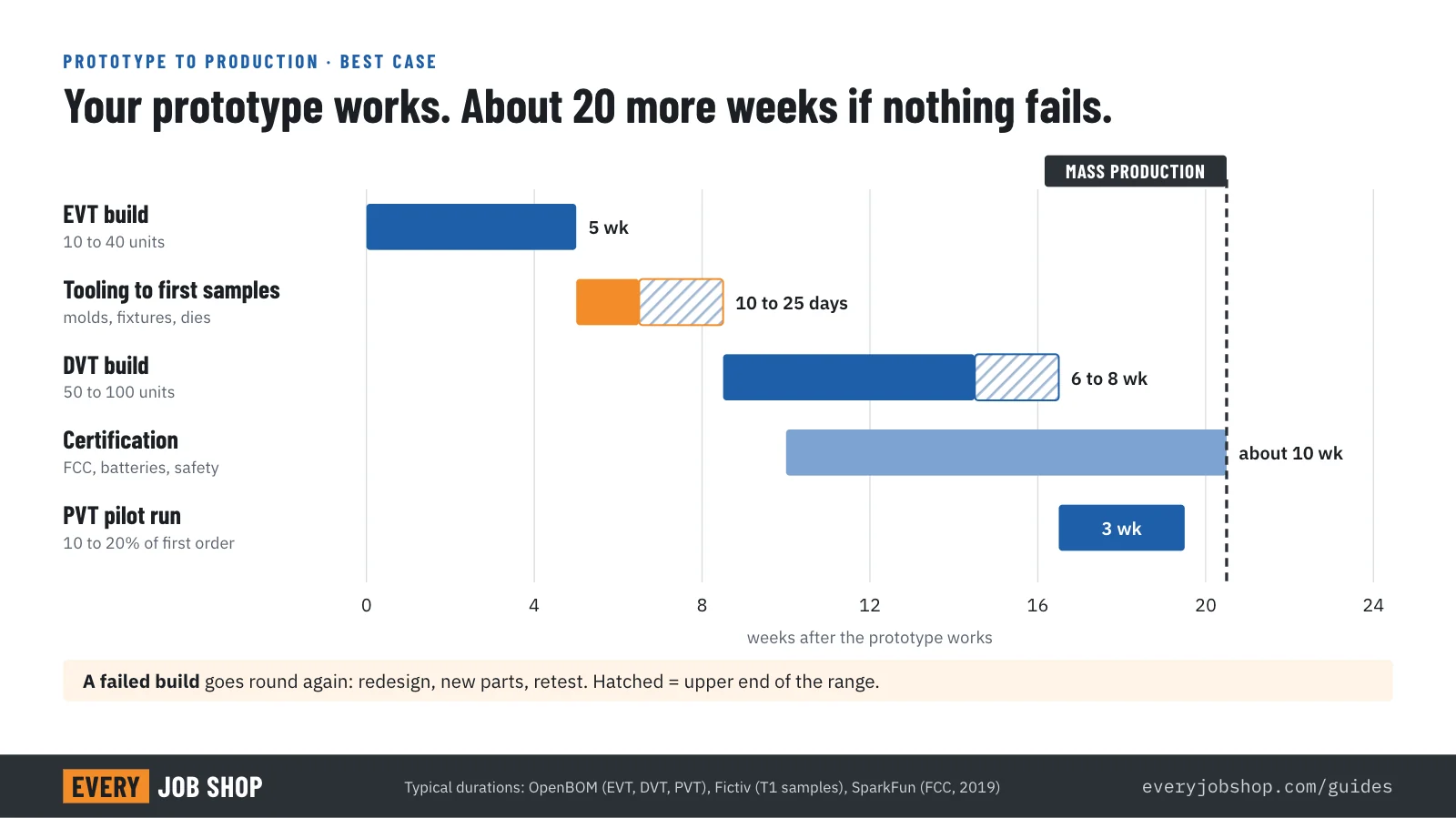
The numbers below are one published set of typical figures, from the product data company OpenBOM (vendor source). Other sources give different ranges; treat them as a starting point, not a rule.
| Build | Question it answers | Typical units | Typical duration |
|---|---|---|---|
| EVT, engineering validation | Does the design work with real parts and the intended processes? | 10 to 40 | 5 weeks |
| DVT, design validation | Does the complete product survive drop, life and environmental tests and certification? | 50 to 100 | 6 to 8 weeks |
| PVT, production validation | Can the factory build it repeatedly at the planned rate and quality? | 10 to 20% of the first order | 3 weeks |
EVT: the design, with real parts
EVT is the first build with parts made the way production parts will be made, or as close as possible. The goal is to find what breaks: components that run hot, parts that do not fit when they are at the edge of their tolerance, a board that works on the bench but not inside the enclosure. The wallet maker Bitkey describes EVT as the build where the hardware becomes mature enough for regulatory certification and early beta testing, and where small design changes still fix reliability problems.
Expect to change the design after EVT. That is the point of it.
DVT: the product, tested to failure
DVT units should be built with production tooling or tooling very close to it, because DVT is where you run the tests that decide whether the product can be sold: drop and vibration, life cycles, temperature, and the certification tests in the next section. A design change after DVT means retesting, which is why it hurts.
This is also where tooling lead time starts to matter. One contract manufacturer says single-cavity P20 or NAK80 steel molds for EVT and DVT produce the first samples (T1) in 10 to 25 days (vendor source). T1 samples are rarely perfect, and each correction to the tool takes another round.
PVT: the factory, at speed
PVT is a pilot run on the real production line, with the real operators and the real inspection plan. It finds the problems that only appear at rate: a fixture that wears, an assembly step that takes twice as long as planned, a supplier whose second batch is not like the first. Once PVT passes, the line is released for mass production.
What it adds up to
With these durations, a product that passes every build at the first attempt needs about 14 to 16 weeks of builds, plus the time to make tooling and to run certification. That is roughly four to five months after the prototype works, in the best case. Every failed build adds a loop of redesign, new parts and retest, which is how a first product turns into a year or more.
Tooling: the largest one-time cost
A prototype needs no tooling. A production run often does, and it is usually the largest single check you write before the first unit ships.
- Injection molds. Protolabs states that its molds start at $1,495 for simple aluminum tools (vendor source, 2026). Formlabs gives $2,000 to $5,000 for a machined aluminum mold for about 1,000 to 5,000 units, and $5,000 to $100,000 for complex molds intended for 10,000 or more. In one moldmaker's case study, a full aluminum mold was quoted at about $13,500 and 3 weeks, and a P20 steel mold at about $21,000 and 5 weeks.
- Aluminum or steel. Aluminum tools are cheaper, faster and easier to modify. Steel tools last far longer: hundreds of thousands to millions of cycles against thousands to tens of thousands for aluminum, according to Protolabs.
- Dies and fixtures for metal parts. Laser cutting, press brake bending and CNC machining need no part-specific tooling, which is why they suit low quantities. At volume, a machined part gets dedicated fixtures and an optimized program, and a sheet metal part may move to stamping with its own dies. Each of those is a new one-time cost, and a new process to validate.
The trap is to order production tooling before the design has passed EVT. A mold is a precise negative of your part. Every design change after the mold is cut is a tool change, and some changes cannot be made at all without a new tool.
Certification: the tests a prototype never had to pass
A prototype on your desk needs no paperwork. A product sold in the US usually does, and the tests need hardware that is final or very close to it.
- FCC Part 15. Nearly every electronic product sold in the US falls under it: as an unintentional radiator if it has any digital circuit, and as an intentional radiator if it has a radio. SparkFun published its full costs for certifying a Bluetooth module in 2019: $4,000 for FCC testing and certification, $12,200 for FCC, Canada and EU together, and about two and a half months from the down payment to the FCC listing. A pre-certified radio module reduces the radio testing, but the finished product still has to meet the rules.
- Lithium batteries. Cells and battery packs have to pass the UN38.3 transport tests before they can be shipped. One test service lists 6 to 8 weeks for most packs, and 1 week for a single-cell pack whose cell already has UN38.3. Choosing cells that already carry the certificate saves weeks.
- Safety and other markets. Products plugged into the mains, products for children and medical devices have their own standards, and the EU, Canada and other markets have their own marks. List the markets before you design, not after.
Moving metal parts from prototype to production
Machined, sheet metal, cast and welded parts are where many hardware products start, and where the prototype habit causes the most surprises.
- Tolerances that were never tested. A prototype part is often fitted by hand. In production, every part is somewhere within its tolerance, and the assembly has to work at the edges. Check your tolerance stack before EVT, and loosen every tolerance that does not need to be tight: our DFM guide shows how much tight tolerances cost.
- A drawing, not just a model. A prototype shop will work from a STEP file and a phone call. A production shop needs a drawing with tolerances, material, finish and critical dimensions, so that the hundredth part matches the first. Our RFQ guide lists what to send.
- First article inspection. Before a production run, the shop measures the first part against every dimension on the drawing and records it in a first article report. It is the point where you and the shop agree that the process makes good parts.
- Any process change is a new first article. Quality software maker 1factory describes a supplier that passed first article on 100 parts machined on a 4-axis CNC, then moved the 30,000-part order to a Swiss screw machine with new fixtures and tooling. The buyer found 6% defective parts at incoming inspection. The design had not changed; the process had, and the first article no longer proved anything.
- Finishing has its own minimums. Anodizing, plating and powder coating are often priced by lot. At prototype quantities the lot charge dominates; at production quantities it disappears, and the finish line's capacity becomes the constraint.
- Quantity breaks change the process. A part that is cheapest machined at 50 pieces can be cheapest cast or stamped at 5,000. Ask for quotes at your real quantities, and read our comparison of sheet metal, CNC and 3D printing by quantity.
Bridge production: shipping before the tooling is ready
There is a gap between the last prototype and the first units off production tooling, and many teams fill it with bridge production: the first few hundred units made with methods that cost more per part but need little or no tooling and are easy to change.
- CNC machined housings and brackets instead of cast or molded ones.
- Laser-cut and bent sheet metal instead of stamped parts.
- Urethane casting for plastic parts that need to look molded, typically 20 to 25 parts per silicone mold (vendor source).
- Aluminum molds that Protolabs lists as suited to prototypes, bridge tooling and low- to medium-volume production.
Bridge parts are more expensive per unit, but they let you ship to your first customers, learn what they actually use, and fix the design before you commit to steel. For a crowdfunded product, that can be the difference between a two-month delay and a year.
Before you talk to a factory: a checklist
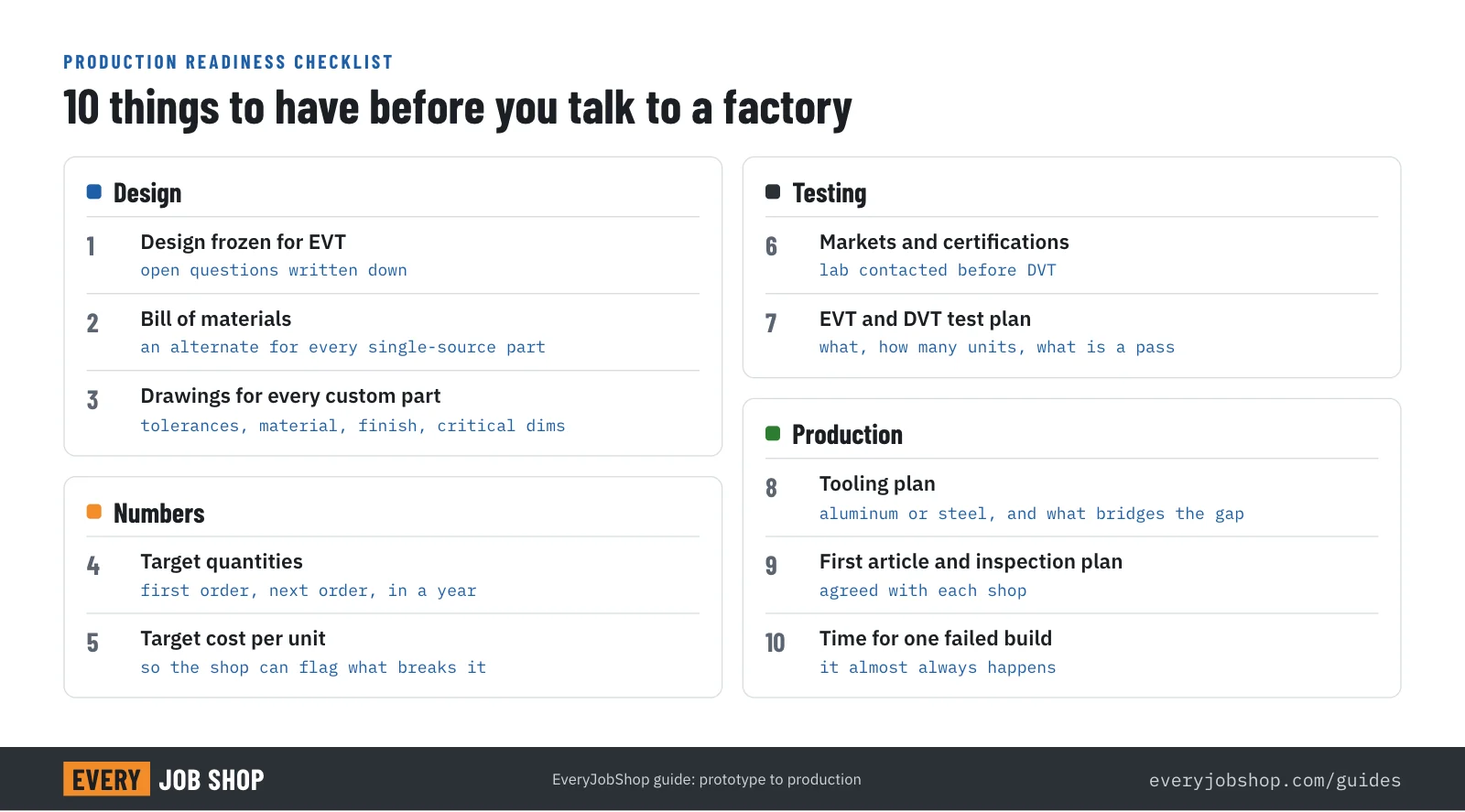
- A design frozen for EVT, with the open questions written down.
- A bill of materials with part numbers, at least one alternate for every part that has a single source, and lead times for the long ones.
- Drawings with tolerances, materials, finishes and critical dimensions for every custom part.
- The target quantities: the first order, the next one, and a year from now. A shop quotes differently for 100 and 10,000.
- A target cost per unit, so the shop can tell you early which choices break it.
- The list of markets and certifications, with a lab contacted before DVT.
- A test plan for EVT and DVT: what you will test, how many units, and what counts as a pass.
- A tooling plan: which parts need tooling, aluminum or steel, and what bridges the gap.
- A first article and inspection plan agreed with each shop.
- Time in the plan for at least one failed build. It almost always happens.
Find the shops for each stage
EveryJobShop is a free index of 3,768 US job shops in 50 states. Search by process, material, certification and state: CNC milling, laser cutting, bending, casting, stamping or all shops, or send one RFQ to up to 30 shops and compare their answers. Taking your first product to production and not sure where to start? Book a free call below.
Questions people ask
- What do EVT, DVT and PVT mean?
- They are the three validation builds between a prototype and mass production. EVT (engineering validation test) checks that the design works with real parts. DVT (design validation test) checks that the complete product survives testing and certification, usually with parts from production tooling. PVT (production validation test) checks that the factory can build it repeatedly at the planned rate and quality. Small teams sometimes merge stages, but each question still has to be answered.
- How long does it take to go from prototype to production?
- One published set of typical durations is 5 weeks for EVT, 6 to 8 weeks for DVT and 3 weeks for PVT (OpenBOM, vendor source). Add tooling and certification and a product that passes every build first time needs roughly four to five months after the prototype works. Every failed build adds another loop, which is why first products often take a year or more.
- How much does production tooling cost?
- For injection molds, published figures start at $1,495 for simple aluminum molds at Protolabs and reach $5,000 to $100,000 for complex molds intended for 10,000 or more parts (Formlabs). In one moldmaker's case study, a full aluminum mold was quoted at about $13,500 and 3 weeks and a P20 steel mold at about $21,000 and 5 weeks. Laser-cut and bent sheet metal and CNC machined parts need no part-specific tooling, only fixtures and programs.
- Do I need FCC certification for my product?
- Almost every electronic device sold in the US falls under FCC Part 15, either as an unintentional radiator (any digital circuit) or, with a radio such as Bluetooth or Wi-Fi, as an intentional radiator. Using a pre-certified radio module reduces the testing, but the finished product still has to meet the rules. Check with an accredited lab early, because the testing needs final hardware.
- What is bridge production?
- Making the first few hundred or thousand units with faster, cheaper-to-change methods (CNC machining, laser-cut sheet metal, urethane casting, aluminum molds) while the production tooling is still being built or the design may still change. It costs more per part, but it lets you ship and learn before you commit to steel tools.
- Can the shop that made my prototype also make the production run?
- Sometimes. Many job shops make both. Ask early whether they can hold your tolerances at the production quantity, what fixtures and first article inspection they plan, and what their capacity is. If production moves to another shop or another machine, ask for a new first article: a process change can invalidate the first one even when the design did not change.