A common belief is that the choice is simple: 3D print the prototypes, injection mold the production run, and machine anything in between. Then a buyer asks for 100 steel brackets, gets a 3D printing quote at several times the price of a laser-cut and bent part, and learns that a machined version costs more than both.
So which process is cheapest at 10, 100 or 1,000 parts?
The answer depends less on the quantity than on two numbers: how much you pay once (tooling, programming, setup) and how much each additional part costs. Every process sits somewhere on that trade-off, and the geometry of your part decides which processes are even on the table. This guide gives the numbers, the usual crossover ranges and a decision table.
The one equation behind every process choice
For any process, the total cost of an order is roughly:
total cost = one-time cost + quantity x cost per part
- The one-time cost is a mold, a fixture, a CAM program, a setup.
- The cost per part is material plus machine time plus labor.
Two processes cross where their totals are equal:
crossover quantity = (one-time cost B - one-time cost A) ÷ (per-part cost A - per-part cost B)
A process with no tooling and a high per-part cost (3D printing) wins at low quantities. A process with expensive tooling and a low per-part cost (injection molding) wins at high quantities. Everything else sits between them.
The processes compared
Laser cutting and bending
For parts that can be made from flat sheet (brackets, panels, enclosures, chassis), laser cutting followed by press brake bending is usually the cheapest metal process at almost any quantity. It uses standard tooling, so the one-time cost is small: a cutting program and a brake setup. As an example of what is normal, Protolabs lists sheet metal parts from 0.024 to 0.250 in thick with a five-day standard lead time (vendor source, 2026).
Our own worked example in the quoting guide for shops prices a 14 gauge mild steel bracket with eleven holes and two bends at about $6.88 a part at 100 pieces, with stated assumptions. Compare the machined aluminum bracket in our CNC cost guide at about $51 a part at 100 pieces. They are different parts, but the gap is the usual one: a mill removes most of a block, while a laser only cuts a profile from sheet.
The limits: constant wall thickness, bends with a minimum radius, and features that a sheet can form. Thick, solid or precise 3D shapes need another process. For a flat part you can price the cutting yourself: our free laser quoting tool calculates a price from a DXF in your browser.
CNC machining
CNC milling and turning make precise parts from solid metal or plastic with no part-specific tooling, but each job needs programming and setup, and each part takes real machine time. Protolabs Network (Hubs) (vendor source) uses about $75 an hour for 3-axis milling as a baseline and gives a standard tolerance of ±0.125 mm (about ±0.005 in), with ±0.025 mm (about ±0.001 in) feasible. Our CNC cost guide shows how a bracket goes from $560 at one piece to about $51 at 100.
CNC is the default for metal parts with tight tolerances, bores, threads and flat sealing faces, from one piece to thousands.
Polymer 3D printing (FDM, SLS, MJF, SLA)
3D printing needs no tooling and almost no setup, so the cost of the first part is close to the cost of the hundredth. Hubs states that "additive manufacturing is typically more affordable than CNC for quantities under 10 units" and lists typical tolerances of ±0.3 mm for SLS, ±0.2 mm for industrial FDM and ±0.5 mm for desktop FDM, all looser than machining. The cost per part barely falls with quantity, which is why printing loses to molding at volume.
Metal 3D printing (DMLS, SLM, binder jetting)
Metal 3D printing makes shapes that cannot be machined: internal channels, lattices, consolidated assemblies. In the Hubs comparison, a metal bracket is cheapest by CNC, more expensive by binder jetting and most expensive by DMLS or SLM, with DMLS and SLM tolerances of about ±0.1 mm. Printed metal parts often still need machining on critical faces. Choose it for geometry, not for price.
Urethane casting
Urethane casting (also called vacuum casting) pours polyurethane into a silicone mold made from a printed or machined master. It sits between printing and molding. Xometry (vendor source) describes it as suited to quantities "from one to one hundred", with a typical tolerance of ±0.010 in or ±0.003 in per inch, whichever is larger, and materials from rubber-like Shore A 25 to rigid Shore D 86. A silicone mold wears out: Mack Prototype (vendor source) estimates 20 to 25 parts per mold depending on size, geometry and material, so larger runs need several molds.
Injection molding
Injection molding has the highest one-time cost and the lowest cost per part. Protolabs states that its mold cost starts at $1,495 (vendor source, 2026), for aluminum molds, with prototyping molds guaranteed for at least 2,000 shots. Formlabs (vendor source, a 3D printer maker) gives $2,000 to $5,000 for a machined aluminum mold for a run of about 1,000 to 5,000 units, and $5,000 to $100,000 for complex molds intended for 10,000 or more units. The cost per part can fall to a dollar or two for small parts, but only after the mold is paid.
Where the crossovers usually fall
The ranges below are recommendations from one vendor, Protolabs Network (Hubs), not universal laws. Even the same source gives slightly different ranges in different places, so treat them as a starting point.
| Quantity | Plastic parts (Hubs) | Metal parts (Hubs) |
|---|---|---|
| 1 to 10 | 3D printing; CNC worth considering | 3D printing or CNC, depending on geometry |
| 10 to 100 | CNC worth considering up to about 100 | CNC; 3D printing or investment casting as alternatives |
| 100 to 1,000 | CNC; injection molding worth considering | CNC |
| 1,000+ | Injection molding | Investment or die casting |
Two additions that the table does not cover, both common rules of thumb rather than sourced figures:
- Sheet metal parts stay with laser cutting and bending from one piece into the thousands. Only at much higher volumes does stamping with dedicated dies start to make sense.
- Urethane casting fills the gap between about 10 and 100 plastic parts when they need to look and feel like molded parts.
A worked crossover: a plastic enclosure half
This is our own example with stated assumptions, to show how to find your crossover. Replace the numbers with your quotes.
- SLS printed: no tooling, $25 a part.
- Urethane cast: $600 for the master and first silicone mold, then $12 a part, and a new mold ($350) for every 25 parts.
- Injection molded: $3,000 aluminum mold (within the Formlabs range above), then $2 a part.
| Quantity | SLS printing | Urethane casting | Injection molding |
|---|---|---|---|
| 10 | $250 | $720 | $3,020 |
| 50 | $1,250 | $1,550 | $3,100 |
| 100 | $2,500 | $2,850 | $3,200 |
| 200 | $5,000 | $5,450 | $3,400 |
| 1,000 | $25,000 | $26,250 | $5,000 |
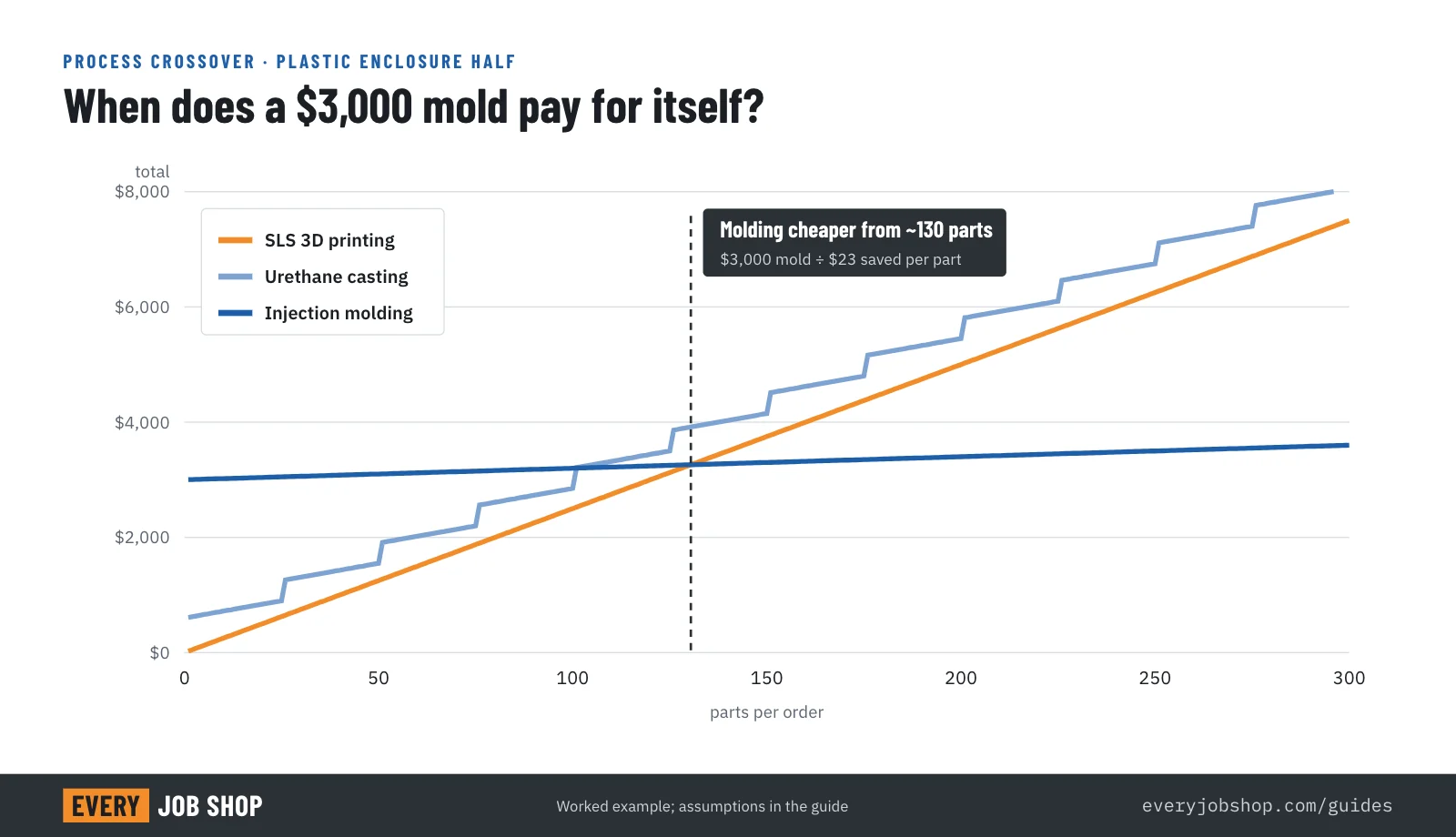
With these assumptions, molding beats printing at about 130 parts ($3,000 ÷ $23 saved per part), and casting never wins on price. Casting earns its place when the parts must look molded (surface, color, rubber-like materials) and the quantity is too small for a mold, or when the design may still change. If the design is final and you need more than a couple of hundred, a mold is usually the better buy.
Decision table by part type
| Part | 10 parts | 100 parts | 1,000 parts |
|---|---|---|---|
| Flat or bent metal part (bracket, panel, chassis) | Laser cut and bent | Laser cut and bent | Laser cut and bent (stamping at much higher volume) |
| Precise metal part (bores, threads, flat faces) | CNC | CNC | CNC, or casting plus machining |
| Metal part with internal channels or lattices | Metal 3D printing | Metal 3D printing | Metal 3D printing, or redesign for casting |
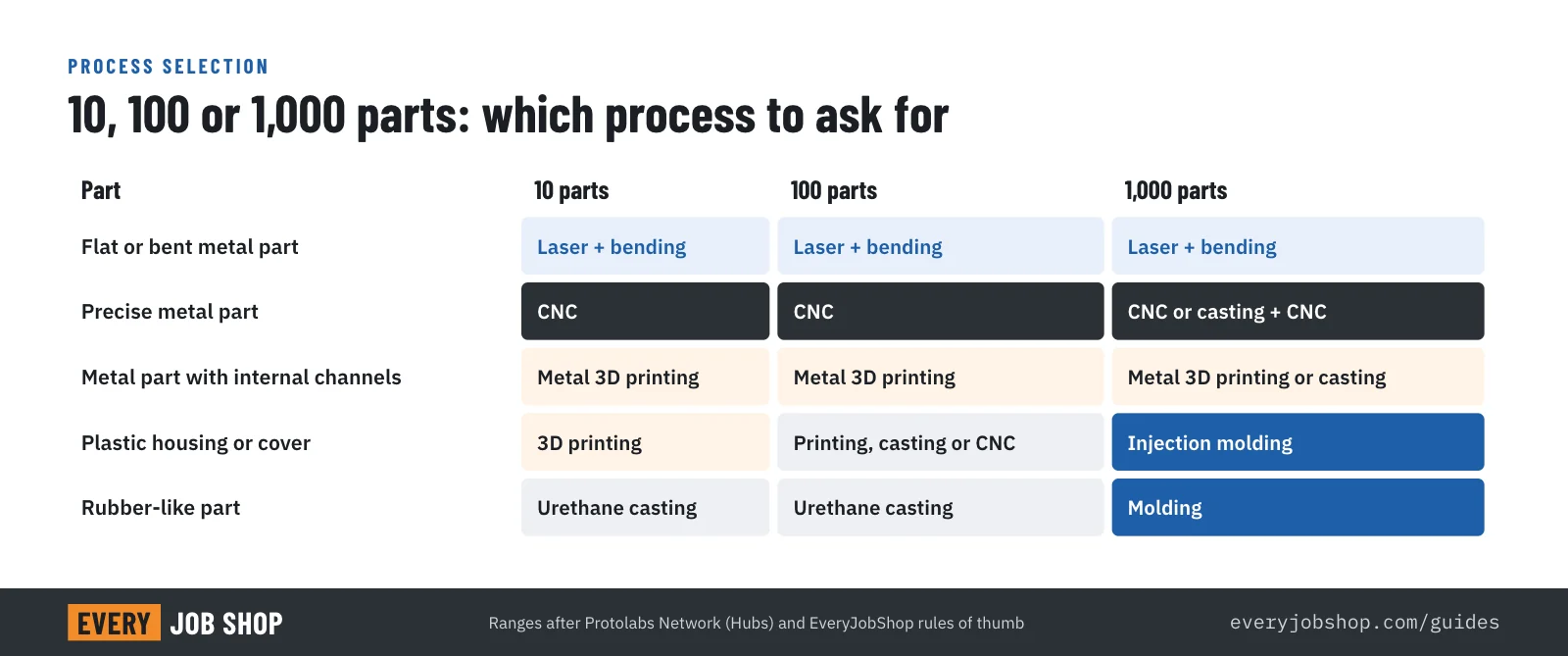
| Plastic housing or cover | 3D printing | 3D printing, urethane casting or CNC | Injection molding |
| Rubber-like part (gasket, grip, seal) | Urethane casting | Urethane casting | Molding (injection or compression) |
| Large metal part, complex shape | CNC or fabrication | Fabrication or casting | Casting plus machining |
Mistakes that make the wrong process look cheap
- Comparing one-piece prices. A 3D printing quote for one part tells you nothing about 500. Always ask for quantity breaks at the volumes you expect.
- Keeping a design made for one process. A bracket drawn as a machined block will be expensive in sheet metal until it is redrawn with constant thickness and bend radii. The same goes for molding: draft angles, uniform walls and no undercuts.
- Ignoring tolerances. Printing and casting tolerances are looser than machining. If the part needs ±0.001 in on a bore, plan to machine that feature after printing or casting.
- Ignoring lead time. A mold takes time to build. A printed or machined part can ship in days. The cheapest process is not always the one that meets the date.
- Forgetting the finish. Anodizing, powder coating or painting has its own lot minimums, which can dominate small orders.
Find shops for each process
EveryJobShop is a free index of 3,768 US job shops in 50 states. Search by process, material, certification and state: laser cutting, bending, CNC milling, metal 3D printing, casting, or all shops. Not sure which process fits? Send one RFQ to up to 30 shops and let their quotes show you where the crossover falls for your part. Our guide on what to include in an RFQ helps you get comparable answers.
Questions people ask
- Is 3D printing always cheapest for small quantities?
- No. For plastic parts it often is below about 10 pieces, but for metal parts CNC machining is frequently cheaper even at low quantities, and a flat or bent part is usually cheapest as laser-cut sheet metal at any quantity.
- At what quantity does injection molding become cheaper?
- There is no single number. It depends on the mold cost and the per-part saving. Protolabs Network (Hubs) recommends considering molding from a few hundred plastic parts and recommends it above about 1,000. Work out the crossover with your own quotes: mold cost divided by the per-part saving.
- What is urethane casting good for?
- Tens of plastic or rubber-like parts that should look and feel close to molded parts, without paying for a steel or aluminum mold. A master is printed or machined, a silicone mold is made from it, and each silicone mold typically yields about 20 to 25 parts.
- Does sheet metal need tooling?
- Laser cutting and press brake bending use standard tools, so there is no part-specific tooling to pay for. That is why sheet metal is economical from one piece. Stamping with dedicated dies is a different process for much higher volumes.
- Can I switch processes later?
- Yes, and it is common: 3D printed or machined prototypes, then cast or molded parts in production. Plan for it early, because each process has its own design rules, and a part designed for machining often needs changes before it can be molded or made from sheet.