Most shop owners believe two things about the metal market right now: that steel has never been this expensive, and that, like everyone else, they pass the higher cost on to their customers.
The government's own price data says both are wrong.
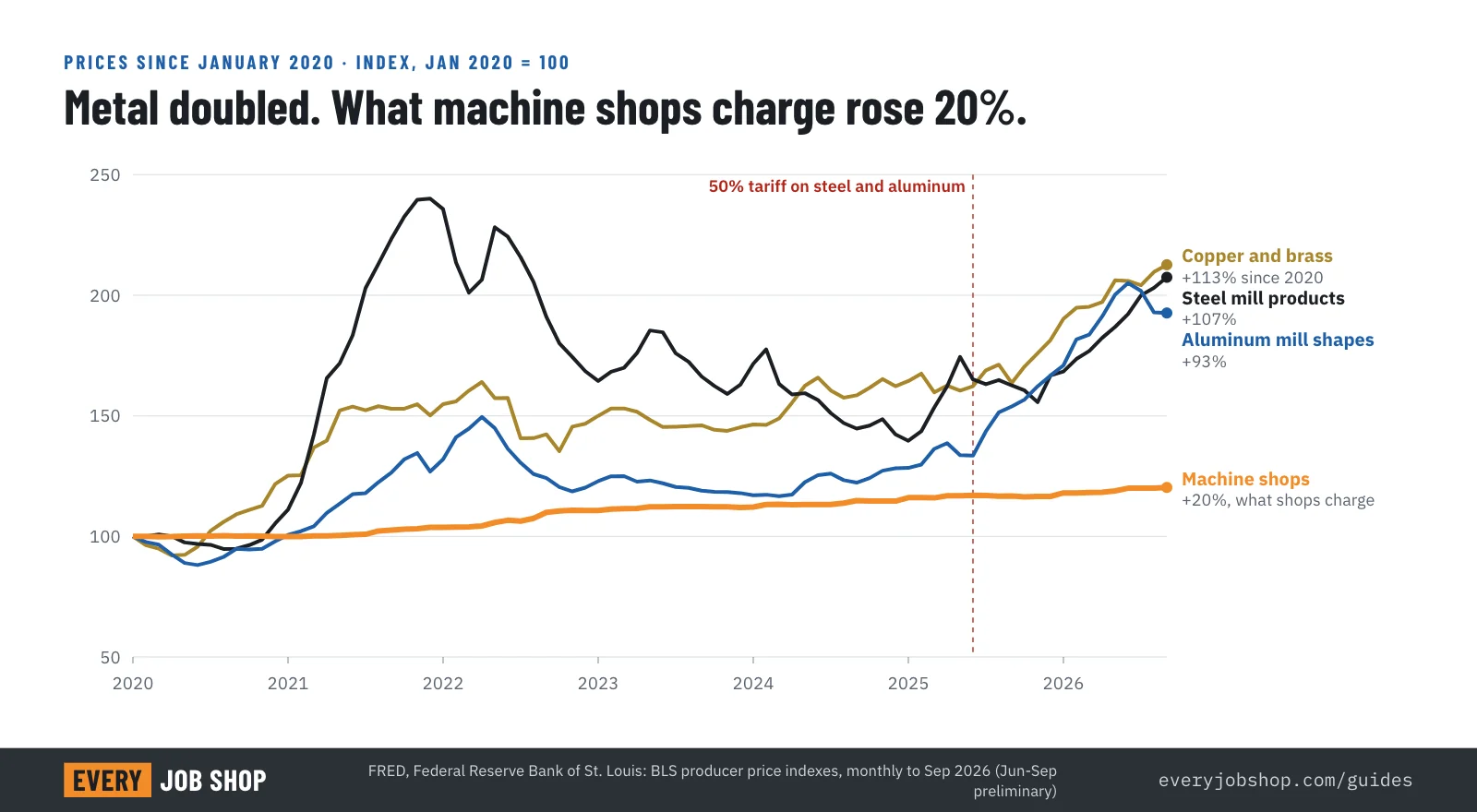
Steel is not at a record. Aluminum and brass are. And the price of what machine shops sell has hardly moved while their material soared: since January 2025, aluminum mill shapes are up 50% and the producer price index for machine shops is up 3.6%. So who is paying for the metal?
This guide walks through the numbers in five charts, from 2020 to October 2026, and ends with what shops are doing about it in their quotes.
The data in one paragraph
From January 2020 to September 2026, US copper and brass mill shapes rose 113%, steel mill products 107% and aluminum mill shapes 93%, according to the producer price indexes of the Bureau of Labor Statistics on FRED. Over the same years the producer price index for machine shops, which tracks what US machine shops are paid for their work, rose 20%. Structural steel fabricators, whose contracts often carry escalation clauses, rose 89%.
Myth 1: "Steel has never been this expensive"
It feels that way. Hot-rolled coil reached $1,255 per short ton in mid-October 2026, up 52% in a year, the highest since May 2022, and Nucor has been raising its published coil price by $10 a ton every week.
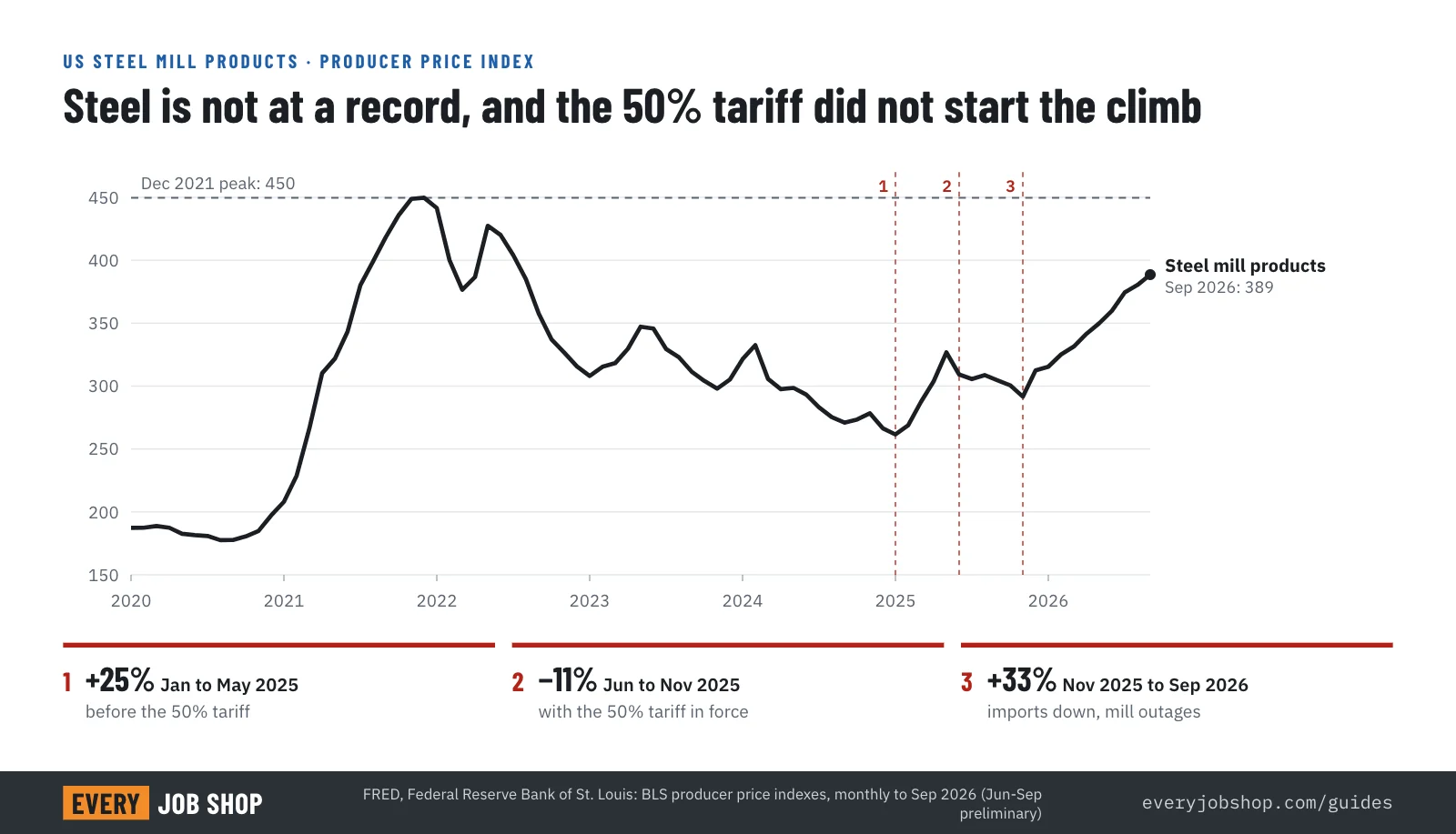
But the steel mill products index in September 2026 was still 14% below its December 2021 peak, and cold-rolled sheet 31% below its November 2021 peak. Steel was more expensive in the post-pandemic squeeze.
The timing is the bigger surprise. The tariff on steel and aluminum went from 25% to 50% on June 4, 2025. Most of the 2025 rise came before that: the steel index climbed 25% from January to May 2025, as the 25% tariff on all countries took effect in March. With 50% in force, steel then fell 11% to November 2025.
The 2026 climb, 33% from November 2025 to September 2026, came with other things: finished steel imports down 24.5% in the first half of 2026, mills that stopped offering spot tons, lead times of 8 to 12 weeks and about a million tons of planned outages for the fall. A tariff sets a floor under domestic prices; the moves on top of it follow supply.
Myth 2: "Steel is the tariff story. Aluminum is fine."
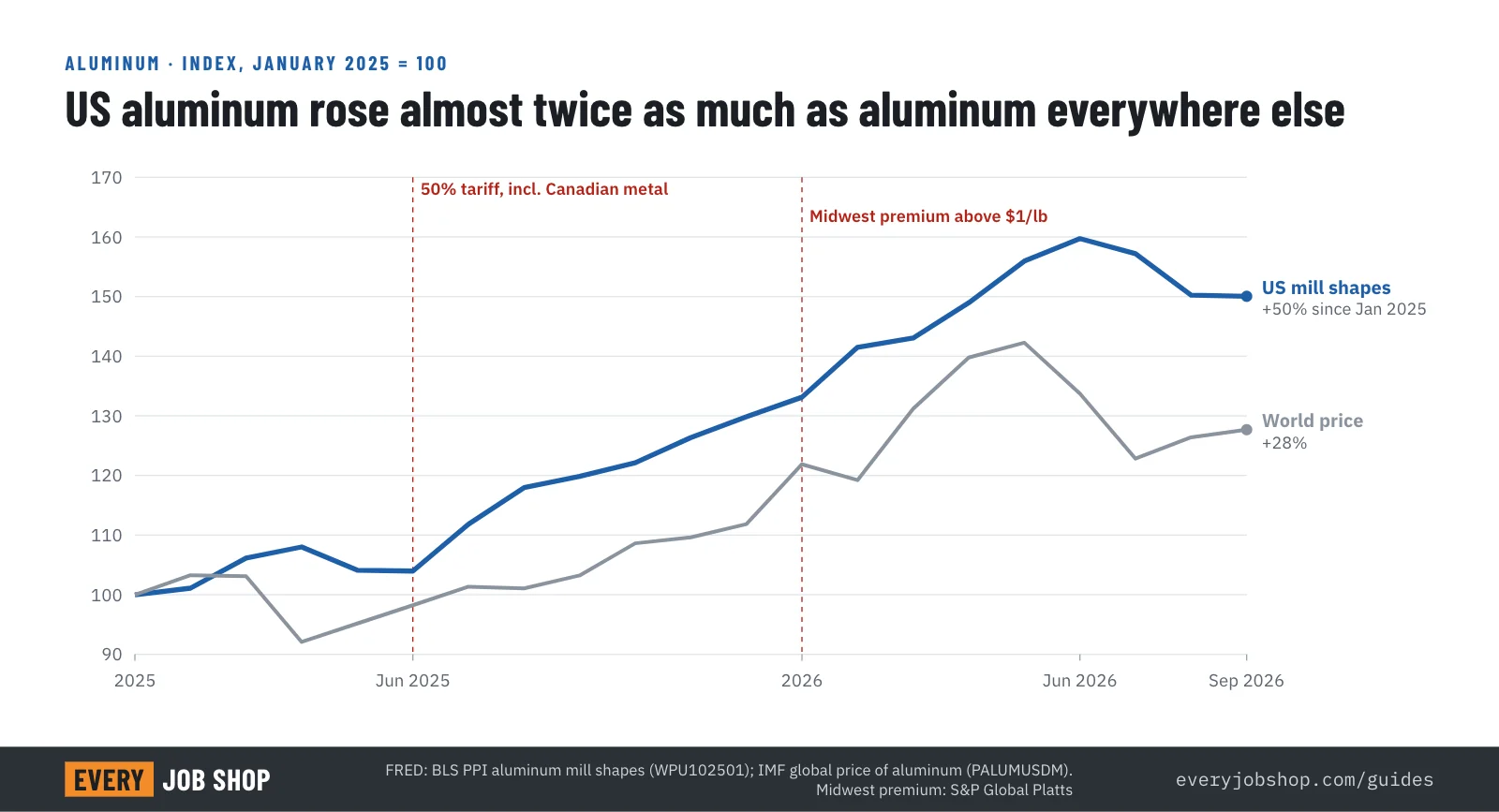
Aluminum is the metal at an all-time high. The aluminum mill shapes index and the index for extruded rod, bar and shapes both set records in June 2026, about twice their January 2020 level.
And the US paid more than everyone else. Since January 2025, US aluminum mill shapes rose 50%; the world aluminum price rose 28%. The gap is the Midwest premium, the amount US buyers pay on top of the world price for delivered metal. Canada was the main source of US primary aluminum imports, and the 50% tariff applies to it too. The premium reached a record 90 cents per pound in December 2025 and passed one dollar per pound for the first time on January 23, 2026, on top of the metal itself.
For a shop that cuts 6061 plate or bar every day, this is the line that moved most.
Myth 3: "The exotic alloys are where the price risk is"
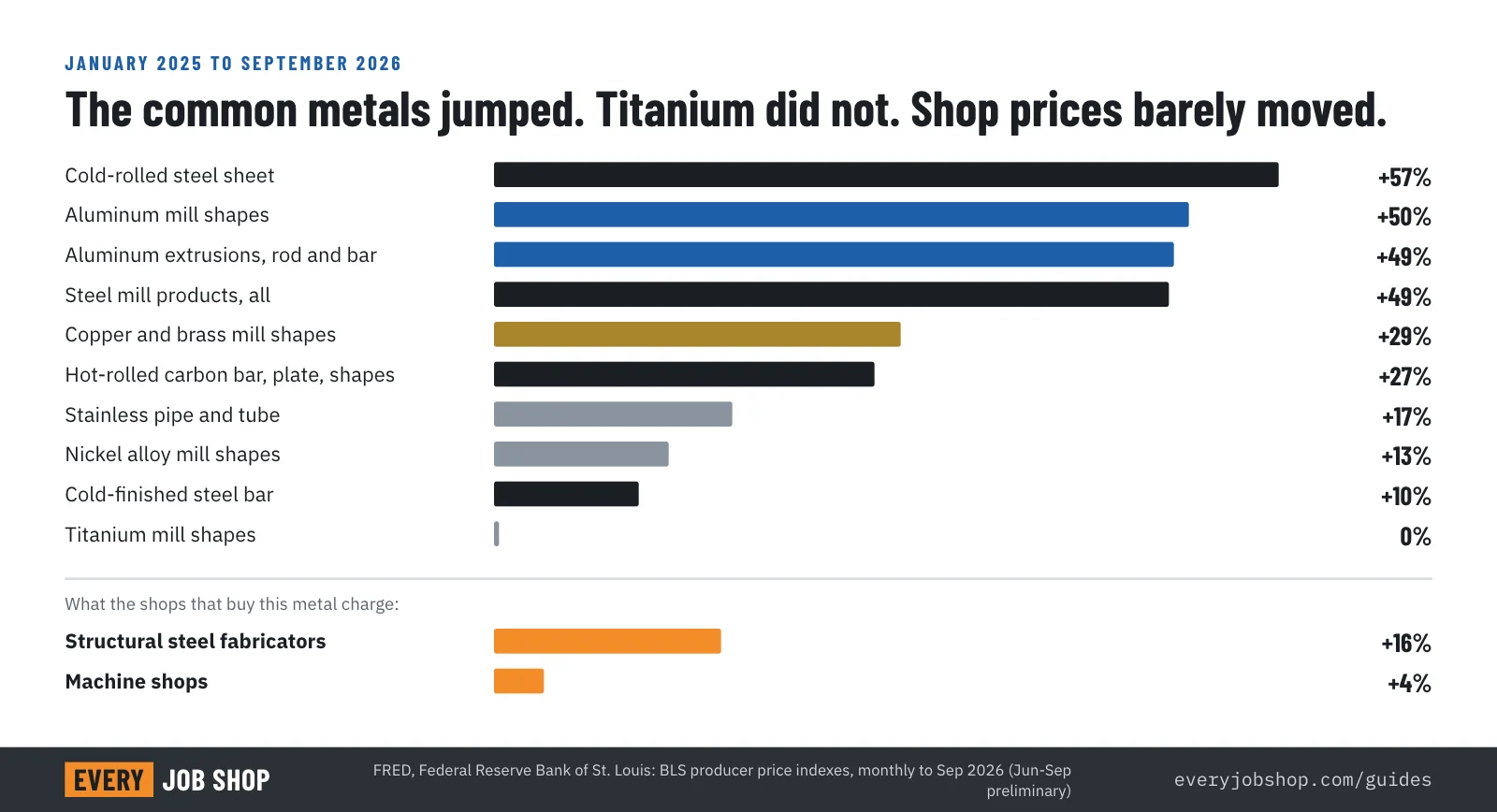
Shops that machine titanium and Inconel for aerospace often price those jobs with the most caution. In 2025 and 2026 they were the calm part of the market. Titanium mill shapes were flat from January 2025 to September 2026, and nickel alloy mill shapes rose 13%. The world nickel price is about half its March 2022 peak.
The volatility was in the everyday metals: steel sheet, aluminum, and copper and brass. Copper and brass mill shapes reached an all-time high in September 2026, 113% above January 2020. A 50% tariff on semi-finished copper products such as rod, sheet and tube has applied since August 1, 2025, and a duty on refined copper, proposed at 15% from 2027 and 30% from 2028, is still undecided. For Swiss and screw machine shops running brass, that is the open risk for next year.
Myth 4: "We pass material costs on to the customer"
Here is the number this guide is named after. From January 2025 to September 2026, the metals machine shops buy rose by a third to a half. The price index for machine shops rose 3.6%. Over the same period structural steel fabricators raised prices 16%.
There are two readings, and both are probably true in part:
- Material is a smaller share of a machined part than it feels. On a tight-tolerance part, machine time, setups, inspection and finishing often cost more than the bar or plate. A 50% rise in material moves the part price far less than 50%.
- Shops absorbed part of it. Fixed-price quotes, blanket orders priced a year ago and customers who push back all delay the pass-through. In the Philadelphia Fed's February 2026 survey, the index of prices paid by manufacturers was 38.9 and the index of prices received 16.7, and 30.8% of firms said customers had become more price sensitive.
The index has limits: it is a broad average, it is repriced only every few months, and it says nothing about any single shop. But a gap this wide over 20 months is worth checking against your own jobs: take five repeat parts, compare the material cost on your last purchase order with the material you assumed in the quote, and see who paid the difference.
Myth 5: "A 30-day quote is safe"
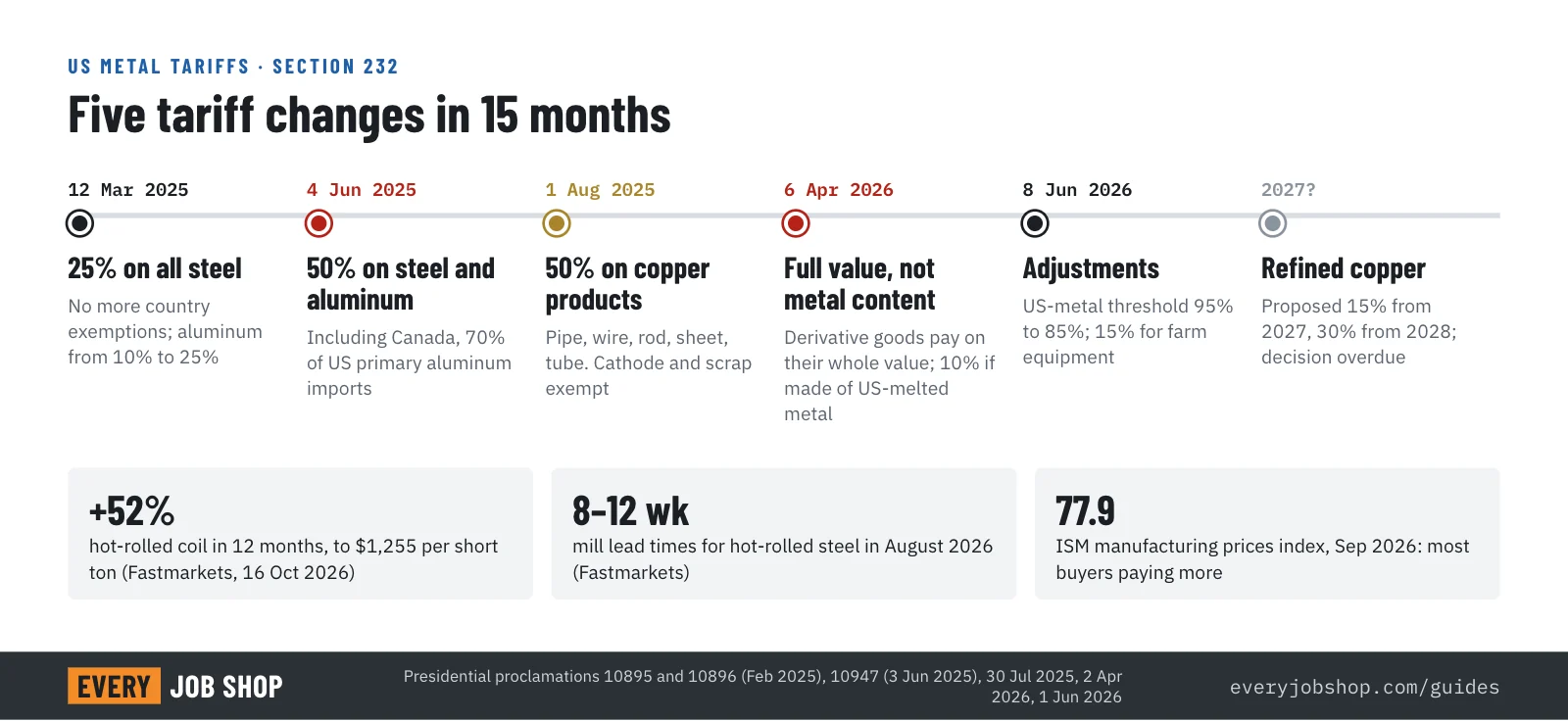
The tariff rules changed five times in 15 months. Since April 6, 2026, the metal tariffs on derivative goods apply to their full customs value, not only the metal content, and goods made entirely from metal melted in the US pay 10%. Further changes took effect on June 8, 2026.
Prices move faster than quotes. Hot-rolled coil rose 52% in twelve months, about 3.5% a month on average. Stainless mills add a raw-material surcharge that is reset every month and applied at shipment, so the price is not known until the metal ships. In September 2026 the ISM manufacturing prices index stood at 77.9, meaning most buyers were paying more month over month, and suppliers' deliveries were slowing.
A worked example: material is 30% of the price of a sheet metal part. The quote is valid 30 days, the customer orders on day 28 and you buy the sheet a week later. At 3.5% a month, the sheet now costs about 4% more than in the quote. That is 1.2% of the part price, taken straight out of the margin, on every order quoted that month. Compare it with your net margin.
What shops are doing about it
- Shorter validity for the metals that move. Keep 30 days for most work, and quote steel sheet, aluminum and brass for 7 to 14 days, or "material at the price on the day of the order".
- A material line in the quote. Show material separately from machining, so a change in metal price changes one line, not the whole negotiation. Customers accept a material change more easily when they can see it.
- An escalation clause for long orders. For blanket orders and annual pricing, tie the material part of the price to a published index, such as the BLS producer price index for the metal, or to the supplier's invoice, reviewed quarterly. Stainless mills already sell to you this way.
- Buy the material when the order comes in, or lock the price with the service center. Ask your service center whether it will hold a price for a few days on a confirmed order, and quote inside that window.
- Requote repeat parts on today's material price. The fastest way to see the gap is to run your repeat parts through your quoting method with this month's material prices. A quote calculator on your own rates does it in minutes for the whole list.
- Use the made-in-USA argument where it holds. Since April 2026, imported parts made from foreign metal pay the metal tariff on their full value. Buyers comparing an overseas quote with yours should compare landed cost, not the ex-works price.
None of this needs new software. It needs the material price to be a number you look up on the day of the quote, not a number from last quarter's spreadsheet.
About the data
- Prices: monthly producer price indexes (PPI) of the US Bureau of Labor Statistics, which measure prices received by US producers, and IMF world prices for aluminum and copper, all from FRED, downloaded October 23, 2026. Series: steel mill products (WPU1017), cold-rolled sheet (WPU101707), hot-rolled carbon bar, plate and shapes (WPU10170410), cold-finished bar (WPU101708), stainless pipe and tube (WPU10170674), aluminum mill shapes (WPU102501), extruded aluminum rod, bar and shapes (PCU3313183313180), copper and brass mill shapes (WPU102502), nickel alloy mill shapes (WPU102504), titanium mill shapes (WPU102505), machine shops (PCU332710332710), fabricated structural metal (PCU332312332312), world aluminum (PALUMUSDM).
- Limits: mill prices are not the price a shop pays a service center, but service-center prices follow them. The Bureau of Labor Statistics revises the last four months, so June to September 2026 values can change. FRED has no current index for stainless sheet or bar, or for hot-rolled sheet after February 2022; for hot-rolled coil this guide uses the Fastmarkets price reported by Bloomberg.
- Tariffs: presidential proclamations and law firm summaries linked in the text. Tariff rules change often; check the current rate with your customs broker before quoting imported material.
The charts may be reused with a credit and a link to this page.
Questions people ask
- How much have US metal prices risen since 2025?
- From January 2025 to September 2026 the US producer price index rose 57% for cold-rolled steel sheet, 50% for aluminum mill shapes, 49% for steel mill products as a whole and 29% for copper and brass mill shapes. Titanium mill shapes were flat and nickel alloy mill shapes rose 13%. Hot-rolled coil reached $1,255 per short ton in October 2026, up 52% in a year.
- Is steel at a record price in 2026?
- No. The steel mill products index in September 2026 was 14% below its December 2021 peak, and cold-rolled sheet was 31% below its November 2021 peak. Aluminum mill shapes (June 2026) and copper and brass mill shapes (September 2026) did set all-time highs.
- Why is aluminum more expensive in the US than on the world market?
- Because of the Midwest premium, the price on top of the world (LME) price for metal delivered in the US. With a 50% tariff on imported aluminum since June 2025, including metal from Canada, the main supplier, the premium passed one dollar per pound for the first time in January 2026. Since January 2025, US aluminum mill shapes rose 50% and the world aluminum price 28%.
- How long should a job shop quote be valid when metal prices move this fast?
- There is no standard. A practical approach is to keep your usual validity for most work and shorten it, or quote material at the price on the day of the order, for the metals that move most: steel sheet, aluminum and brass. Hot-rolled coil rose about 3.5% a month on average over the year to October 2026, so a 30-day fixed price on sheet carries a few percent of material risk.
- What is a material surcharge or escalation clause?
- A line in the quote or the terms that adjusts the price if the material cost changes between the quote and the order, tied to a published index or to the supplier's invoice. Steel and stainless mills work this way themselves: stainless mills add a raw-material surcharge that is reset every month and applied at shipment.
- Where does the data in this guide come from?
- Monthly producer price indexes from the US Bureau of Labor Statistics and world metal prices from the IMF, both downloaded from FRED (Federal Reserve Bank of St. Louis) on October 23, 2026, plus tariff proclamations, Fastmarkets, S&P Global Platts, ISM and Federal Reserve surveys, each linked in the text. PPI values for June to September 2026 are preliminary and can be revised.