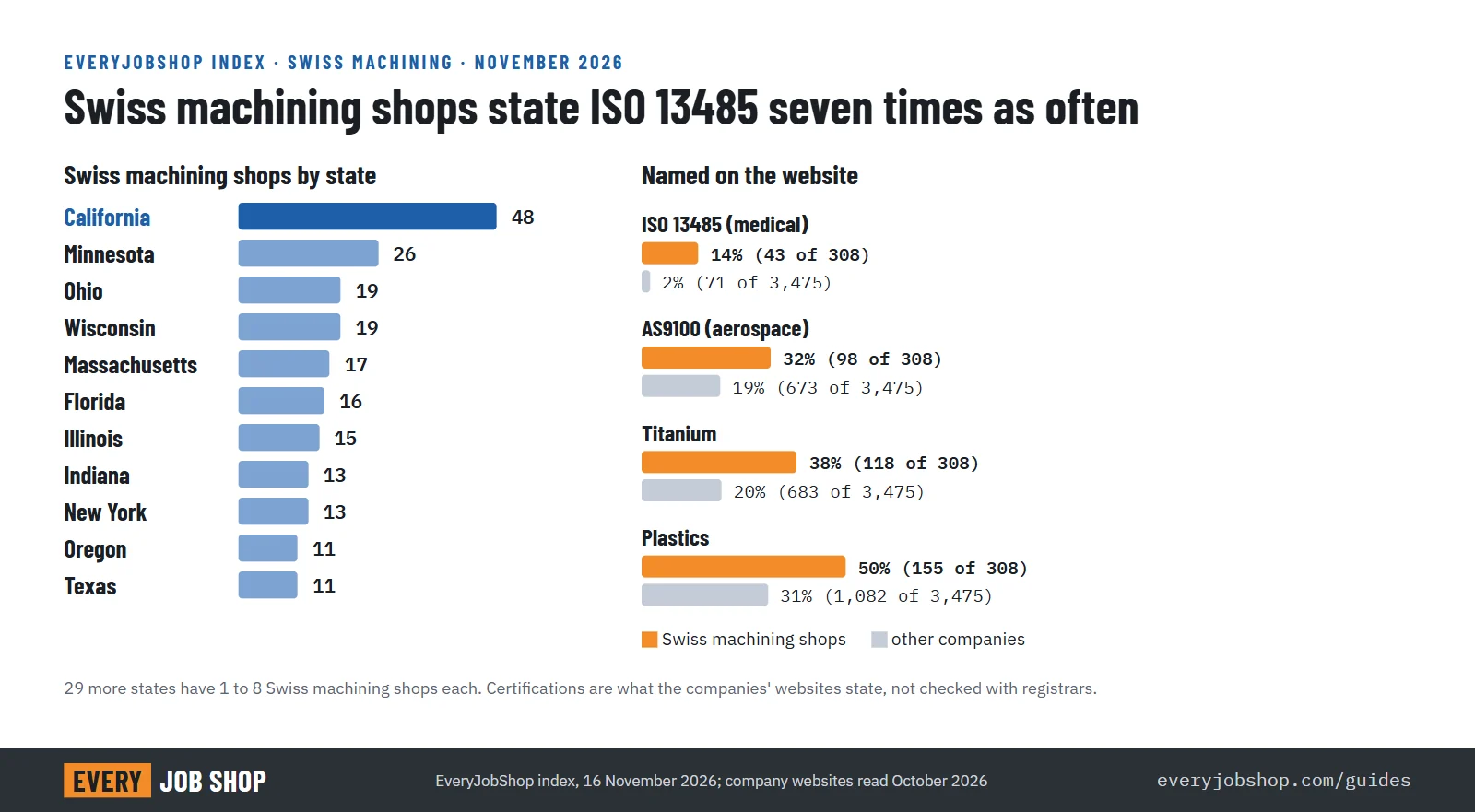
Swiss machining shops are seven times as likely as other job shops to state ISO 13485, the quality standard for medical devices. Of the 308 US shops in the EveryJobShop index that list Swiss machining, 43 (14%) state it on their website, against 71 of the other 3,475 companies (2%). Almost a third state AS9100 as well. The reason is the machine: a Swiss-type lathe is built for small, long, precise turned parts in quantity, which is exactly what bone screws, connector pins and hydraulic fittings are.
So when does a part belong on a Swiss machine, what decides the price, and how do you find a shop that runs one well?
This guide explains how the machine works and where its limits are, with the figures the machine builders publish (labelled as vendor figures), a worked cost example with its assumptions stated, and our own numbers on the 308 shops as of November 16, 2026.
Key numbers
- 308 of 3,783 US job shops (8%) list Swiss machining, in 40 states. California has 48, then Minnesota (26), Ohio and Wisconsin (19 each) and Massachusetts (17).
- Minnesota has the highest share: 26 of its 94 companies (28%) list Swiss machining, then New Hampshire (8 of 40, 20%) and Oregon (11 of 67, 16%).
- Certifications: 43 state ISO 13485 (14%, against 2% of the other companies), 98 state AS9100 (32% against 19%), 99 state ITAR (32% against 18%) and 189 ISO 9001 (61% against 39%).
- Materials: 38% name titanium (20% of the others), 50% plastics (31%), 44% copper or brass (25%).
- Machines: 123 name a Swiss lathe builder or the words "Swiss-type" on their site. Citizen is named by 60, Tsugami by 29, Tornos by 11 and Star by 7.
- They do more than turn: 289 also list CNC milling, 123 grinding and 101 EDM.
Certifications, materials and machines are what the companies' own websites state, read by our crawler in October 2026. We have not checked them with registrars or builders.
What a Swiss-type lathe is
On a conventional CNC lathe the bar is clamped in a chuck that stays put, and the tools travel along the part. The further the cut is from the chuck, the more the part bends away from the tool, which is why long thin parts chatter, taper or need a tailstock.
A Swiss-type lathe, also called a sliding headstock lathe or Swiss screw machine, turns this around:
- The headstock moves. The collet grips the bar and the whole headstock slides along the Z axis, pushing the bar forward.
- A guide bushing holds the bar next to the tools. The bar passes through a bushing fixed in front of the headstock, and the tools cut a few millimeters from it. The unsupported length stays short however long the finished part is.
- Many tools work at once. A gang of turning tools, live (driven) tools for cross holes and flats, and a sub-spindle that picks the part off and machines the back end. Most parts come off complete, without a second operation.
- It runs from bar. A bar feeder pushes new bar in, so a machine can run a long batch with little attention.
How much the guide bushing matters shows in the builders' own specifications (vendor figures). Tsugami's B0386-III can travel 320 mm with the guide bushing and 70 mm when it runs without one as a chucker. Star's SR-38 type B lists a 320 mm headstock stroke as standard and 95 mm in its non-guide-bush version. Many current machines convert both ways: guide bushing for long parts, chucker mode for short parts, where it saves bar.
Which parts suit a Swiss machine
The rule of thumb from how the machine works: small diameter, long relative to its diameter, many features, many pieces.
- Small diameters. Most Swiss-type lathes take bar up to 20, 32 or 38 mm. Tiny parts are where they have no competition: Tsugami's P036W takes bar of 3 mm (1/8 in) at up to 20,000 rpm (vendor figures).
- Long and slender. Shafts, pins, probes and screws several times longer than their diameter, which on a chucker would need a tailstock or a steady rest.
- Complete in one cycle. Cross holes, flats, slots, threads and the back end done on the sub-spindle. A part that would go lathe, then mill, then deburr is one operation on a Swiss machine.
- High volume. Setup takes hours, so the machine pays off over hundreds or thousands of parts. Shops also run Swiss machines for prototypes when the material is hard to hold any other way.
Typical work: bone screws and surgical pins, dental implants, electrical connector pins and contacts, hydraulic and pneumatic fittings, valve stems, firearm parts, watch and instrument parts. That is why so many of the shops state ISO 13485 and AS9100, and why they name titanium, plastics and brass more often than other shops.
Sizes and tolerances: what the builders and shops publish
Machine capacity is set by the bar the machine takes and how far the headstock travels in one chucking. From the builders' own pages (vendor figures):
| Machine | Max bar or machining diameter | Headstock stroke per chucking | Source |
|---|---|---|---|
| Tsugami P036W | 3 mm | 30 mm | Tsugami America |
| Citizen Cincom L20E-2M8 | 20 mm (25 mm option) | 200 mm | Citizen Machinery Europe |
| Star SR-38 type B | 38 mm | 320 mm (95 mm non-guide-bush type) | Star Micronics |
| Tsugami B0386-III | 38 mm | 320 mm with guide bushing, 70 mm without | Tsugami America |
A part longer than the stroke is made by re-chucking: the collet opens, the headstock moves back, grips again and keeps cutting. It works, but each re-chuck can leave a small witness mark, so ask the shop where it will fall on a long part.
Tolerances depend on the shop, the material and the bar more than on the brochure. In a Cutting Tool Engineering article written with an applications engineer from Marubeni Citizen-Cincom, plus or minus 0.001 inch is called loose for Swiss work, and some shops hold plus or minus 0.0002 inch. The same article explains the condition: the bar diameter has to be consistent, typically centerless ground to plus or minus 0.0002 inch for that kind of work, because the bar runs in the guide bushing. Our tolerance guide puts Swiss turning at about plus or minus 0.0005 inch on diameters for ordinary work and shows what each step tighter costs.
Two practical points from the same article: standard drawn bar (about plus or minus 0.0005 inch) is enough for most typical work, so ground bar is worth asking about only where the tolerance needs it; and titanium is usually not a candidate for running unattended overnight, because of tool breakage, heat and chips. Both show up in the price.
When a conventional lathe or mill-turn is the better choice
- The diameter is over about 38 mm. That is the top of most Swiss lines. A CNC turning center or a mill-turn takes the part.
- The part is short and stubby. Without the length that needs support, a guide bushing adds bar waste and nothing else. A conventional lathe with a bar feeder, or a Swiss machine in chucker mode, is cheaper.
- The quantity is small and the part is simple. A 2-axis lathe sets up in less time. Ten plain bushings do not need a Swiss setup.
- The part starts from a casting, forging or plate, not from bar. Swiss machines are bar-fed.
- The part needs heavy milling. A Swiss machine's live tools are small. A part that is mostly a milled body with a turned feature goes to a mill-turn or a machining center.
What drives the cost
A Swiss quote is mostly cycle time multiplied by the machine rate, plus setup spread over the batch, plus bar. The five things that move it:
- Cycle time. Every second counts thousands of times. Features that need a slow tool (deep small holes, threads in hard material, fine finishes) add seconds to every part.
- Quantity. Setup, often several hours of tooling and proving out, is spread over the batch.
- Bar. Material grade, ground versus drawn bar, and the remnant left at the end of each bar.
- Unattended running. A part that can run lights-out costs less per hour than one that needs an operator watching for broken tools.
- Inspection. A medical or aerospace part with a first article report and full lot traceability carries more paperwork than a commercial pin.
Worked example
Assumptions, made up for illustration and not a quote: a 316 stainless pin, 4 mm diameter and 25 mm long, with one cross hole and a chamfer at each end; a cycle time of 90 seconds; a machine rate of $100 an hour (above the $65 an hour Protolabs Network uses as a baseline for turning, vendor figure, because a Swiss machine with a bar feeder costs more to own); setup of 4 hours at the same rate ($400); bar, finishing and inspection left out.
| Quantity | Run time | Run cost | Setup | Cost per part |
|---|---|---|---|---|
| 50 | 1.25 h | $125 | $400 | $10.50 |
| 1,000 | 25 h | $2,500 | $400 | $2.90 |
| 10,000 | 250 h | $25,000 | $400 | $2.54 |
| 10,000, cycle cut to 60 s | 166.7 h | $16,667 | $400 | $1.71 |
At 50 pieces the setup is three quarters of the price. At 10,000 the setup hardly matters and the cycle time is everything: cutting 30 seconds off the cycle saves about 20 times what the whole setup costs. That is why a design change that removes a slow feature is worth asking about on a high-volume part. Our CNC cost guide covers the rest of a machining quote.
Where the Swiss shops are
| State | Swiss machining shops | Share of the state's shops | State ISO 13485 | State AS9100 | Name a Swiss builder or "Swiss-type" |
|---|---|---|---|---|---|
| California | 48 | 8% | 9 | 25 | 21 |
| Minnesota | 26 | 28% | 8 | 10 | 13 |
| Ohio | 19 | 9% | 2 | 5 | 9 |
| Wisconsin | 19 | 13% | 1 | 2 | 7 |
| Massachusetts | 17 | 14% | 4 | 4 | 7 |
| Florida | 16 | 11% | 3 | 4 | 6 |
| Illinois | 15 | 10% | 1 | 1 | 5 |
| Indiana | 13 | 9% | 0 | 1 | 5 |
| New York | 13 | 10% | 0 | 4 | 4 |
| Oregon | 11 | 16% | 1 | 5 | 6 |
| Texas | 11 | 5% | 1 | 1 | 2 |
Minnesota stands out twice: the highest share of Swiss shops of any state with 30 or more companies in the index, and 8 of its 26 Swiss shops state ISO 13485, nearly as many as California with almost twice the shops. Only California, Minnesota and Massachusetts have four or more Swiss shops that state ISO 13485. New Hampshire has 8 Swiss shops, 3 of them with ISO 13485.
Texas is the opposite case: the second-largest state in the index (235 companies) has 11 Swiss shops. For small turned parts there, the list is short; widen the search to neighbouring states or use the national Swiss list.
29 more states have between 1 and 8 Swiss shops each. Our state by state guide has every state with all its processes.
What the Swiss shops say about their machines
123 of the 308 Swiss shops name a Swiss-type lathe builder or the words "Swiss-type" on their website. By builder: Citizen 60, Tsugami 29, Tornos 11 and Star 7. Two cautions on these counts. Our crawler matches the word, so a few "Citizen" hits may be something else on the page. And it only recognises Star when the site writes "Star Swiss", so Star is undercounted.
The Swiss shops also name more inspection and milling equipment than the rest of the index: 42% name a 5-axis machine (26% of the others) and 33% a CMM (22%). A shop with both Swiss lathes and 5-axis mills can take a turned part that also needs a milled feature too big for the live tools.
One limit of our data: all 308 Swiss shops come from the part of the index built from the SBA small business search in October 2026. The older part of the index has no Swiss tag, and 51 more companies name a Swiss builder or "Swiss-type" without listing Swiss machining. The real number of shops running Swiss machines is higher than 308.
How to find and vet a Swiss shop
- Filter by what the part needs. Start from all Swiss machining shops, then add a certification: ISO 13485 for medical parts, AS9100 for aerospace, or a material such as titanium.
- Ask which machine would run it. Bar capacity, number of axes, live tooling and a sub-spindle. A 38 mm part on a 32 mm machine is a no; a 3 mm part on a 38 mm machine is wasteful.
- Ask about the bar. Will the shop buy ground bar, and does the material come with mill certs and lot traceability? For an implant grade the answer must be yes.
- Ask what they hold and how they measure. Which diameters at which tolerance, measured with what (optical comparator, vision system, air gauge, CMM), at what sampling rate.
- Check the certificate. For ISO 13485, ask for the certificate and check the site and scope; for AS9100 look it up in OASIS. Our certification guide explains each one, and the AS9100 and ITAR guide shows how to check them.
- Ask about secondary operations. Passivation, heat treat, laser marking, cleaning and packaging for medical parts: in house or outside, and who approves the processor.
- Order a first article. Compare the inspection report with your drawing before releasing the production quantity. The vetting guide has the full question list.
When you send the RFQ, give the quantity per release and per year, not only the first batch: setup is spread over it, and a shop prices 500 pieces once differently from 500 a month. Our RFQ guide lists the rest.
Find Swiss machining shops
Browse all 308 Swiss machining shops on a map with their states, or go straight to the largest groups: California, Minnesota, Ohio, Wisconsin and Massachusetts. With a drawing ready, send one RFQ to up to 30 shops and state the annual quantity, the material and the certification you need.
Questions people ask
- What is Swiss machining?
- Swiss machining, or Swiss-type turning, is done on a sliding headstock lathe. The bar stock is held by the headstock collet and slides forward through a guide bushing, and the tools cut right next to the bushing. Because the support stays next to the cut, the lathe can turn long, slender parts without the bar bending away from the tool. Most Swiss-type lathes take bar from a few millimeters up to 32 or 38 mm in diameter.
- What size parts can a Swiss lathe make?
- It depends on the machine. Builders' own figures: Tsugami's P036W takes bar up to 3 mm, Citizen's L20E is a 20 mm machine (25 mm as an option), and Star's SR-38 and Tsugami's B0386-III take 38 mm. Part length per chucking is set by the headstock stroke, 200 mm on the Citizen L20E and 320 mm on the Star SR-38 and Tsugami B0386-III; longer parts are made by re-chucking. Above about 38 mm, a conventional CNC lathe or a mill-turn is the usual choice.
- What tolerances can Swiss machining hold?
- In a Cutting Tool Engineering article written with a Citizen applications engineer, a tolerance of plus or minus 0.001 inch is described as loose for a Swiss machine and some shops hold plus or minus 0.0002 inch on diameters. Holding that needs consistent bar stock, typically centerless ground. Ask the shop what it holds on your material and how it measures it.
- How many Swiss machining shops are there in the US?
- In the EveryJobShop index, 308 of the 3,783 US job shops (8%) list Swiss machining as of November 2026, in 40 states. California has 48, Minnesota 26, Ohio and Wisconsin 19 each and Massachusetts 17. Minnesota has the highest share: 26 of its 94 companies in the index (28%).
- Are Swiss shops good for medical parts?
- They are where most medical turned parts are made, and the data shows it: 14% of the Swiss machining shops in our index state ISO 13485, the medical device quality standard, against 2% of the other companies. 43 of the 114 companies in the index that state ISO 13485 are Swiss shops. Ask for the certificate and check its scope covers your work.