Search "machine shop near me" and you get a page of twenty. Ask an AI assistant and you get five. From the buyer's side, the machining industry looks like a small world where everybody already knows everybody.
The Census Bureau counts 17,156 machine shops with paid employees in the United States. That is one machine shop for every 19,500 Americans. So why does a buyer only ever see a few hundred of them, and what does the typical one look like?
This report takes the latest County Business Patterns data (2023, released June 2025), compares it with 2008, 2013 and 2018, and sets it against the 3,771 shops in the EveryJobShop index.
Key findings
- 17,156 machine shops (NAICS 332710) had paid employees in March 2023. They employed 223,313 people and paid $14.2 billion in annual wages, $63,700 per employee.
- The typical shop is tiny. 46% have 1 to 4 employees and 83% have fewer than 20. The average is 13 people. Only 266 shops (1.6%) have 100 or more.
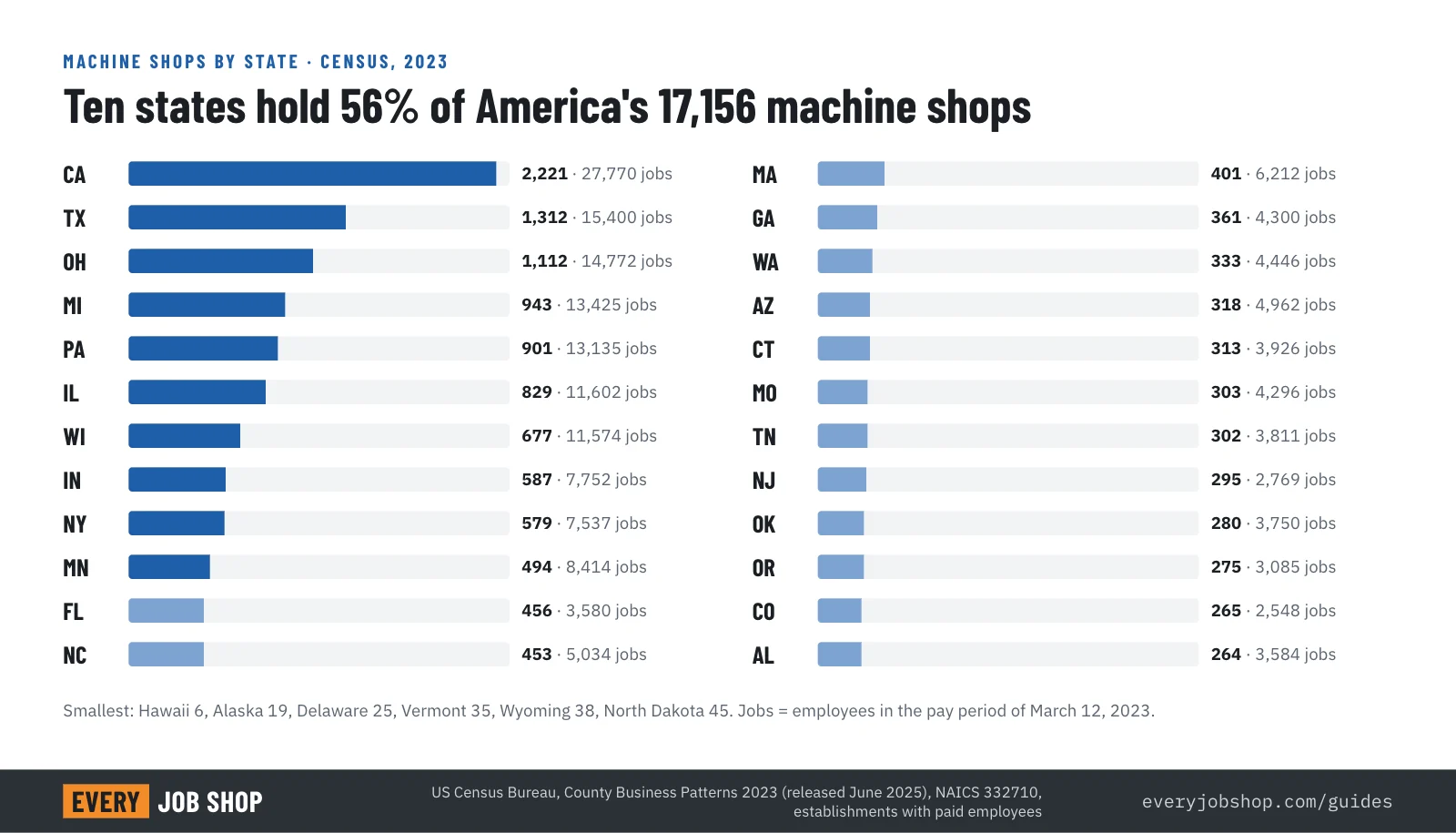
- Ten states hold 56% of the shops. California leads with 2,221, then Texas (1,312), Ohio (1,112), Michigan (943) and Pennsylvania (901). Hawaii has 6.
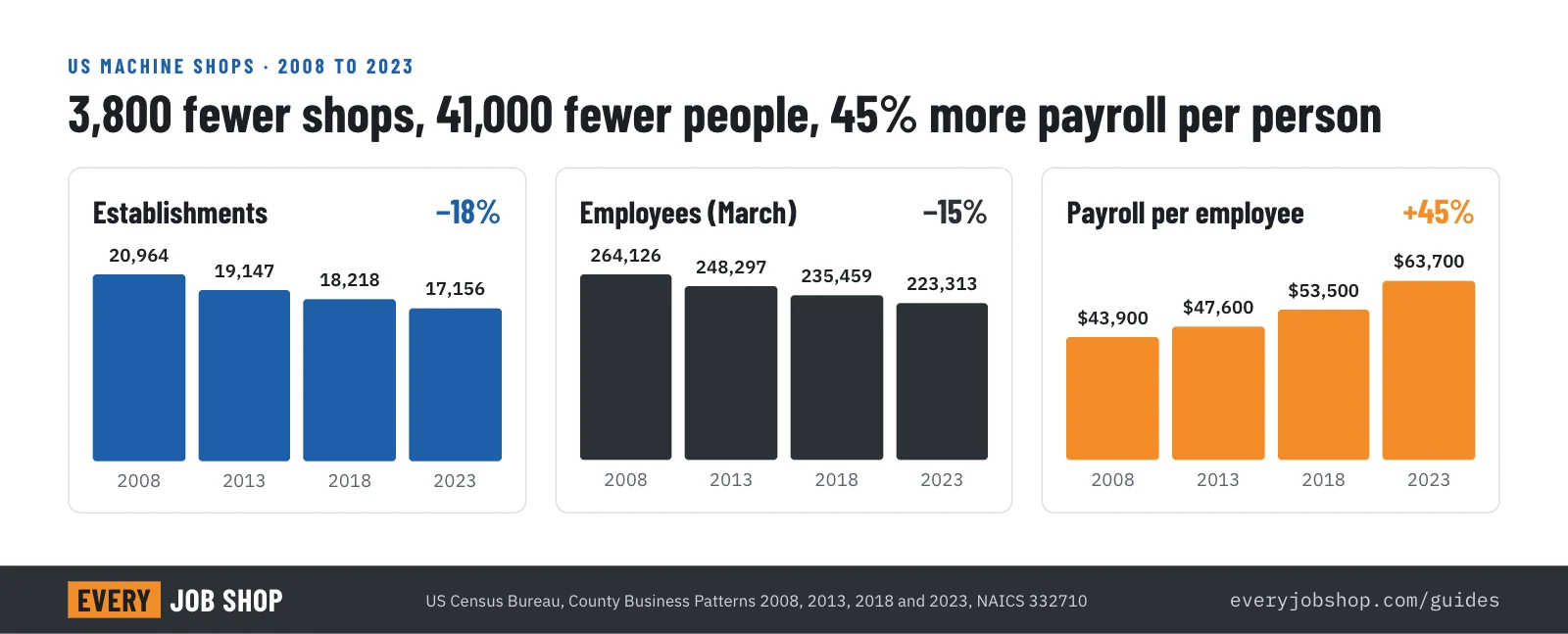
- The count has fallen 18% since 2008, from 20,964 to 17,156, and employment 15%, from 264,126 to 223,313. Payroll per employee rose 45% in nominal dollars.
- The wider job shop universe is about 35,700 establishments once sheet metal, structural fabrication, stamping, forging, foundries, finishing and tool and die shops are added.
- Buyers see a fraction of them. In our October test, 82% of the shops recommended by four AI assistants were named by only one of them, and only 1 in 4 shop websites states what the shop makes. The EveryJobShop index covers about 22% of the Census count so far.
Where the numbers come from
The Census Bureau's County Business Patterns (CBP) counts every business location with paid employees, by industry, every year. The 2023 edition was released on June 26, 2025 and is the latest. Employment is the number of people on the payroll in the pay period that includes March 12; annual payroll is for the whole year.
"Machine shop" is Census industry NAICS 332710: establishments primarily engaged in machining metal and plastic parts on a job or order basis. Three things to keep in mind:
- An establishment is one physical location. A company with three plants is three establishments.
- Each location is counted once, under its main activity. A sheet metal fabricator with a milling department is counted as a fabricator, not a machine shop.
- The count excludes shops with no paid employees. The Census tracks one-person businesses separately in its Nonemployer Statistics; a garage shop run by its owner alone is there, not here.
A different federal survey, the BLS Occupational Employment and Wage Statistics, puts employment in machine shops at 265,030 in May 2023, with 64,080 machinists at a mean wage of $52,330 and 32,440 CNC tool operators at $50,600. The two surveys count differently, so the figures are not identical, but they agree on the scale: a quarter of a million people.
Finding 1: a quarter million people in 17,156 small shops
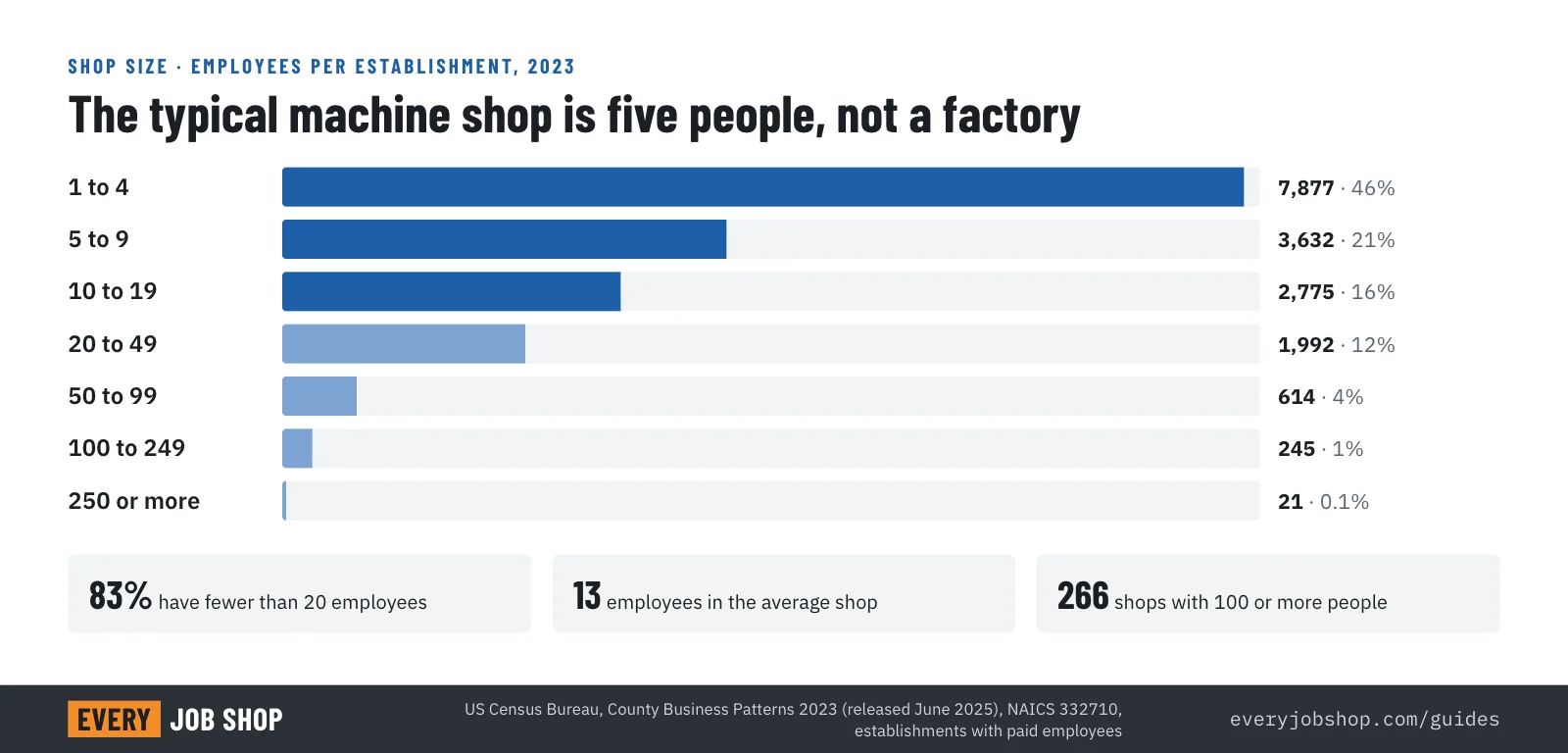
Of the 17,156 machine shops in 2023, 7,877 (46%) had 1 to 4 employees, 3,632 (21%) had 5 to 9 and 2,775 (16%) had 10 to 19. That is 14,284 shops, 83%, with fewer than 20 people. Another 1,992 had 20 to 49 and 614 had 50 to 99. Only 245 had 100 to 249 employees, 16 had 250 to 499 and 5 had 500 to 999. No machine shop establishment had 1,000 or more.
The average works out to 13 employees per shop, and the median is clearly below 5. Annual payroll was $14.23 billion, or $63,700 per employee.
For a buyer this changes what "capacity" means. A 5-person shop with two machining centers cannot take a 10,000-piece order next to its existing work, however good it is. It can take 200 pieces and do them well. The RFQ guide explains why the quantity, this order and the next, belongs in the first message.
Finding 2: where the shops are
California had 2,221 machine shops in 2023 (13% of the US total) with 27,770 employees. Texas followed with 1,312, Ohio 1,112, Michigan 943, Pennsylvania 901, Illinois 829, Wisconsin 677, Indiana 587, New York 579 and Minnesota 494. Those ten states hold 9,655 shops, 56% of the country.
The shops are not the same size everywhere. Wisconsin (17.1 employees per shop) and Minnesota (17.0) have the largest shops on average; Massachusetts (15.5), Arizona (15.6) and Pennsylvania (14.6) are above the national 13. Florida (7.9), New Jersey (9.4) and Colorado (9.6) have the smallest. A Wisconsin machine shop is, on average, twice the size of a Florida one.
At the bottom of the table: Hawaii 6, Alaska 19, Delaware 25, Vermont 35, Wyoming 38 and North Dakota 45. Every state page on EveryJobShop, for example California or Ohio, lists the indexed shops by process and city.
Finding 3: 3,800 fewer shops than in 2008
| Year | Machine shops | Employees (March) | Annual payroll | Payroll per employee |
|---|---|---|---|---|
| 2008 | 20,964 | 264,126 | $11.60 billion | $43,900 |
| 2013 | 19,147 | 248,297 | $11.83 billion | $47,600 |
| 2018 | 18,218 | 235,459 | $12.60 billion | $53,500 |
| 2023 | 17,156 | 223,313 | $14.23 billion | $63,700 |
Source: County Business Patterns for each year. The 2008 and 2013 files use the 2007 and 2012 NAICS editions; code 332710 is unchanged across them.
The number of machine shops fell by 3,808, or 18%, in fifteen years, and employment by 40,813, or 15%. The decline is steady rather than sudden: about 1,000 fewer establishments every five years. Payroll went the other way, up 23% in nominal dollars, and payroll per employee rose 45%, from $43,900 to $63,700. US consumer prices rose about 41% over the same period, so real pay per person is roughly flat; what changed is that the remaining shops pay out more per head than the ones that closed.
The size mix barely moved. 84% of shops had fewer than 20 employees in 2008 and 83% in 2023. The largest shops thinned out slightly: 33 establishments with 250 or more employees in 2008, 21 in 2023.
So the picture is not consolidation into big plants. It is attrition at the small end, with the survivors keeping the same shape.
Finding 4: the wider job shop universe
Machine shops are the largest group of job shops, but not the only one. The same 2023 Census file gives the neighbouring industries that also make parts to order:
| Industry (NAICS) | Establishments | Employees |
|---|---|---|
| Machine shops (332710) | 17,156 | 223,313 |
| Sheet metal work manufacturing (332322) | 4,652 | 129,616 |
| Plating, polishing, anodizing and coating (332812, 332813) | 4,662 | 101,960 |
| Fabricated structural metal (332312) | 3,434 | 114,153 |
| Special die, tool, jig and fixture (333514) | 1,976 | 40,467 |
| Foundries, all metals (3315) | 1,335 | 107,273 |
| Metal stamping (332119) | 1,094 | 45,585 |
| Cutting tool and machine tool accessories (333515) | 1,060 | 23,991 |
| Forging, iron, steel and nonferrous (332111, 332112) | 336 | 23,144 |
Together: about 35,700 establishments and 810,000 employees. For scale, the Census counted 284,452 manufacturing establishments of all kinds in 2023, so machine shops alone are 6% of American manufacturing locations, and job shops of all kinds are one in eight.
Finding 5: why buyers see a few hundred
If there are 17,000 machine shops, why does every search return the same handful?
- Most shop websites say little. We read 3,768 job shop websites in October 2026: only 25.5% state a material, a machine and a certification, and a third never name a material at all. A shop that does not say it machines titanium cannot be found by a buyer looking for titanium.
- AI assistants disagree with each other. In the same report, four assistants answered 50 buyer questions; 82% of the shops they recommended were named by only one assistant, and Thomasnet was their most cited source. Which shop you see depends on which assistant you ask.
- Directories are partial. Our own index has 3,771 shops, 22% of the Census machine shop count, and some of those are fabricators and foundries rather than machine shops. By state the coverage runs from about 35% in Washington, 32% in Florida, 31% in Massachusetts and Arizona and 30% in Colorado, through 26% in California and 18% in Texas, down to 13% in North Carolina and 10% in Georgia. The methodology page explains how shops enter the index; the Southeast is where we have the most work to do.
The practical conclusion for a buyer: the shops you can find are a sample, and not a random one. The ones with complete websites and directory listings show up; the other 80% exist, work for someone, and never appear in a search. Searching by state and process, then asking, reaches more of them than any single list.
For a shop: there are 17,156 of you, and buyers see a few hundred. Being in the visible few is mostly a matter of stating what you make on your own site and in the directories assistants read. If you are listed here, the claim box on your company page lets you complete the listing.
Cite this report
EveryJobShop, "How many machine shops are in the US? 17,156, and 5 of 6 have fewer than 20 people.", October 2026, https://everyjobshop.com/guides/how-many-machine-shops-in-the-us
The charts may be reused with a credit and a link to this page. The underlying Census files are public: cbp23us.zip and cbp23st.zip on the County Business Patterns datasets page, industry code 332710, legal form of organization "all".
Find the shops near you
EveryJobShop is a free index of 3,771 US job shops in 50 states. Browse by state, for example California, Texas or Ohio, filter by process such as CNC milling, CNC turning or Swiss machining, or search all shops. With a drawing ready, send one RFQ to up to 30 matching shops and compare the quotes.
Questions people ask
- How many machine shops are there in the United States?
- 17,156 establishments with paid employees in March 2023, according to the Census Bureau's County Business Patterns for NAICS 332710 (machine shops). They employed 223,313 people and paid $14.2 billion in wages. One-person shops without employees are counted separately by the Census in its Nonemployer Statistics and are not in this figure.
- Which state has the most machine shops?
- California, with 2,221 machine shops and 27,770 employees in 2023. Texas (1,312), Ohio (1,112), Michigan (943) and Pennsylvania (901) follow. The ten largest states hold 56% of all US machine shops.
- How big is a typical machine shop?
- Small. 46% of US machine shops have 1 to 4 employees, 83% have fewer than 20, and the average is 13. Only 266 shops (1.6%) have 100 or more employees, and 21 have 250 or more.
- Is the number of machine shops growing or shrinking?
- Shrinking. The Census counted 20,964 machine shops in 2008, 19,147 in 2013, 18,218 in 2018 and 17,156 in 2023: 18% fewer in 15 years. Employment fell 15% over the same period, while annual payroll per employee rose 45% in nominal dollars (consumer prices rose about 41%).
- How many job shops are there, including fabricators and foundries?
- Adding the neighbouring Census industries that also make parts to order (sheet metal work, structural metal fabrication, stamping, forging, foundries, plating and coating, tool and die, cutting tools) gives roughly 35,700 establishments in 2023. Each shop is counted once, under its main activity, so a fabricator that also machines appears only in the fabrication count.
- How many of these shops are in the EveryJobShop index?
- 3,771 shops in 50 states as of October 2026, about 22% of the Census machine shop count. The index also includes fabricators, foundries and other job shops, so the share of machine shops alone is lower. Coverage is highest in Washington, Florida, Massachusetts, Arizona and Colorado (around 30% or more) and lowest in Georgia and North Carolina (10 to 13%).