When a buyer asks ChatGPT, Claude or Perplexity for "an AS9100 shop that machines titanium near Phoenix", the assistant searches the web, reads shop websites and names the shops whose pages state those facts. Most shop owners assume their website already says what they do.
We checked. In October 2026 we read the websites of the 3,768 US job shops in the EveryJobShop index and recorded whether each one states the three facts buyers ask about most: a material, a machine and a certification.
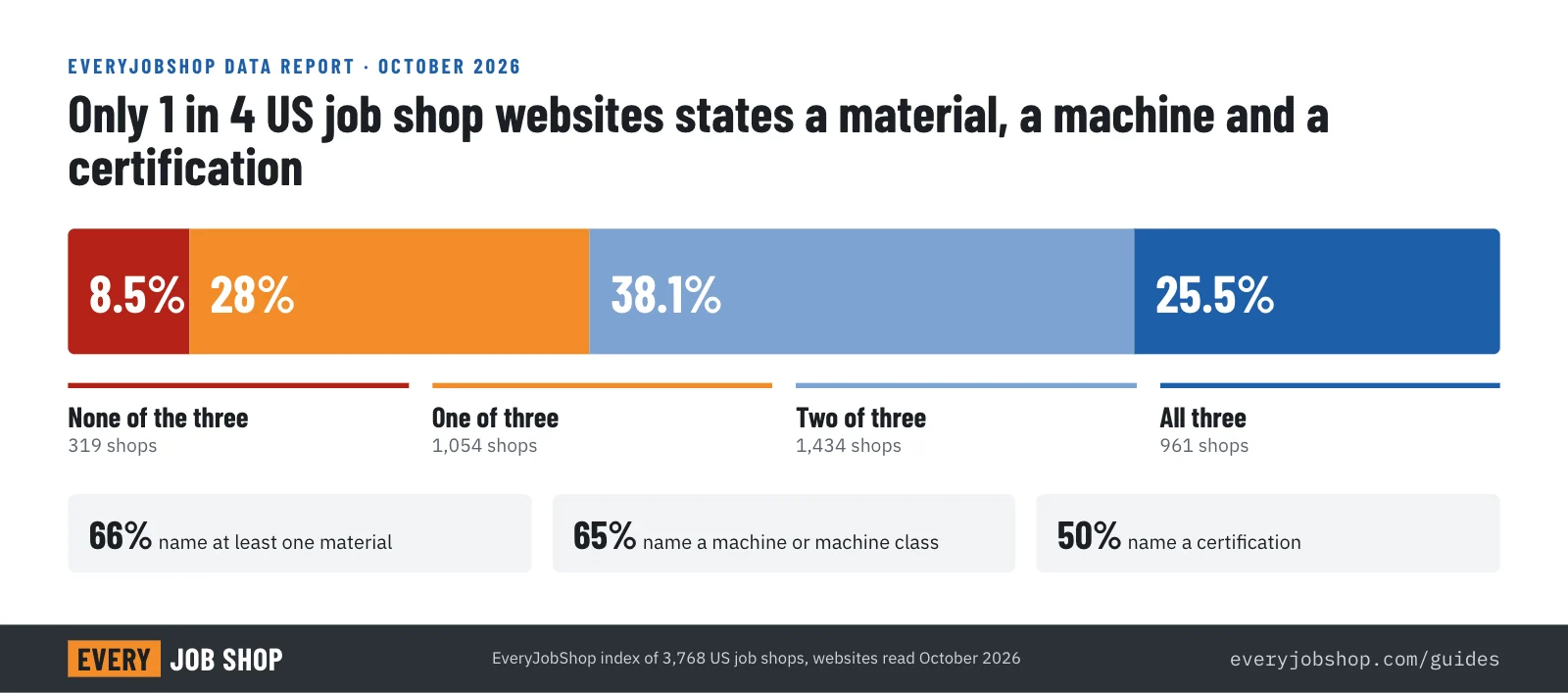
Key findings
- Only 961 of 3,768 shops (25.5%) state all three on the home page and up to two about or capabilities pages. 319 shops (8.5%) state none of them.
- A third of shops never name a material (34%), a third never name a machine (35%) and half never name a certification (50%).
- One in three AS9100 shops names no material at all: 256 of the 770 shops that state AS9100. They are certified for aerospace work, but a search for titanium or Inconel cannot match them.
- 84% of shops stating ITAR registration or defense work do not mention CMMC (602 of 716), although CMMC self-assessments have been a contract requirement since November 2025.
- The gap depends on the trade. Swiss machining shops state all three facts most often (53%), welding shops least often (23%).
- AI assistants rarely agree, and they lean on directories. We asked ChatGPT, Claude, Perplexity and Gemini 50 buyer questions, one per state. 82% of the shops they recommended were named by only one of the four, and Thomasnet was cited in 67 of the 200 answers.
- And on the state. Among the 24 states with at least 50 shops, Colorado (34%), Minnesota (32%) and California (31%) lead; Missouri (12%), New Jersey (17%) and Indiana (17%) trail.
Why this matters now
Buyers have started to ask assistants instead of searching. In G2's 2025 survey of 1,169 B2B decision-makers, 29% said they start research in tools like ChatGPT more often than on Google. That survey covers software buyers; nobody has published a comparable study for buyers of machined parts yet.
An assistant does not browse ten links. It reads pages for the buyer and returns a short list. Google states that its AI features need no special markup, only that a page is indexed and eligible to be shown with a snippet. What decides whether a shop is named is whether its pages state what the buyer asked for. A shop that never writes "6061" or "AS9100" on its site gives the assistant nothing to match.
How we measured it
- Who: the 3,768 US companies in the EveryJobShop index that make parts to order: machine shops, fabricators, foundries, stampers, forges and metal 3D printing services, in all 50 states. The methodology page describes how companies enter the index.
- What we read: each company's home page and up to two pages about the company or its capabilities, read by a crawler that identifies itself as
EveryJobShopBotand respects robots.txt. Data as of October 15, 2026. - What counts:
- Material: the site names at least one material group, such as aluminum, stainless steel, titanium, copper and brass, or plastics.
- Machine: it names a machine maker or a machine class, such as 5-axis, Swiss-type or press brake.
- Certification: it names ISO 9001, AS9100, ISO 13485, IATF 16949, Nadcap, ITAR registration or CMMC.
- Limits: a fact stated only on a deeper page or inside a PDF brochure is not counted. Certifications and CMMC are counted as stated on the website, not checked with registrars or the Department of Defense. 37 of the 3,768 websites could not be read and count as stating nothing.
Finding 1: what is missing
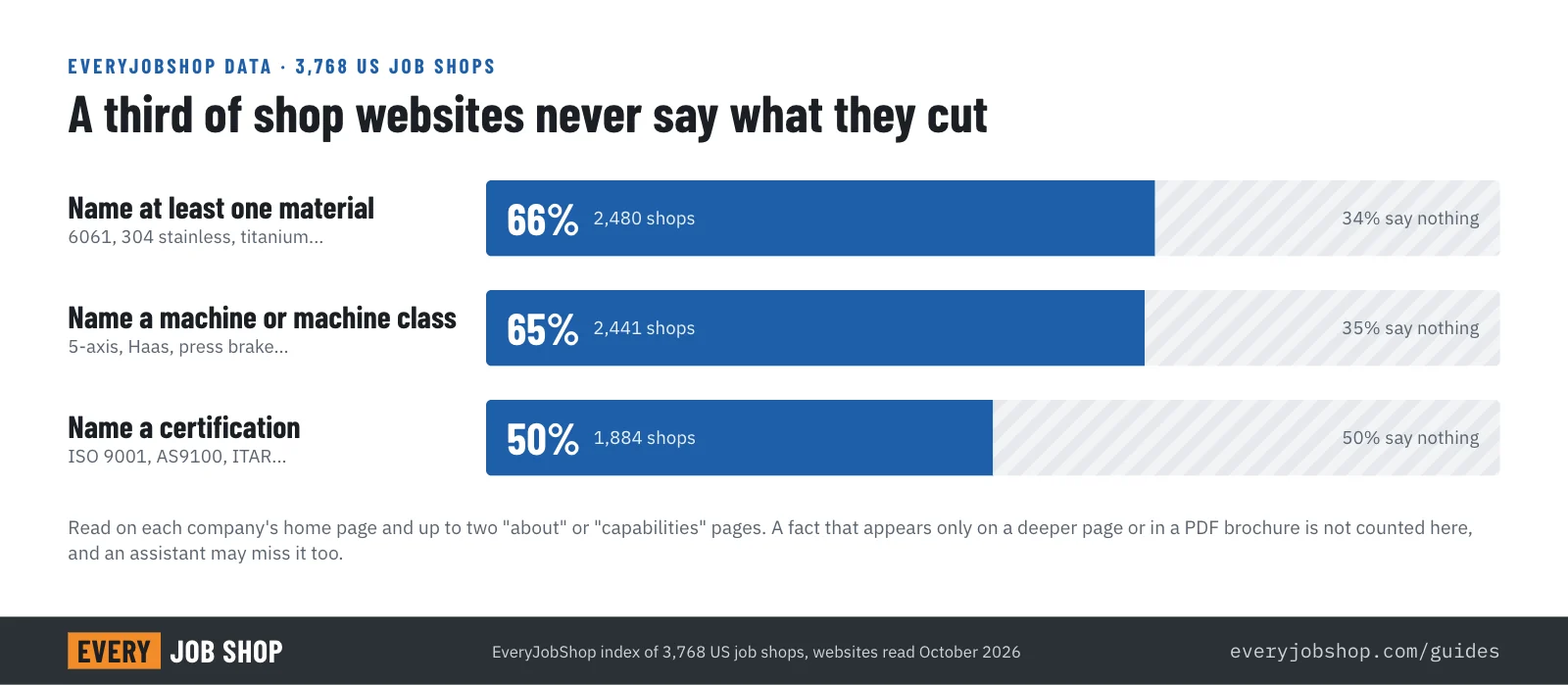
Two in three shops name at least one material (2,480 shops, 66%) and about as many name a machine or machine class (2,441, 65%). Only half name a certification (1,884, 50%). The most common material is aluminum (1,761 shops), followed by carbon steel (1,534) and stainless steel (1,529). Titanium appears on 797 sites. 723 shops mention 5-axis machining.
Put together, the three facts rarely appear on the same site: 961 shops state all three, 1,434 state two, 1,054 state one and 319 state none.
Finding 2: by state
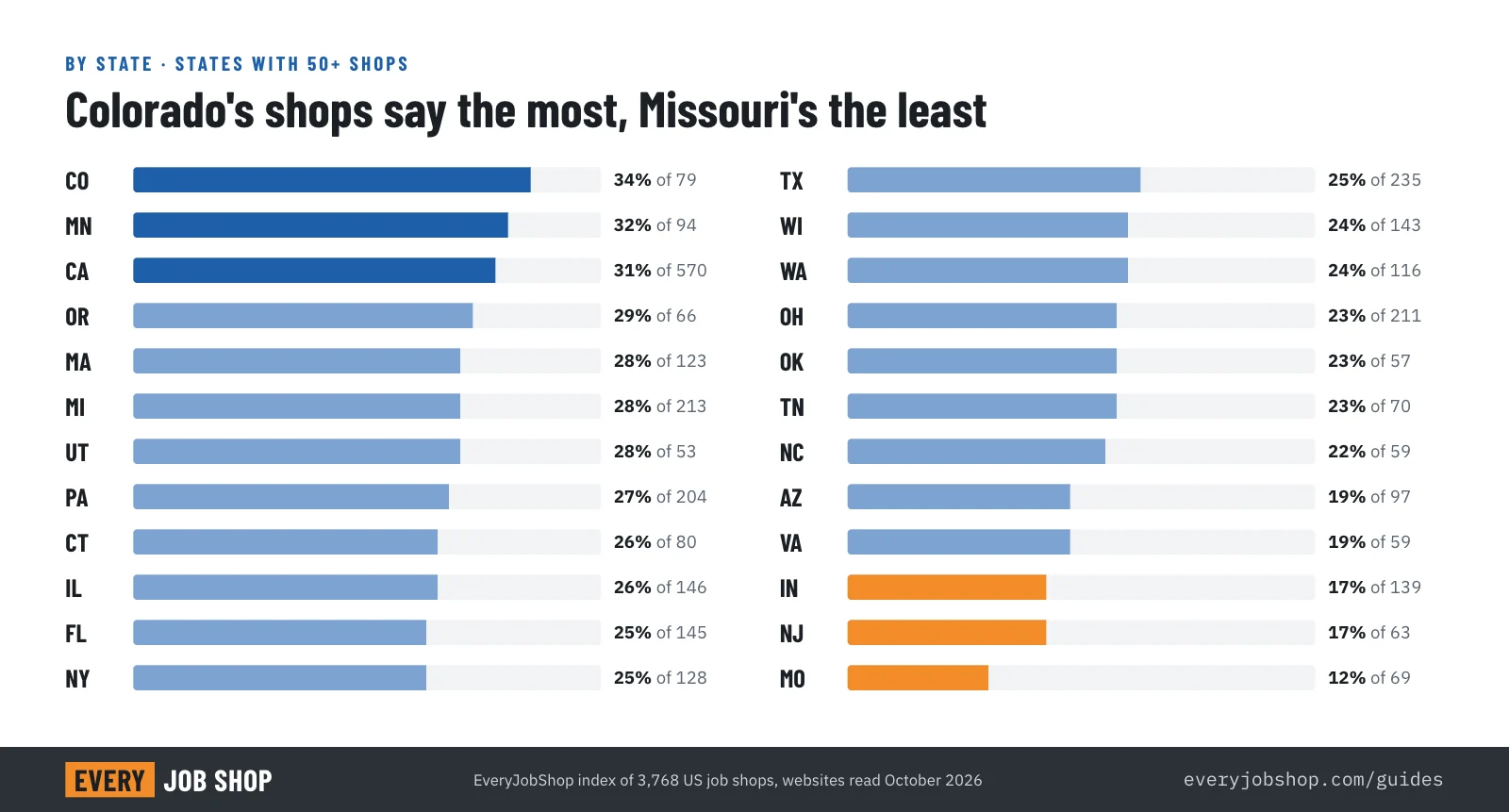
Among the 24 states with at least 50 shops in the index, the share of websites stating all three facts ranges from 34% in Colorado to 12% in Missouri. California, with 570 shops the largest state in the index, is third at 31%. Texas (235 shops) and Ohio (211) sit near the national average at 25% and 23%.
Finding 3: by process
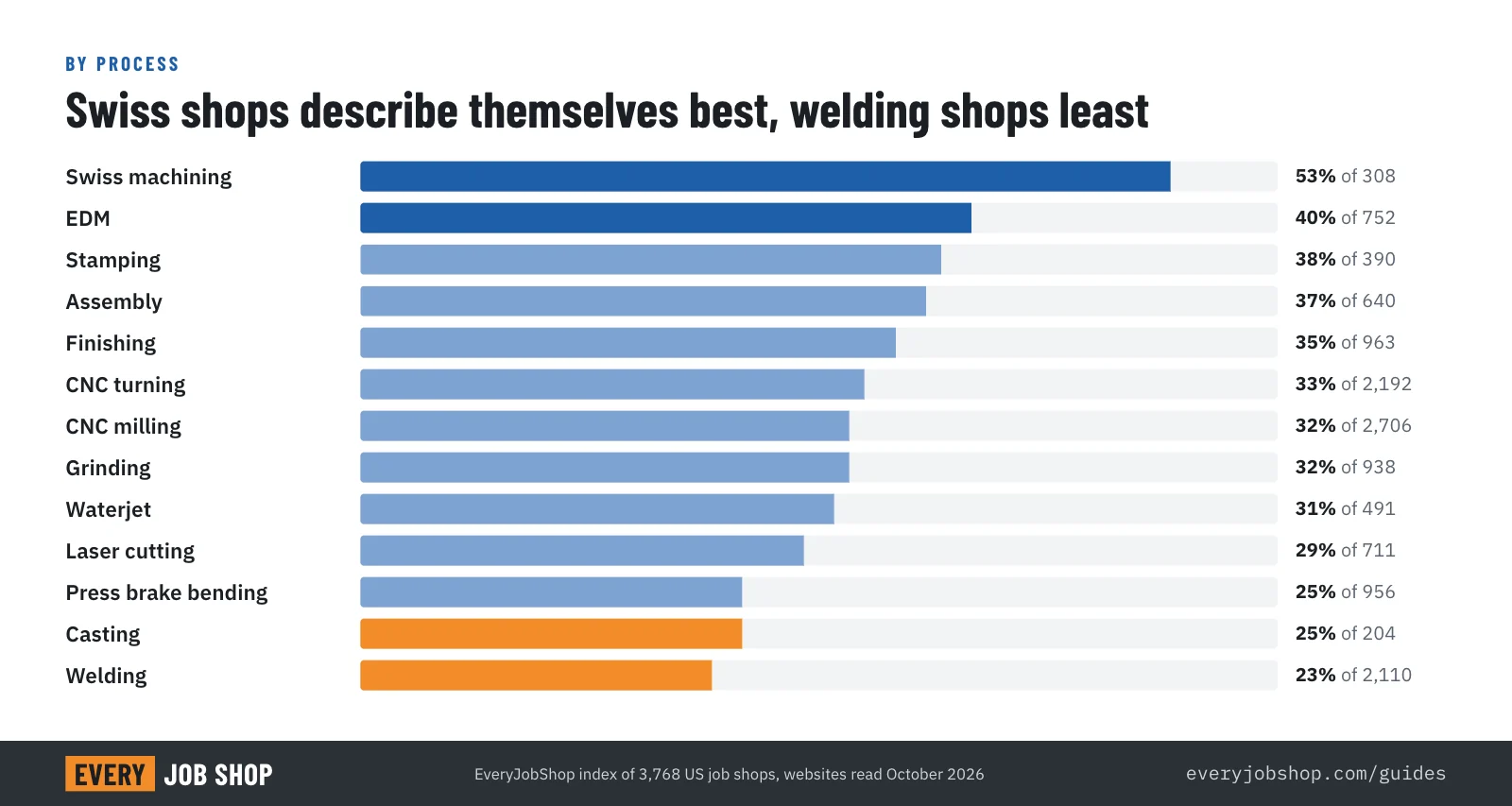
Shops in precise, specialized trades describe themselves best. 53% of Swiss machining shops and 40% of EDM shops state all three facts. General CNC milling (32% of 2,706 shops) and turning (33% of 2,192) are close to the average. Welding and fabrication shops, the largest group after milling and turning with 2,110 shops, state all three least often (23%), as do press brake bending (25%) and casting (25%).
Finding 4: aerospace and defense
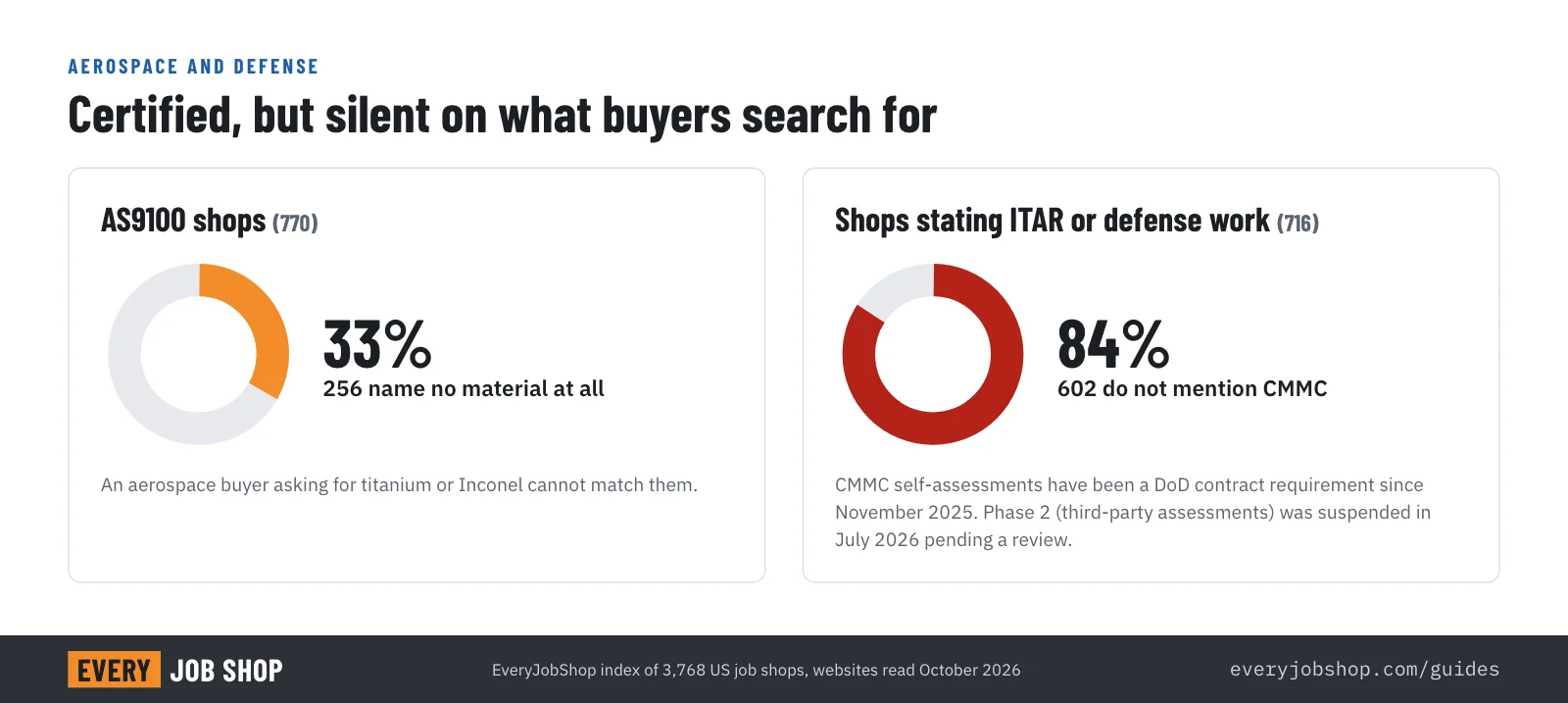
770 shops state AS9100 on their website, the quality standard for aviation, space and defense suppliers. 256 of them (33%) name no material at all. For a buyer, and for an assistant, that is the difference between "an aerospace shop" and "an aerospace shop that machines the part I need".
716 shops state ITAR registration or defense work. Only 114 of them (16%) mention CMMC, the Department of Defense program that checks how contractors protect defense information. The DFARS rule that puts CMMC into contracts took effect on November 10, 2025, starting Phase 1, in which solicitations can require a CMMC self-assessment. Phase 2, with third-party Level 2 assessments, was due on November 10, 2026, but the Pentagon suspended it on July 13, 2026 and launched a review of the program; the Phase 1 requirements stay in force. Many shops will hold a CMMC status they simply do not mention; the finding is about what a defense buyer can see, not about compliance.
Finding 5: what AI assistants actually recommend
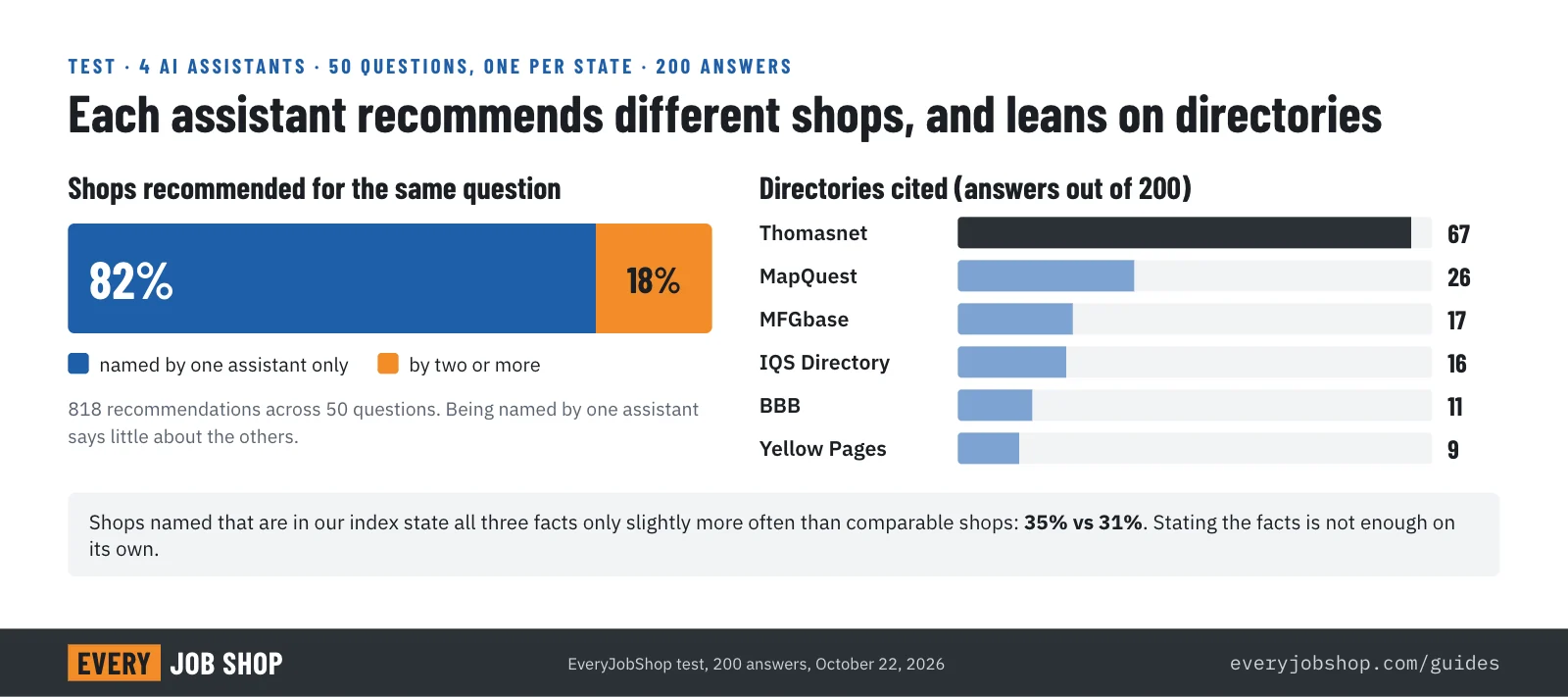
To see what buyers actually get, on October 22, 2026 we asked four AI assistants with live web search 50 questions a buyer would ask, one for each US state. Examples: "I need 200 brackets machined from 6061 aluminum, ±0.002", anodized, from an ISO 9001 machine shop near Phoenix, Arizona. Which shops should I ask for a quote?" and "I need a metal fabrication and welding shop in Las Vegas, Nevada. Which shops should I ask for a quote?" The models were GPT-5.6 Terra, Claude Sonnet 5.5, Perplexity Sonar and Gemini 3.8 Flash, called through OpenRouter with each provider's own web search: 200 answers in total.
- The assistants rarely agree. Across the 50 questions they made 818 shop recommendations. Only 18% of the shops were named by two or more assistants; 82% were named by just one. A shop that shows up in one assistant can be missing from the next.
- Directories are a main source. Thomasnet was cited in 67 of the 200 answers, most of them from Claude (30 of 50) and Perplexity (35 of 50). MapQuest (26 answers), MFGbase (17), IQS Directory (16), BBB (11) and Yellow Pages (9) followed. A complete, consistent listing in the directories of the trade is part of being found.
- Stating the facts helps only a little on its own. 151 of the named shops are in our index. 35% of them state all three facts, against 31% of the 1,872 comparable shops in the same states and processes; 3% state none, against 6%. We also read the websites of 373 named shops that are not in the index with the same crawler; they state all three facts less often (16%), partly because we read fewer pages of them.
What we take from it: assistants do not reward a good capabilities page alone. They combine what a shop says about itself with what directories and other sites say about it, and each assistant does this differently. A shop that wants to be named needs both: the facts on its own site, and the same facts in the listings the assistants read, and it should check each assistant separately.
This is still a small test. Answers through an API can differ from the consumer apps, Gemini's answers linked through Google redirects (45 of its 50 answers named no shop website directly), and the comparison does not control for size or reputation. The questions, the raw answers and the analysis are available on request.
What it means
For shops: the facts are already known inside the shop. Writing them on one capabilities page (materials by grade, machines with their work envelopes, tolerances, certifications with the standard version, quantities, lead times) is the cheapest marketing a shop can do, and it is what AI assistants read. Our guide Why ChatGPT can't recommend your shop lists ten fixes in order.
For buyers: a missing fact on a website is not a missing capability. Search the index by process and state, then ask. A complete RFQ gets answers from the shops that can do the work; our guide on what to send for a machine shop quote has a checklist.
Cite this report
EveryJobShop, "We read 3,768 US job shop websites. Only 1 in 4 tells an AI assistant what the shop makes.", October 2026, https://everyjobshop.com/guides/us-job-shop-websites-ai-visibility-report-2026
The charts may be reused with a credit and a link to this page. For other cuts of the data, interviews or questions about the method, write to hello@everyjobshop.com.
Correction, October 22, 2026: an earlier version of this page reported a first test with 20 questions, in which the shops the assistants named stated all three facts far more often than comparable shops (48% vs 32%). With 50 questions and 200 answers the difference is much smaller (35% vs 31%). The section above reports the larger test.
Questions people ask
- Where does the data come from?
- From the EveryJobShop index of 3,768 US companies that make parts to order: machine shops, fabricators, foundries, stampers, forges and metal 3D printing services. For each company we read the home page and up to two about or capabilities pages, and recorded whether they name a material, a machine or machine class, and a certification.
- Does a missing fact mean the shop cannot do the work?
- No. It means the fact is not stated on the pages we read. Many of these shops do excellent work in materials they never mention. The point of the report is that a buyer or an AI assistant reading the same pages cannot know it.
- Are the certifications verified?
- No. A certification counts when the company's own website names it. We did not check certificates with registrars or with the government. The same applies to CMMC: we count mentions, not status.
- Which AI assistants did you test?
- GPT-5.6 Terra, Claude Sonnet 5.5, Perplexity Sonar and Gemini 3.8 Flash, each with its provider's own web search, called through OpenRouter on October 22, 2026. Each answered the same 50 buyer questions, one per US state: 200 answers in total.
- Can I use the charts?
- Yes. The charts and numbers may be reused in articles, reports and presentations with a credit and a link to this page.
- Can I get the numbers for my state or my process?
- Every state, process and city page on EveryJobShop is built from the same index and shows the shops behind the numbers. For a cut of the data that is not on the site, write to hello@everyjobshop.com.